































Essential Pokemon Types Word Search | Grades 6–7 ELA

Paste this activity's link or code into your existing LMS (Google Classroom, Canvas, Teams, Schoology, Moodle, etc.).
Students can open and work on the activity right away, with no student login required.
You'll still be able to track student progress and results from your teacher account.
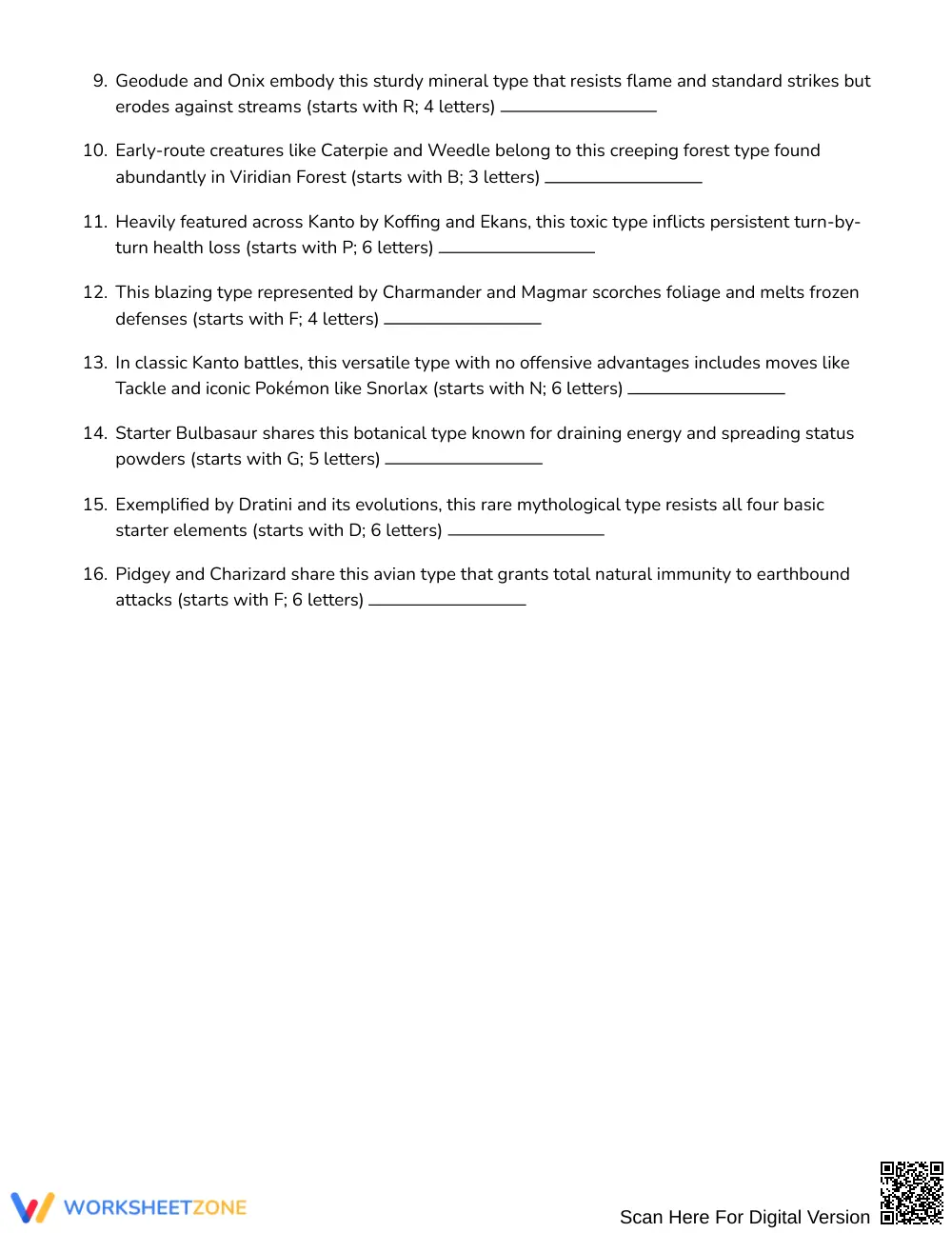
This Pokémon vocabulary word search builds reading comprehension and domain-specific recall for middle school learners. Students read 16 descriptive clues, infer the corresponding type or battle category, and locate each term hidden in an expansive letter matrix. The no-word-bank format transforms routine word finding into an active textual analysis and categorization exercise.
At a Glance
- Grade: Grades 6–7 · Subject: English Language Arts (ELA)
- Standard: Not standards-assessed — vocabulary enrichment
- Skill Focus: Pokémon types and simple type categories
- Format: 3 pages · 16 words · Answer key included · PDF
- Best For: Vocabulary enrichment and early finisher work
- Time: 25–35 minutes
This 3-page printable activity features a clean, high-density 18 by 18 letter grid accompanied by 16 contextual clues rather than a passive word bank. To complete the activity, students analyze descriptive sentences containing rich vocabulary—such as botanical, telekinetic, and spectral—to determine target answers before locating them. A comprehensive 4-page answer key provides clear solution paths showing exact letter coordinates for every term.
This word search operates as a rigorous clue-driven puzzle rather than a simple recognition task:
- Grid Structure: An 18 by 18 letter matrix provides 324 total character spaces, offering an engaging spatial challenge for middle grade students.
- Search Vectors: Words run in all 8 cardinal and intercardinal directions, including north, northeast, east, southeast, south, southwest, west, and northwest.
- Clue-Based Identification: Without a standard word list, students must deduce the 16 hidden terms from context clues before scanning the grid.
This activity provides targeted vocabulary enrichment and is not aligned to a specific Common Core State Standard. Instead of assessing isolated grade-level benchmarks, it reinforces informational reading, context clue deciphering, and conceptual classification through high-interest content.
Use this puzzle as an engaging hook during a descriptive vocabulary unit or as an independent early-finisher task following direct instruction. During independent work time, circulate to observe how students decode multi-syllabic academic vocabulary like "versatile" and "mythological" within the clue descriptions. Expect students to complete the full search in 25 to 35 minutes.
This resource is designed for Grades 6–7 students who enjoy popular culture themes and high-interest reading challenges. It offers natural scaffolding for diverse learners; students requiring assistance can use paired peer-reading strategies to unpack complex clues, while advanced readers tackle the puzzle entirely without support. Pair this activity with an informational reading passage on classification systems or character archetypes.
Vocabulary acquisition in middle school requires frequent encounters with descriptive context clues and domain-specific terminology. According to Fisher & Frey (2014), intentional word-learning tasks that require students to retrieve definitions from context and apply conceptual schema significantly increase long-term vocabulary retention compared to rote memorization. This Grades 6–7 word search integrates active retrieval by withholding a traditional word bank, compelling learners to synthesize 16 complex sentence clues covering descriptive attributes such as elemental types and battle categories. As students identify terms hidden across an 18 by 18 grid in eight possible orientations, they reinforce orthographic mapping, letter-sequence recognition, and analytical reading habits. By shifting word searches from passive letter-scanning into active clue analysis, educators provide meaningful literacy engagement that strengthens reading fluency and semantic categorization within accessible, high-interest thematic frameworks across various English language arts classroom settings.


