































Essential Point Not Optimum Worksheet | Grade 12 Calculus

Paste this activity's link or code into your existing LMS (Google Classroom, Canvas, Teams, Schoology, Moodle, etc.).
Students can open and work on the activity right away, with no student login required.
You'll still be able to track student progress and results from your teacher account.
Opening
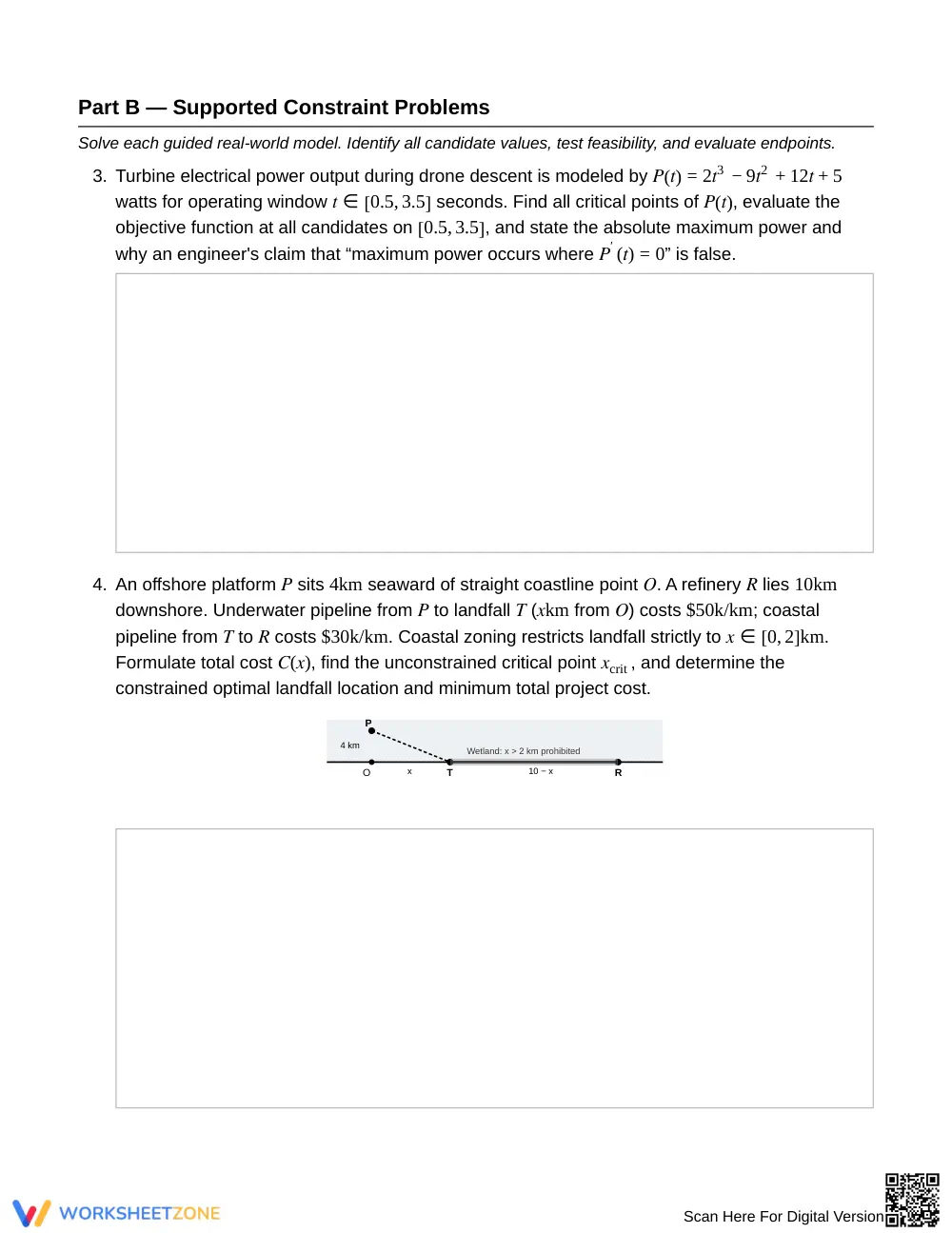
Students tackle eight rigorous calculus problems that require them to locate and evaluate critical points, test feasibility, and determine absolute extrema when the interior critical point fails to be optimal. This worksheet sharpens analytical reasoning and prepares learners for high‑stakes assessments on constrained optimization.
At a Glance
- Grade: 12 · Subject: Calculus
- Standard:
— Analyze models where a critical point is not the optimum- Skill Focus: Constrained optimization and boundary extrema
- Format: 4 pages · 8 problems · Answer key included · PDF
- Best For: Advanced derivative application practice
- Time: 30–45 minutes
What’s Inside
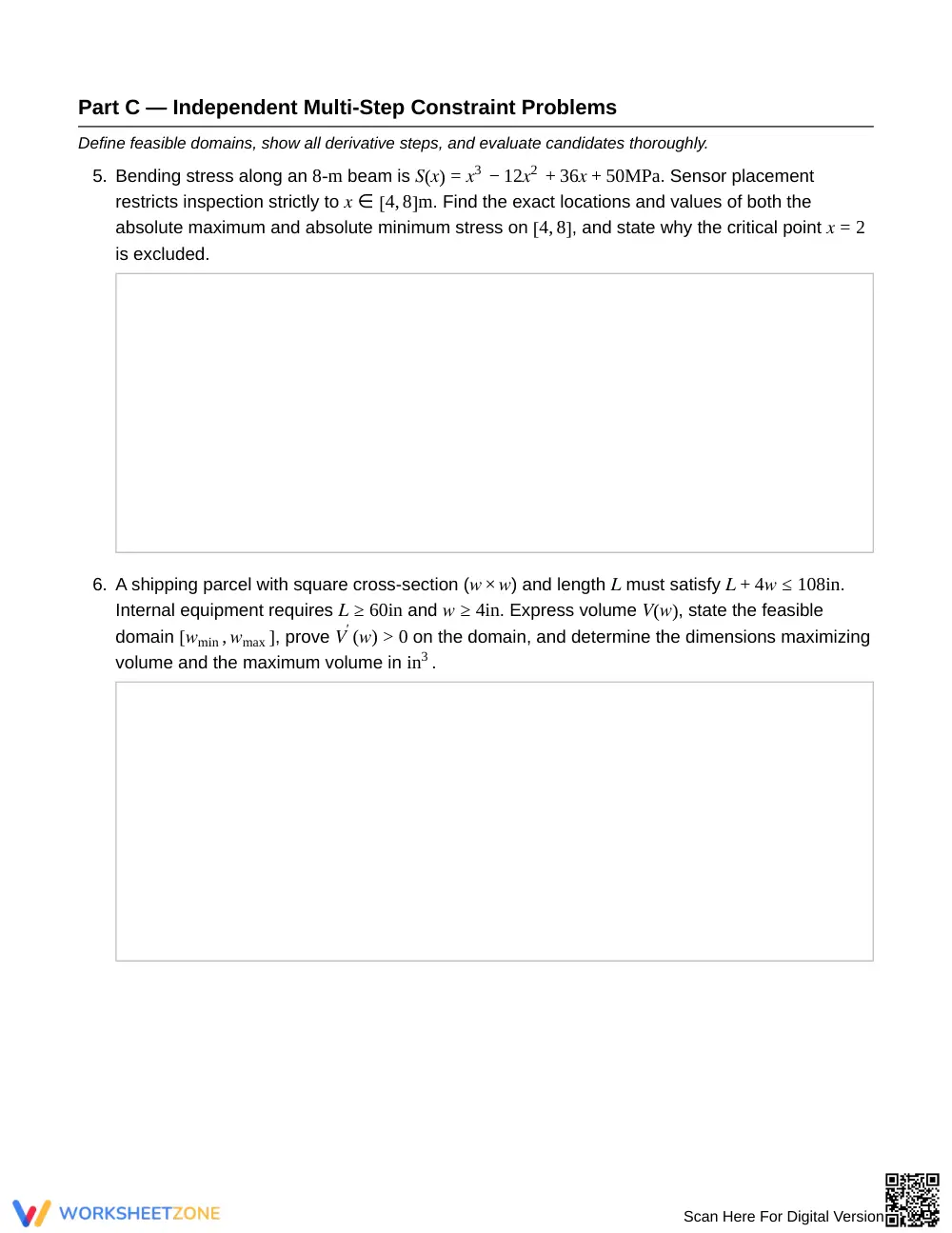
Inside the four‑page packet you’ll find a diagnostic theory section, two guided real‑world constraint problems, three independent multi‑step challenges, and a final construction task. Each part supplies worked examples, clear notation boxes, and a comprehensive answer key on the back, ensuring students can self‑check every step.
Skill Progression
- Guided practice (2 problems): Worked example with step‑by‑step scaffolding introduces the derivative test and boundary evaluation.
- Supported practice (3 problems): Sentence frames and a word bank help students set up feasibility constraints before solving.
- Independent practice (3 problems): Full‑release tasks require students to locate critical points, test endpoints, and justify why the interior optimum is infeasible.
These stages follow the classic I Do, We Do, You Do release model, gradually shifting responsibility to the learner.
Standards Alignment
No specific state standard code is attached to this worksheet; it aligns with typical College Board AP Calculus AB expectations for analyzing constrained optimization.
How to Use It
Use the diagnostic section as a pre‑assessment before a unit on extrema to gauge students’ conceptual readiness, then move directly into the guided problems for a focused lesson. After instruction, assign the independent challenges as a formative check; observe whether students correctly justify why the interior critical point is not optimal, noting any misconceptions for quick reteaching.
Who It’s For
This resource targets advanced 12th‑grade calculus students preparing for AP exams or college‑level calculus. It offers natural differentiation through the scaffolded practice levels and pairs well with a teacher‑created anchor chart on the Extreme Value Theorem.
Research shows that explicit modeling of non-optimal critical points improves transfer to novel problems (Fisher & Frey, 2014). When learners routinely examine mathematical cases where derivatives fail to produce practical optima, they construct flexible cognitive frameworks for constrained optimization. In accordance with findings by Sweller and colleagues (2011), structured scaffolding through worked examples reduces extraneous cognitive load, enabling students to focus attention on domain boundaries and feasibility constraints. By embedding eight authentic scenarios across this packet, teachers provide targeted opportunities for structured retrieval practice. Students do not simply calculate stationary points; they critically evaluate domain limitations, test endpoints, and justify why interior values fail to maximize or minimize real-world functions. This deliberate sequence bridges theoretical calculus concepts and applied mathematical modeling, establishing rigorous habits of verification that prepare twelfth graders for advanced academic study and high-stakes cumulative examinations in calculus.


