




























Views
Downloads



Essential Playground Energy Worksheet | Grade 6 Science

Paste this activity's link or code into your existing LMS (Google Classroom, Canvas, Teams, Schoology, Moodle, etc.).
Students can open and work on the activity right away, with no student login required.
You'll still be able to track student progress and results from your teacher account.
This Grade 6 science worksheet guides students to analyze energy changes during playground activities. Learners interpret data from slide and swing scenarios to track gravitational potential, kinetic, and thermal energy. By evaluating system boundaries and claims, students solidify understanding of energy conservation.
At a Glance
- Grade: 6 · Subject: Science
- Standard: Explain energy transformations, system boundaries, and conservation across physical systems
- Skill Focus: Explain Energy Changes in a Playground Activity
- Format: 5 printable pages · 10 structured problems · Full answer key included · PDF
- Best For: Energy unit practice and data analysis
- Time: 40–50 minutes of instructional time
What's Inside
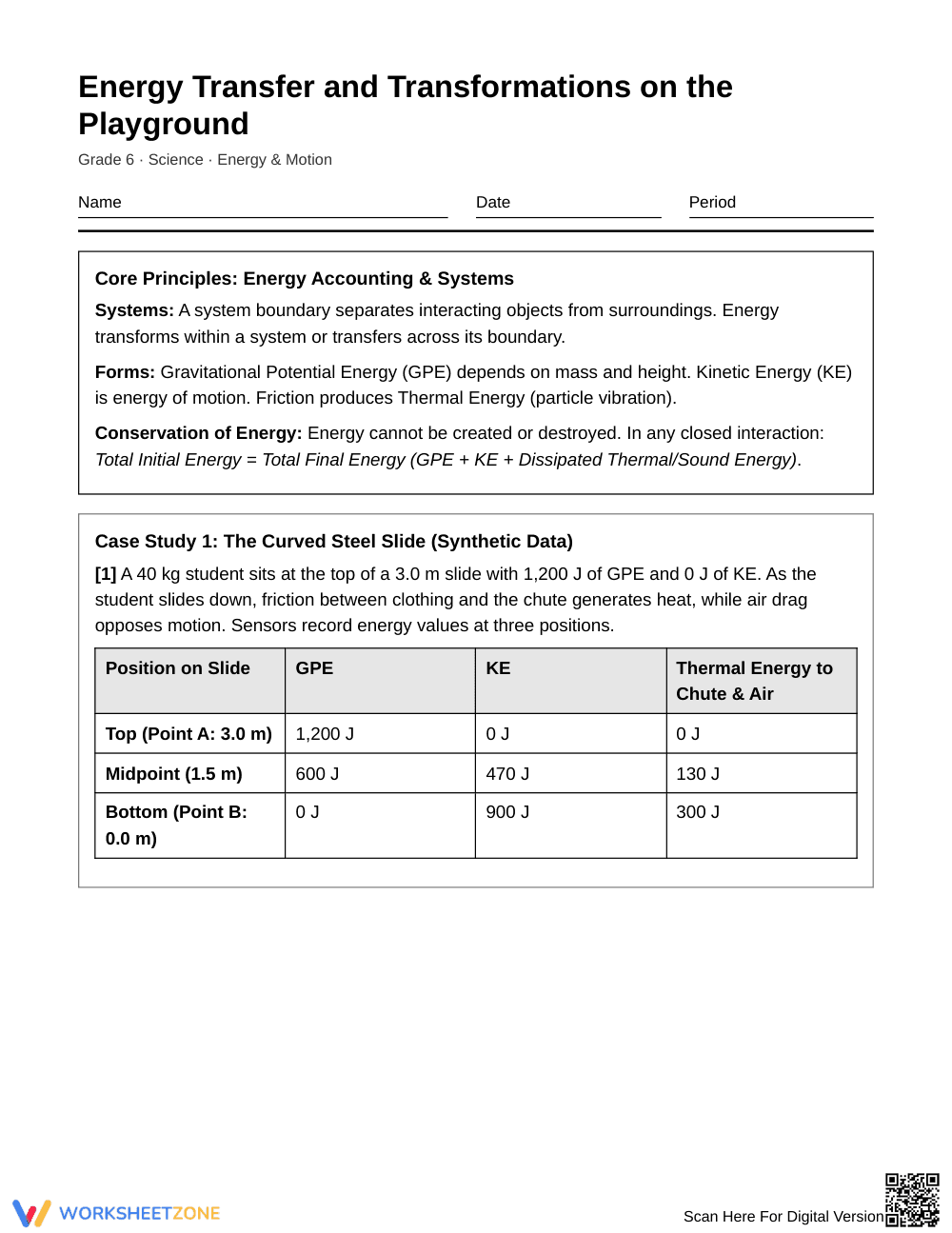
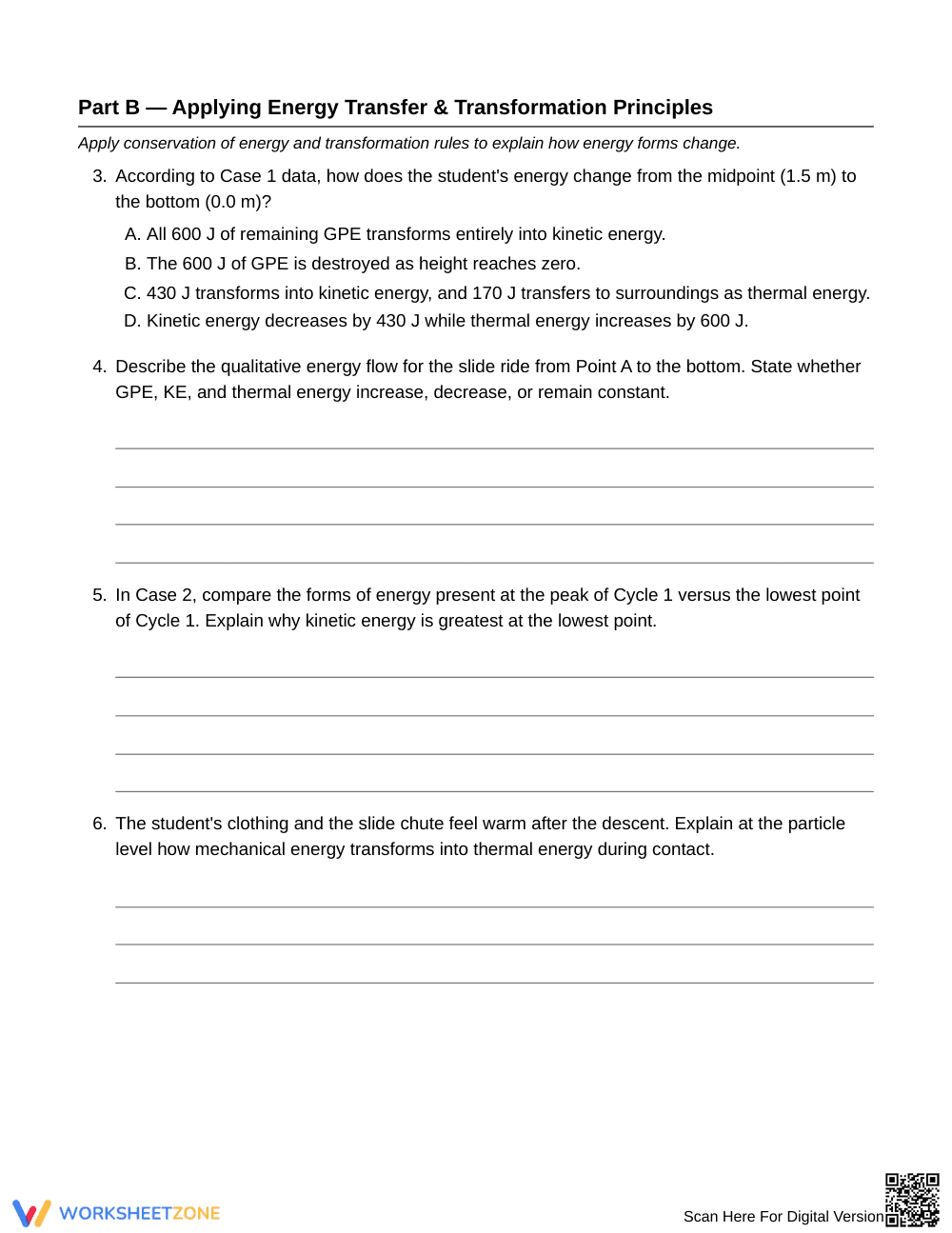
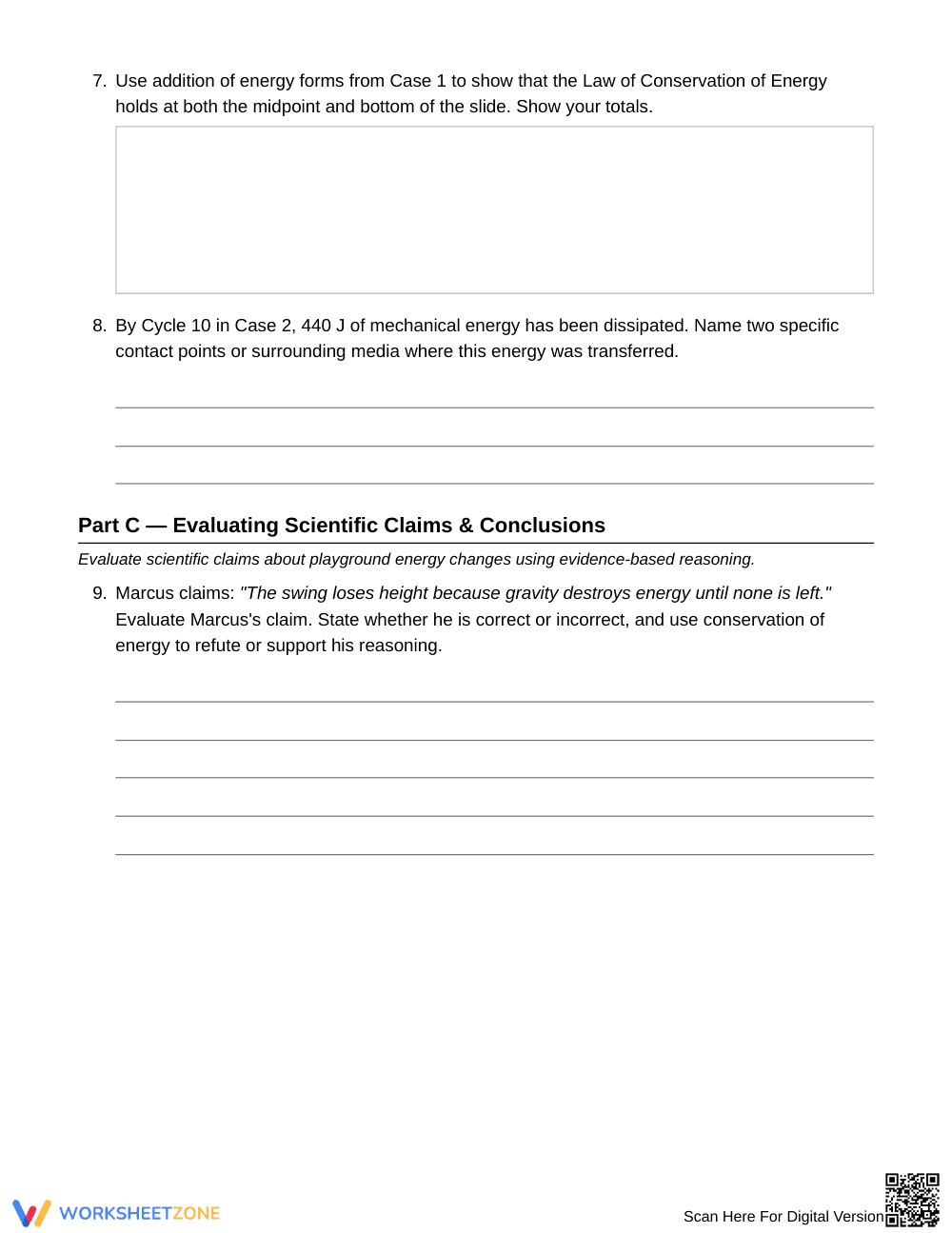
This 5-page resource features core principle notes, two case studies with data tables, and 10 analytical tasks. Students investigate a slide and swing to calculate energy transfers, trace friction at the particle level, and assess claims. A 2-page answer key provides complete calculations and model responses.
Skill Progression
- Guided practice (Part A, 2 problems): Students identify system boundaries and sensor limitations using provided data tables.
- Supported practice (Part B, 6 problems): Learners calculate energy transformations, explain friction at the particle level, and verify conservation totals.
- Independent practice (Part C, 2 problems): Students evaluate and refute scientific claims about energy destruction and slide velocity.
This sequence follows a gradual-release model, transitioning learners from guided identification to independent scientific argumentation.
Standards Alignment
This worksheet aligns with physical science expectations requiring students to construct arguments proving that changing an object's motion transfers energy to or from it. Supporting standards address modeling how potential energy changes with an object's position. Both standard codes can be copied directly into lesson plans, IEP goals, or district curriculum mapping tools.
How to Use It
Use this worksheet after direct instruction on kinetic and potential energy. For formative assessment, check whether students correctly sum kinetic and thermal energy to equal initial potential energy in Part B. Completion takes 40 to 50 minutes during independent practice or collaborative science stations.
Who It's For
This resource serves Grade 6 science classrooms, physical science units, and small-group intervention. Clear data tables assist developing readers, while claim refutations challenge advanced students. Pair this activity with an interactive roller coaster simulation to connect quantitative problem-solving with dynamic visual models.
According to Fisher & Frey (2014), purposeful gradual-release frameworks enable middle school learners to master demanding conceptual tasks by bridging initial teacher modeling with evidence-based peer analysis and individual evaluation. This Grade 6 physical science worksheet targets the core skill of explaining energy changes in everyday playground activities, providing students with structured opportunities to analyze real-world mechanical systems. By examining quantitative data from slides and tire swings, students systematically track kinetic energy, gravitational potential energy, and thermal dissipation under the law of conservation of energy. Learners evaluate boundary definitions, account for friction at the particle level, and assess scientific claims for validity. The progression from guided system accounting to independent claim refutation scaffolds abstract physical science principles into manageable, authentic data interpretation tasks. This targeted resource equips educators with standard-aligned practice that deepens student scientific literacy and analytical reasoning across diverse instructional settings.


