




























Essential Pig Data Analysis Worksheet | Grade 7-12 Science
Paste this activity's link or code into your existing LMS (Google Classroom, Canvas, Teams, Schoology, Moodle, etc.).
Students can open and work on the activity right away, with no student login required.
You'll still be able to track student progress and results from your teacher account.
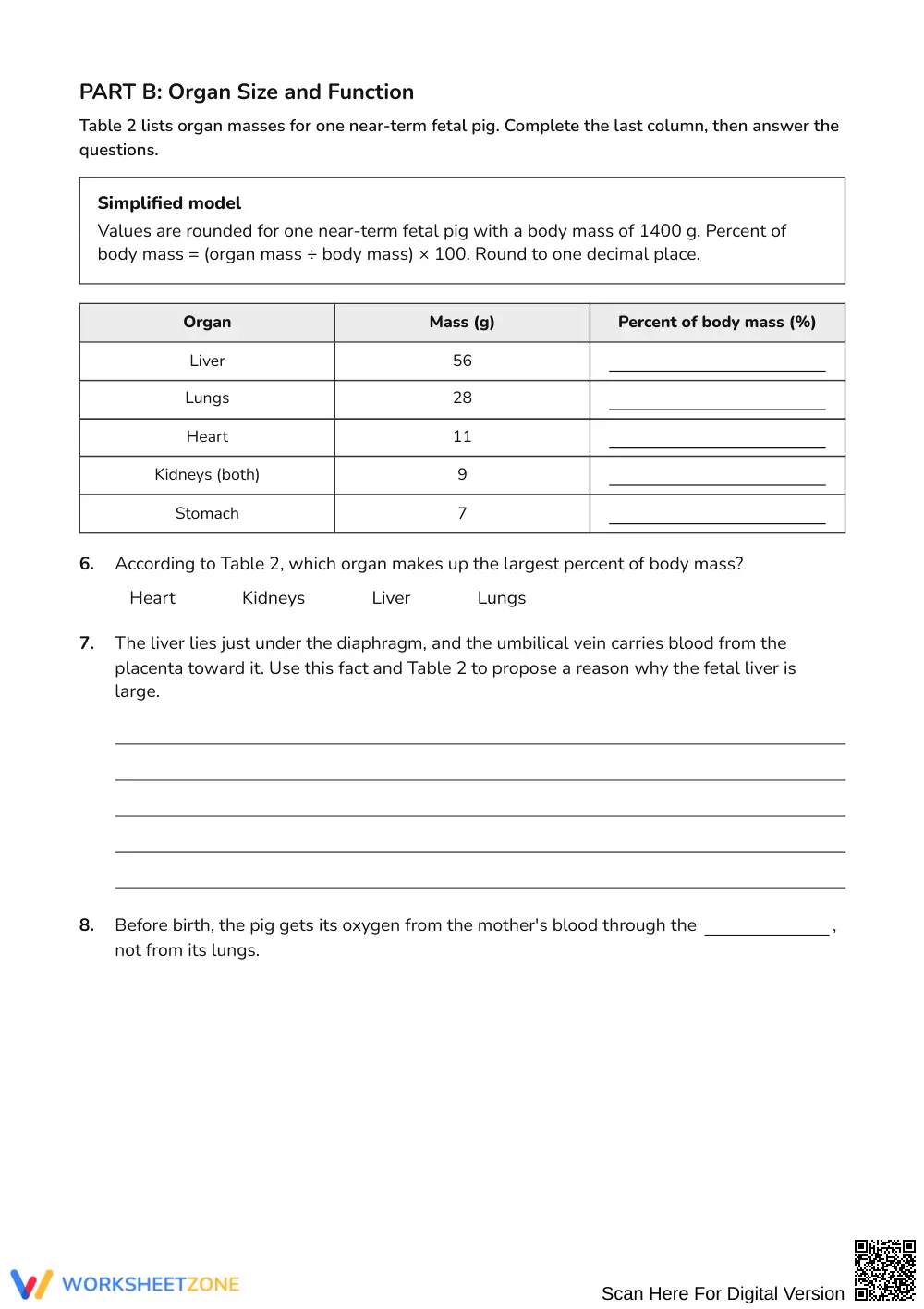
This fetal pig data analysis worksheet trains middle and high school students to interpret real-world quantitative biological data. Learners calculate rates of physical growth, compute relative organ proportions, track prenatal circulatory oxygen saturation, and formulate evidence-based physiological predictions across 28 scaffolded questions.
At a Glance
- Grade: Grades 7–12 · Subject: Science
- Standard: Data Analysis in Life Science — Analyze and interpret quantitative data to explain anatomical development and physiological systems
- Skill Focus: Data Table Analysis
- Format: 4 pages · 28 problems · Answer key included · PDF
- Best For: Biology and anatomy data interpretation practice
- Time: 45–60 minutes
What's Inside
This 4-page science packet features 28 targeted analytical tasks arranged across four developmental themes. Students work with three comprehensive reference tables, a ventral-view heart diagram with a dedicated word bank, and targeted calculation prompts. A complete 4-page answer key provides full computational models, expected percentage calculations, and evidence-grounded explanatory paragraphs for every question.
Skill Progression
- Guided practice (Part A): Students examine fetal growth intervals across 5 developmental milestones, calculating daily mass gain and comparing geometric dimensional expansion using provided benchmark reference figures.
- Supported practice (Parts B & C): Learners compute relative organ proportions using an explicit percentage formula and analyze circulatory oxygen saturation gradients alongside an anatomical heart diagram labeled with a word bank.
- Independent practice (Part D): Students independently synthesize prior data tables to predict cardiovascular shifts at birth, detailing how lung ventilation alters pulmonary oxygen levels and prompts shunt closures.
This sequence implements a gradual-release instructional model that transitions students from direct tabular extraction to multifaceted physiological reasoning.
Standards Alignment
This worksheet aligns with secondary life science standards focusing on data analysis, mathematical thinking, and organ system interactions. Students interpret empirical evidence to evaluate how anatomical structures support survival before and after birth. Both standard codes can be copied directly into lesson plans, IEP goals, or district curriculum mapping tools.
How to Use It
Use this resource following instruction on mammal anatomy or during a fetal pig dissection unit as a quantitative pre-lab activity. Alternatively, assign it as a partner station during a circulatory systems module. During class, check Table 3 to ensure students recognize that umbilical vein blood carries the highest oxygen saturation. Expected completion time is 45 to 60 minutes.
Who It's For
This resource serves general biology, life science, and introductory anatomy students in grades 7 through 12. Built-in scaffolds such as labeled heart diagrams, explicit percentage formulas, and organized tables support striving readers and English language learners. Pair this worksheet directly with a fetal pig dissection guide or a mammalian circulatory system diagram.
Scientific data table analysis requires secondary science learners to translate discrete numerical values into dynamic biological models. This 4-page life science worksheet guides students through 28 targeted analytical questions evaluating fetal pig growth kinetics, relative organ masses, and fetal circulatory pathways. Rather than engaging in passive memorization, students calculate daily growth velocities, compute anatomical mass percentages, and trace oxygen saturation differentials across prenatal cardiac shunts. According to Fisher & Frey (2014), structured data analysis paired with guided-release scaffolds significantly strengthens disciplinary literacy and cognitive transfer in secondary STEM classrooms. By transitioning from direct table extraction to evidence-based physiological forecasting, learners construct meaningful scientific explanations grounded in empirical biological data. The instructional resource includes comprehensive teacher answer keys with worked calculations, making it an adaptable asset for biology classrooms, pre-dissection laboratories, and quantitative data literacy skill interventions.


