
































Essential Piecewise Kinematics Worksheet | Grade 12 Physics

Paste this activity's link or code into your existing LMS (Google Classroom, Canvas, Teams, Schoology, Moodle, etc.).
Students can open and work on the activity right away, with no student login required.
You'll still be able to track student progress and results from your teacher account.
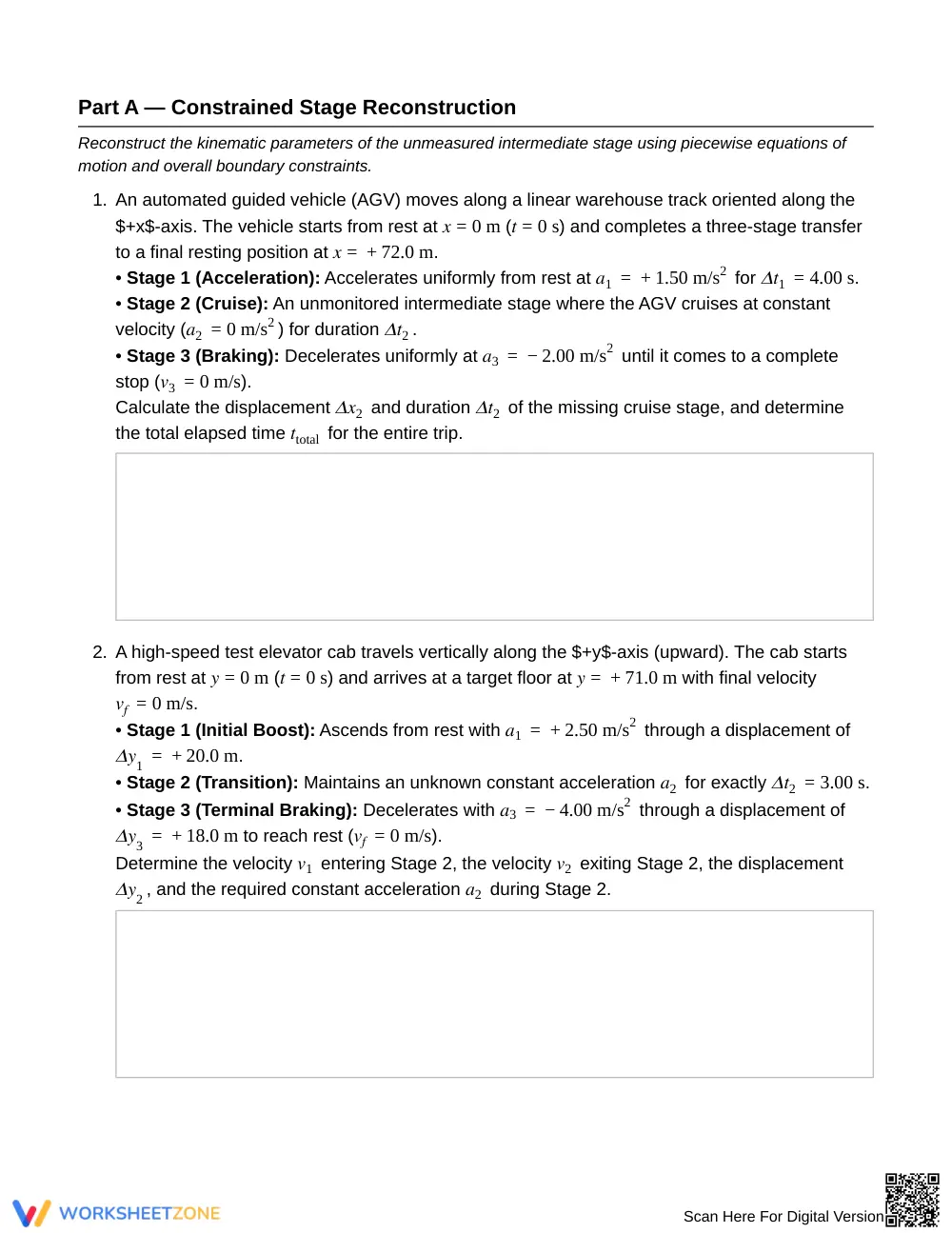
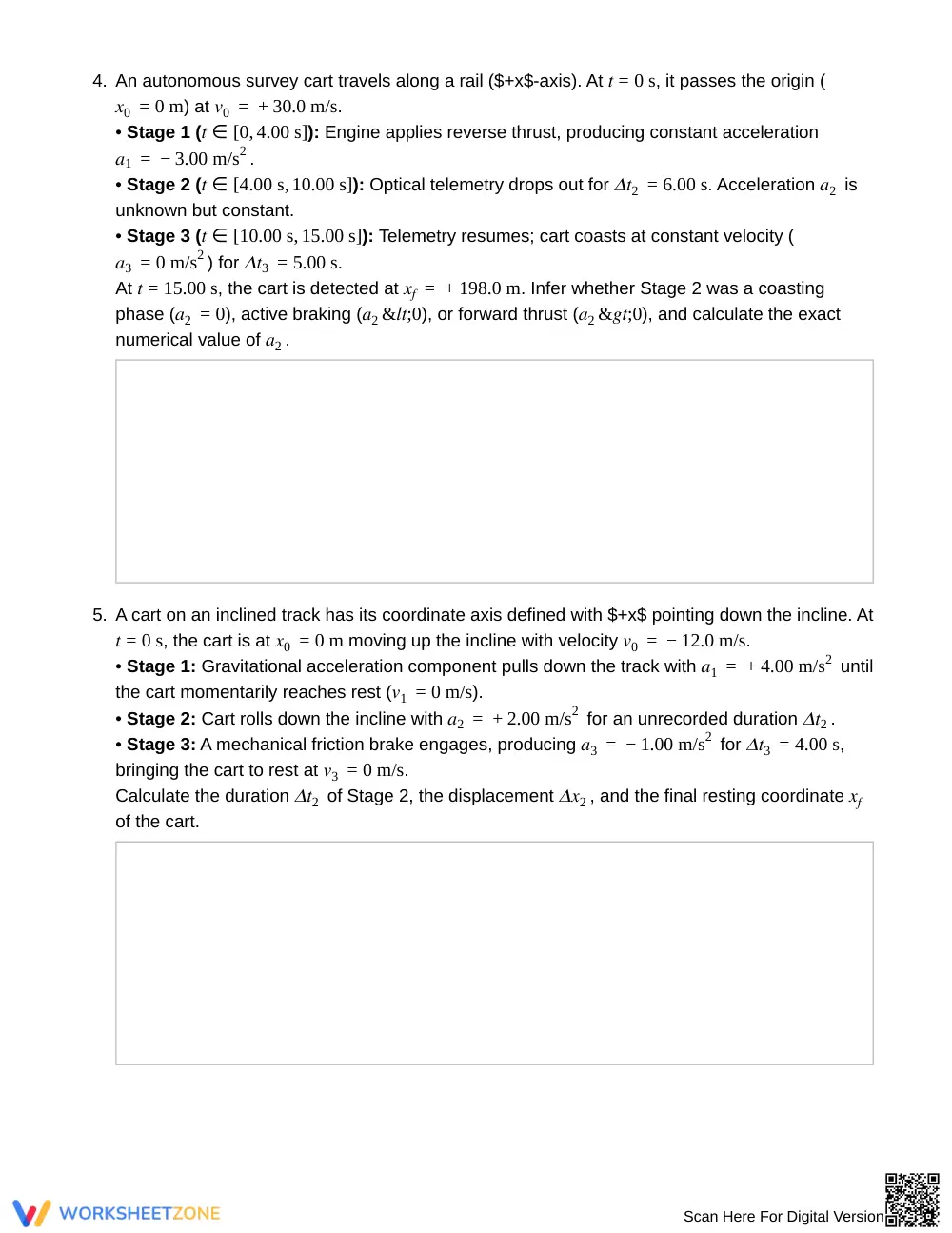
This advanced physics worksheet trains Grade 12 students to deduce missing intermediate kinematic stages using global boundary constraints and piecewise continuity. Working through engineering and telemetry scenarios, learners calculate unmeasured displacements, durations, and accelerations across multi-phase trajectories. This resource prepares students to solve complex, non-uniform one-dimensional motion problems.
At a Glance
- Grade: 12 · Subject: Physics
- Standard: Advanced Kinematics — Infer unmeasured intermediate motion stages using piecewise boundary conditions
- Skill Focus: Infer a Missing Stage from Endpoint Constraints
- Format: 5 pages · 6 problems · Answer key included · PDF
- Best For: Advanced mechanics and AP Physics practice
- Time: 60–80 minutes
What's Inside
This 5-page worksheet provides 6 multi-step analytical problems with an exhaustive 4-page answer key showing step-by-step mathematical proofs. A foundational framework introduces temporal continuity, velocity matching, and displacement summation. Realistic scenarios feature automated warehouse vehicles, vertical test elevators, maglev sleds, and robotic gantries subject to hardware constraints.
Skill Progression
- Guided Practice (Part A, Problems 1–2): Students apply velocity continuity and total displacement constraints to reconstruct unmonitored cruise and transition intervals.
- Supported Practice (Part B, Problems 3–5): Learners evaluate competing kinematic models, resolve sign changes on inclined tracks, and deduce acceleration from telemetry dropouts.
- Independent Practice (Part C, Problem 6): Students synthesize a symmetric trapezoidal profile under speed ceilings and defend why triangular alternatives fail.
This sequence supports gradual release, shifting from scaffolded boundary reconstruction to independent profile synthesis.
Standards Alignment
This resource aligns with advanced physics standards in one-dimensional kinematics and multi-stage motion modeling. Students apply kinematic formulas to piece together trajectories and verify boundary conditions. Both standard codes can be copied directly into lesson plans, IEP goals, or district curriculum mapping tools.
How to Use It
Implement this worksheet after direct instruction on multi-stage 1D motion and kinematic graphs. Guide students through the analytical framework and Problem 1 before assigning Part B for collaborative partner work. Formatively assess whether students correctly transfer final velocity from one stage as the initial velocity of the next. Typical completion takes 60 to 80 minutes.
Who It's For
This set is built for Grade 12 AP and honors physics students mastering multi-stage motion. Differentiate by assigning Parts A and B for targeted practice or Part C for engineering-bound learners. Pair with motion-detector lab data or velocity-time graph analysis.
According to Fisher & Frey (2014), purposeful gradual-release design bridges the gap between mechanical formula substitution and autonomous conceptual synthesis. In secondary physics curricula, multi-stage kinematics problems frequently challenge learners when unmeasured intermediate intervals lack direct scaffolding. By anchoring piecewise boundary conditions within an explicit continuity framework, this worksheet facilitates guided cognitive transfer. Students analyze structured three-stage vehicle trajectories before progressing to inverse telemetry discrimination and hardware-constrained profile synthesis. Empirical findings synthesized by Fisher & Frey (2014) demonstrate that systematically increasing cognitive independence—transitioning from guided reconstruction of intermediate cruise intervals to defending structural rejections of competing velocity models—substantially improves conceptual retention and algebraic reasoning. Consequently, this resource equips twelfth-grade physics students with the durable analytical models needed to master multi-phase kinematic motion, resolve boundary discontinuities, and defend complex quantitative solutions across rigorous STEM learning environments.


