































Essential Pale & Amber Beers Word Search | Adults ELA

Paste this activity's link or code into your existing LMS (Google Classroom, Canvas, Teams, Schoology, Moodle, etc.).
Students can open and work on the activity right away, with no student login required.
You'll still be able to track student progress and results from your teacher account.
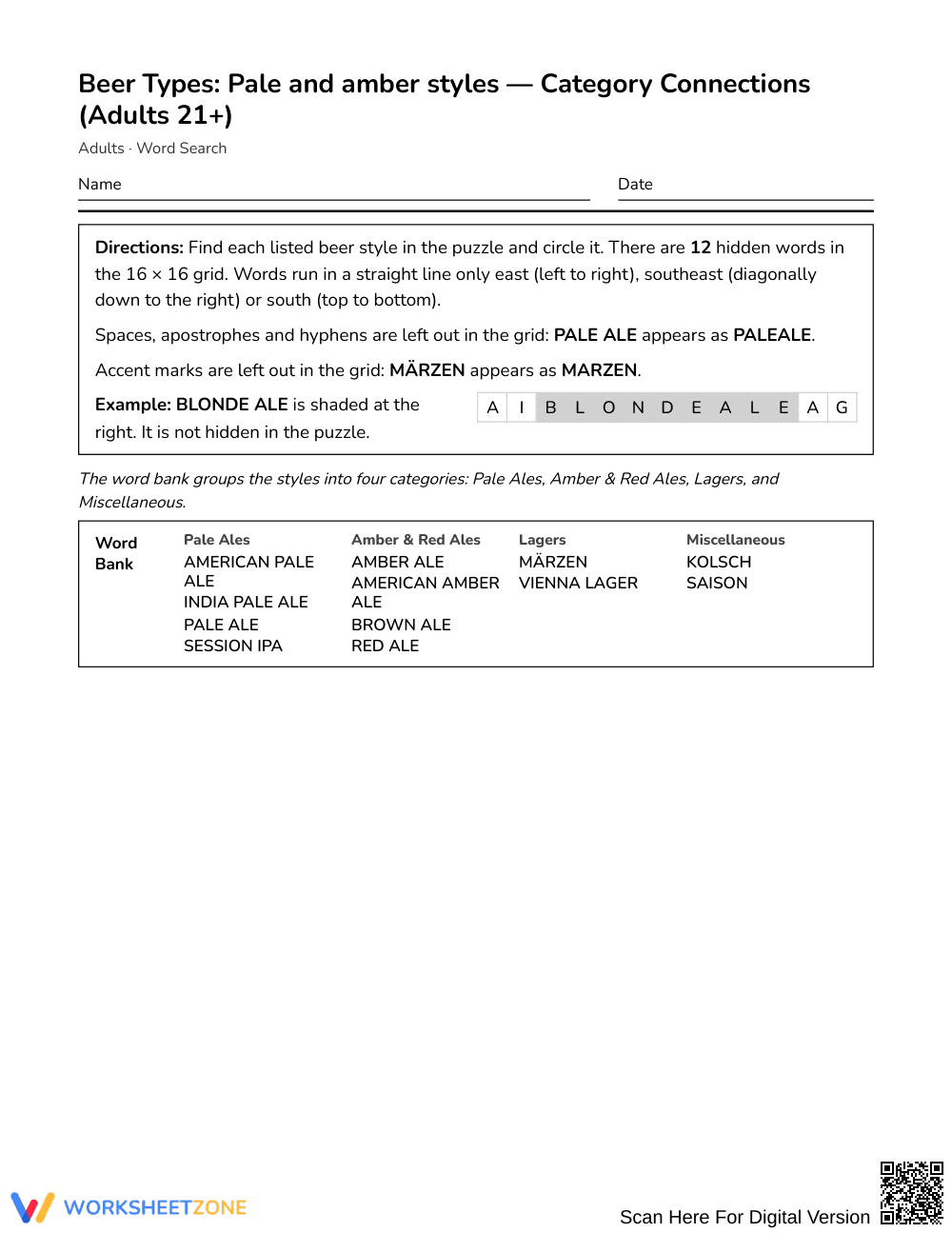
This adult beverage vocabulary word search introduces adult learners to 12 foundational brewing styles, emphasizing distinct pale, amber, lager, and specialty profiles. Learners expand contextual beverage literacy by recognizing professional style designations, connecting sensory descriptions to accurate terminology, and reinforcing domain-specific vocabulary through active orthographic search.
At a Glance
- Grade: Adults · Subject: English Language Arts (ELA)
- Standard: Not standards-assessed — vocabulary enrichment
- Skill Focus: pale and amber styles
- Format: 2 pages · 12 words · Answer key included · PDF
- Best For: Hospitality training or leisure enrichment
- Time: 15–25 minutes
What's Inside
The activity spans 2 pages featuring a dense letter layout, complete target term listings, and explanatory style summaries. A 3-page answer key provides clear word locations for rapid verification. Terms are organized conceptually into four categories: Pale Ales, Amber & Red Ales, Lagers, and Miscellaneous styles.
Puzzle Mechanics and Structure
The activity utilizes a 16 × 16 letter grid containing 12 hidden terms. Words run across three specific orientations: East (horizontal left-to-right), Southeast (diagonal downward), and South (vertical downward). Learners locate targets using a categorized word bank that links each entry to its fermentation profile and historical brewing background.
Standards Alignment
This activity is designed purely for vocabulary enrichment and lifelong learning. It is not aligned to an academic K–12 standard or formal state benchmark, focusing instead on real-world beverage industry terminology and practical reading comprehension.
How to Use It
Deploy this puzzle as an introductory warm-up before a sensory evaluation workshop or as independent review during a culinary arts or hospitality unit. For formative observation, monitor whether learners use the category headers to identify shared brewing characteristics or rely strictly on letter hunting. Expect completion within 15 to 25 minutes.
Who It's For
This resource is tailored for adult learners (ages 21+) enrolled in vocational culinary programs, hospitality onboarding, or community continuing education courses. It pairs effectively with sensory tasting mats, style guideline handbooks, or introductory lectures on fermentation science.
Adult vocabulary acquisition thrives when domain-specific terminology is embedded within structured, categorized practice. According to Fisher & Frey (2014), intentional word exposure coupled with conceptual sorting strengthens lexical retrieval and deepens background schema in mature readers. This word search engages adult learners by pairing 12 specific brewing terms with sensory definitions across a 16 × 16 puzzle grid. Rather than encountering isolated vocabulary, participants identify connections among pale ales, malty amber beers, and crisp lagers across East, Southeast, and South letter paths. The structured format promotes active orthographic analysis, supporting workplace readiness in culinary and beverage hospitality settings. By linking classification headers to practical descriptions, this non-assessed enrichment resource fosters adult vocabulary retention, perceptual discrimination, and domain literacy without unnecessary instructional overhead.


