


























Views
Downloads



Essential One-Step Inequalities Worksheet | Grade 6 Math
Paste this activity's link or code into your existing LMS (Google Classroom, Canvas, Teams, Schoology, Moodle, etc.).
Students can open and work on the activity right away, with no student login required.
You'll still be able to track student progress and results from your teacher account.
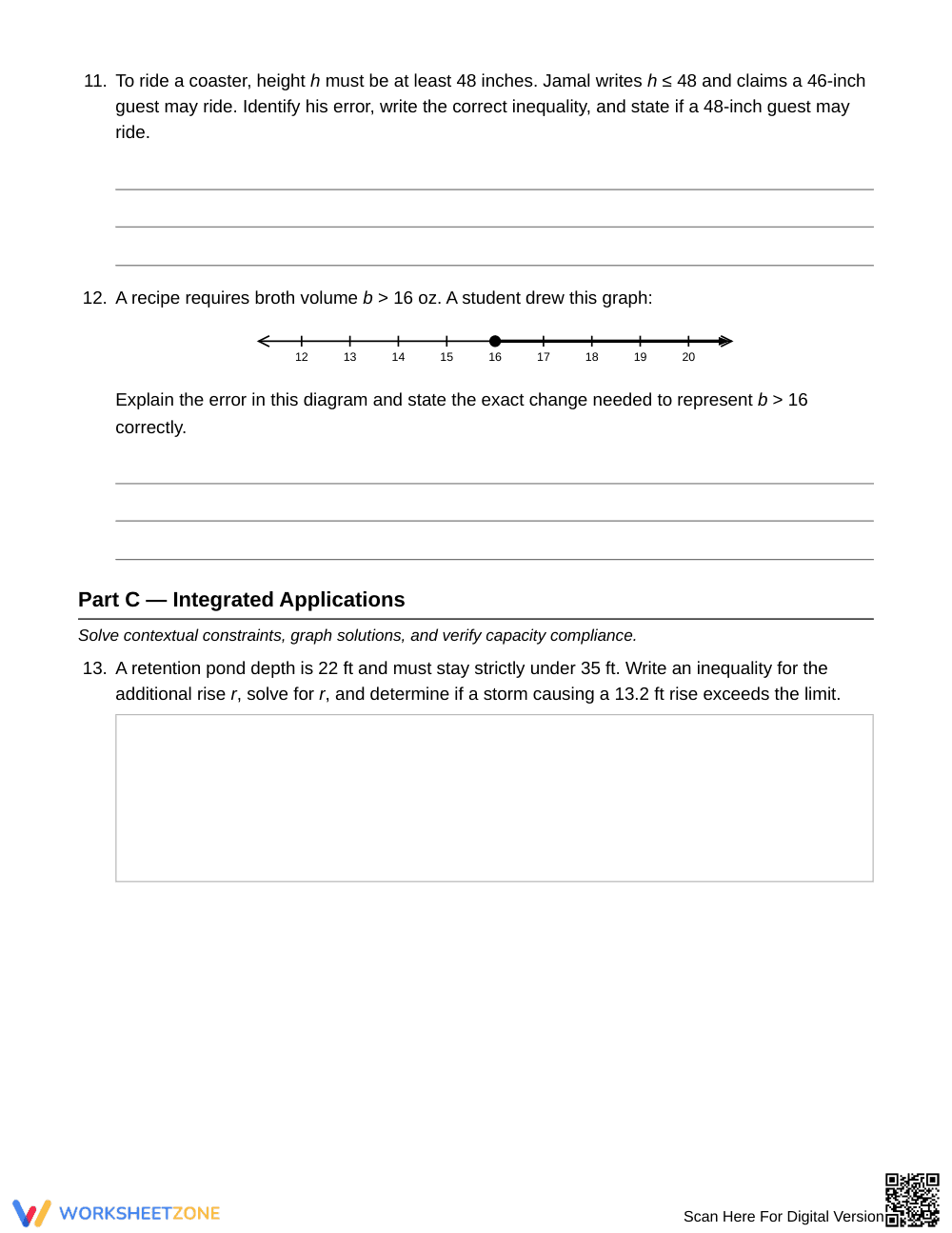
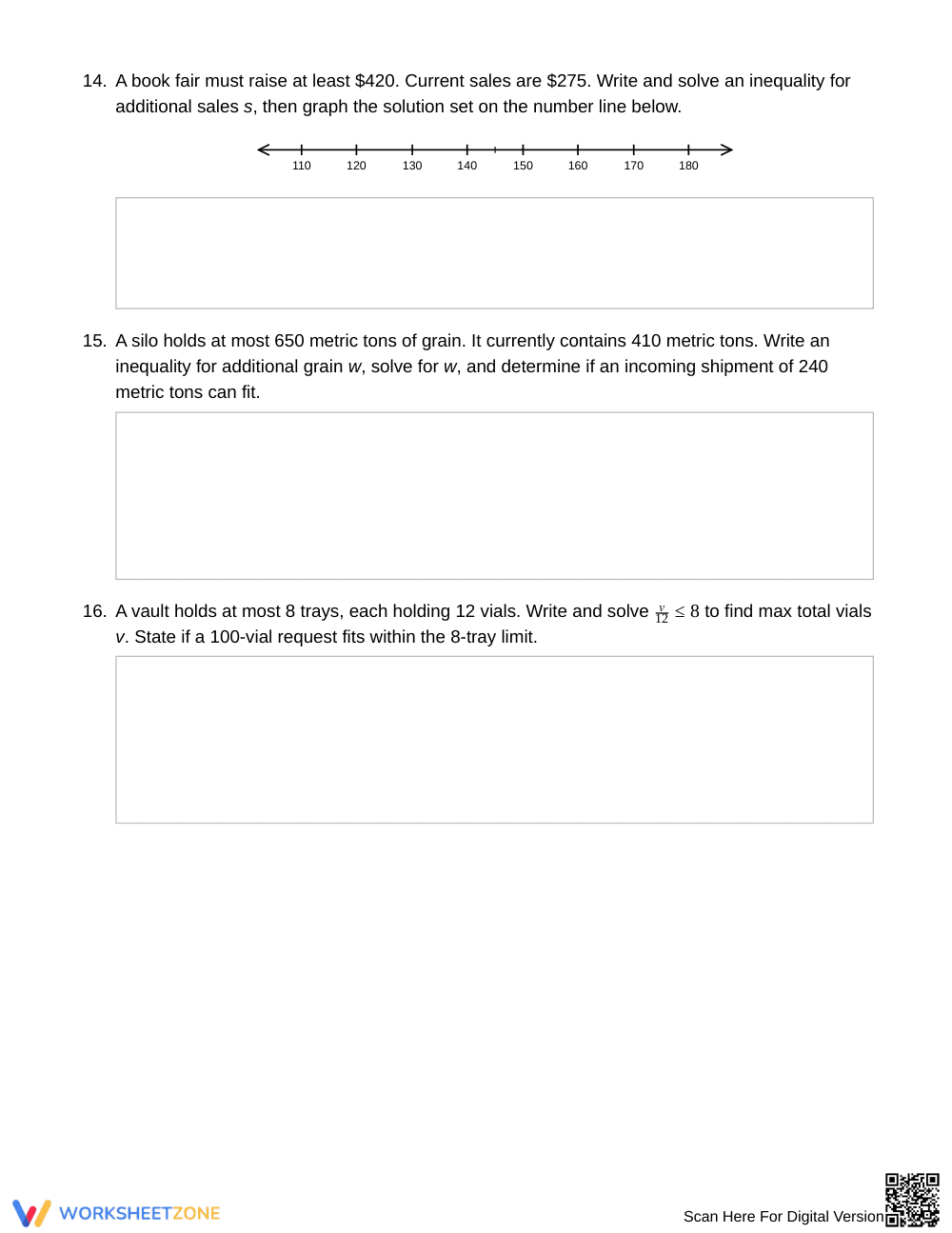
This Grade 6 math worksheet guides students to model real-world capacity constraints and limits using one-step inequalities. Learners analyze boundary points, write algebraic inequalities from contextual word problems, and graph infinite solution sets on number lines to master representational constraint modeling.
At a Glance
- Grade: 6 · Subject: Math
- Standard:
6.EE.B.8— Write inequalities for real-world constraints and graph infinite solution sets- Skill Focus: Mix One-Step Constraints and Representations
- Format: 5 pages · 16 problems · Answer key included · PDF
- Best For: Independent practice and constraint modeling
- Time: 35–45 minutes
What's Inside
Across 5 printable pages, this resource delivers 16 structured tasks. It features a Core Concept reference box, constraint modeling, number line graphing, and error analysis. A complete 2-page answer key provides step-by-step solutions for efficient grading.
Skill Progression
- Guided Practice (Part A, 4 tasks): Students evaluate boundary values, distinguish open versus closed circles, and interpret infinite solution sets.
- Supported Practice (Part B, 8 tasks): Learners write one-step addition and multiplication inequalities from capacity prompts, test values, and correct misconceptions.
- Independent Practice (Part C, 4 tasks): Students solve contextual capacity scenarios, graph solution sets, and verify real-world feasibility.
This gradual-release structure builds learner autonomy from concept recognition to independent algebraic formulation.
Standards Alignment
This resource aligns with 6.EE.B.8: Write an inequality of the form x > c or x < c to represent a constraint or condition in a real-world problem, recognize infinite solution sets, and graph solutions on number lines. It also supports 6.EE.B.5 by testing solution values. Both standard codes can be copied directly into lesson plans, IEP goals, or district curriculum mapping tools.
How to Use It
Use this worksheet after direct instruction on inequality symbols. Assign Part B for partner practice analyzing constraint keywords, or use Part C as a 35–45 minute formative assessment. During work, check if students accurately graph closed circles for inclusive limits (≤, ≥) and open circles for strict limits (<, >).
Who It's For
Designed for Grade 6 math classrooms, tier-2 intervention, and pre-algebra review. Pair with an inequality keyword anchor chart for additional visual support.
According to research synthesized by Fisher & Frey (2014) on structured instructional frameworks, mathematics learners achieve higher rates of conceptual mastery when explicit modeling transitions deliberately into supported application and independent problem solving. This worksheet directly targets standard 6.EE.B.8 by requiring Grade 6 students to translate verbal constraints into one-step inequalities, graph solution sets on number lines, and analyze boundary conditions in practical contexts. By embedding targeted error analysis alongside 16 scaffolded tasks, the resource prompts students to confront common symbolic misconceptions regarding strict and inclusive inequalities. Students develop strong representational fluency by moving between verbal descriptions, algebraic statements, and visual diagrams. As demonstrated in gradual-release research, structured progression from conceptual identification to applied capacity constraints equips learners to retain algebraic modeling skills, justify boundary conditions accurately, and evaluate mathematical relationships with verified precision across diverse middle school problem-solving contexts.


