




























Views
Downloads


Essential Ohm's Law Worksheet | Grades 8-12 Science

Paste this activity's link or code into your existing LMS (Google Classroom, Canvas, Teams, Schoology, Moodle, etc.).
Students can open and work on the activity right away, with no student login required.
You'll still be able to track student progress and results from your teacher account.
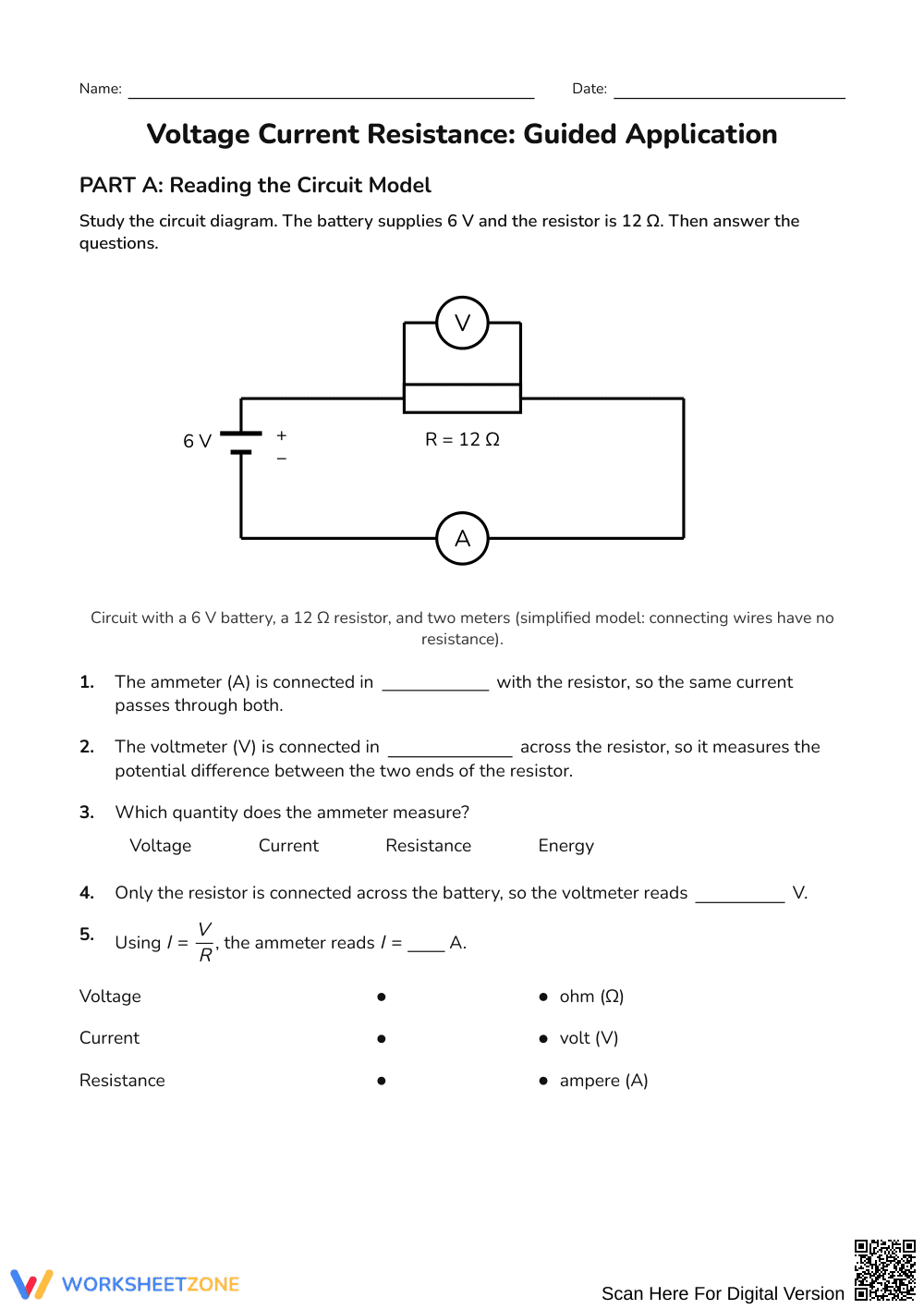
This four-page physics and physical science worksheet guides students through voltage, current, and resistance relationships using authentic circuit diagrams, experimental data tables, and qualitative prediction items. Students calculate values using Ohm's law, analyze linear and non-ohmic graphs, and articulate microscopic particle explanations for resistance changes across 25 progressive exercises.
At a Glance
- Grade: Grades 8–12 · Subject: Science / Physics
- Standard: Relate electric current, potential difference, and resistance qualitatively and quantitatively through models
- Skill Focus: Ohm's law calculations, circuit analysis, and particle-level reasoning
- Format: 4 pages · 25 problems · Answer key included · PDF
- Best For: High school physics circuit units
- Time: 45–60 minutes
What's Inside
The resource contains 4 student worksheets paired with a complete 4-page answer key featuring worked calculations. Students interact with schematic circuit diagrams containing meters, evaluate an experimental voltage-versus-current graph, fill in missing values across an Ohm's law calculation matrix, and write constructed responses explaining series circuits and non-ohmic filament behavior.
Skill Progression
- Guided Practice (Part A): Students examine labeled circuit diagrams, identify metric units for potential difference, current, and resistance, and read series ammeter and parallel voltmeter values with provided formulas.
- Supported Practice (Part B): Learners interpret linear graphical data, confirm constant resistance through slope ratios, and complete a multi-step calculation table applying V = I × R across diverse values.
- Independent Practice (Part C): Students solve series circuit prompts, predict circuit behavior under altered physical conditions, contrast wet versus dry skin resistance, and explain filament heating at the molecular collision level.
This sequence mirrors the gradual-release model, shifting learners from concrete circuit reading toward autonomous quantitative evaluation and microscopic reasoning.
Standards Alignment
This activity aligns with high school physical science standards requiring students to develop and use models to illustrate that electric current depends on both potential difference and resistance. Students also analyze real-world safety parameters involving current through conductors. Both standard concepts can be copied directly into lesson plans, IEP goals, or district curriculum mapping tools.
How to Use It
Deploy this packet after direct instruction introducing Ohm's law and basic circuit schematic symbols. During independent work time, observe whether students calculate total series resistance before solving for current in Part C. The complete assignment takes 45 to 60 minutes and works effectively for paired problem-solving or independent review.
Who It's For
Designed for introductory physical science and high school physics classrooms, this worksheet supports diverse learners through explicit visual diagrams and structured formula prompts before demanding conceptual synthesis. Pair this worksheet directly with a hands-on breadboard laboratory or a digital DC circuit simulator.
According to research highlighted by Fisher & Frey (2014) on effective gradual-release architecture, students achieve deeper conceptual durable mastery when analytical tasks bridge visual representations, numeric computation, and open-ended written reasoning. Rather than isolating Ohm's law into routine algorithmic drill, this 25-task instructional sequence prompts learners to construct meaning across three distinct representational tiers: schematic symbols, coordinate data plots, and particulate collision mechanics. Grounding quantitative physics equations in concrete real-world contexts—such as human body electrical resistance under wet and dry conditions—helps students connect theoretical science principles to measurable physical consequences. The structured shift from direct identification to analytical prediction equips high school science students with the exact cognitive scaffolding necessary to evaluate series circuit interactions independently and accurately.


