


























Views
Downloads


Essential Ohm's Law Graph Worksheet | Grade 8-12 Science
Paste this activity's link or code into your existing LMS (Google Classroom, Canvas, Teams, Schoology, Moodle, etc.).
Students can open and work on the activity right away, with no student login required.
You'll still be able to track student progress and results from your teacher account.
This science worksheet equips students in grades 8 through 12 to analyze experimental circuit data and interpret voltage-current graphs. Learners calculate resistance using Ohm's law, determine slope values, compare distinct ohmic components, and evaluate voltage distribution in series circuits. Students build quantitative reasoning skills by connecting graphical slope directly to physical resistance values.
At a Glance
- Grade: Grades 8–12 · Subject: Science
- Standard: Physical Science — Analyze and interpret data to determine relationships among voltage, current, and resistance
- Skill Focus: Graph and Evidence Interpretation for Ohm's Law
- Format: 3 pages · 17 problems · Answer key included · PDF
- Best For: High school physics circuit data review
- Time: 35–45 minutes
What's Inside
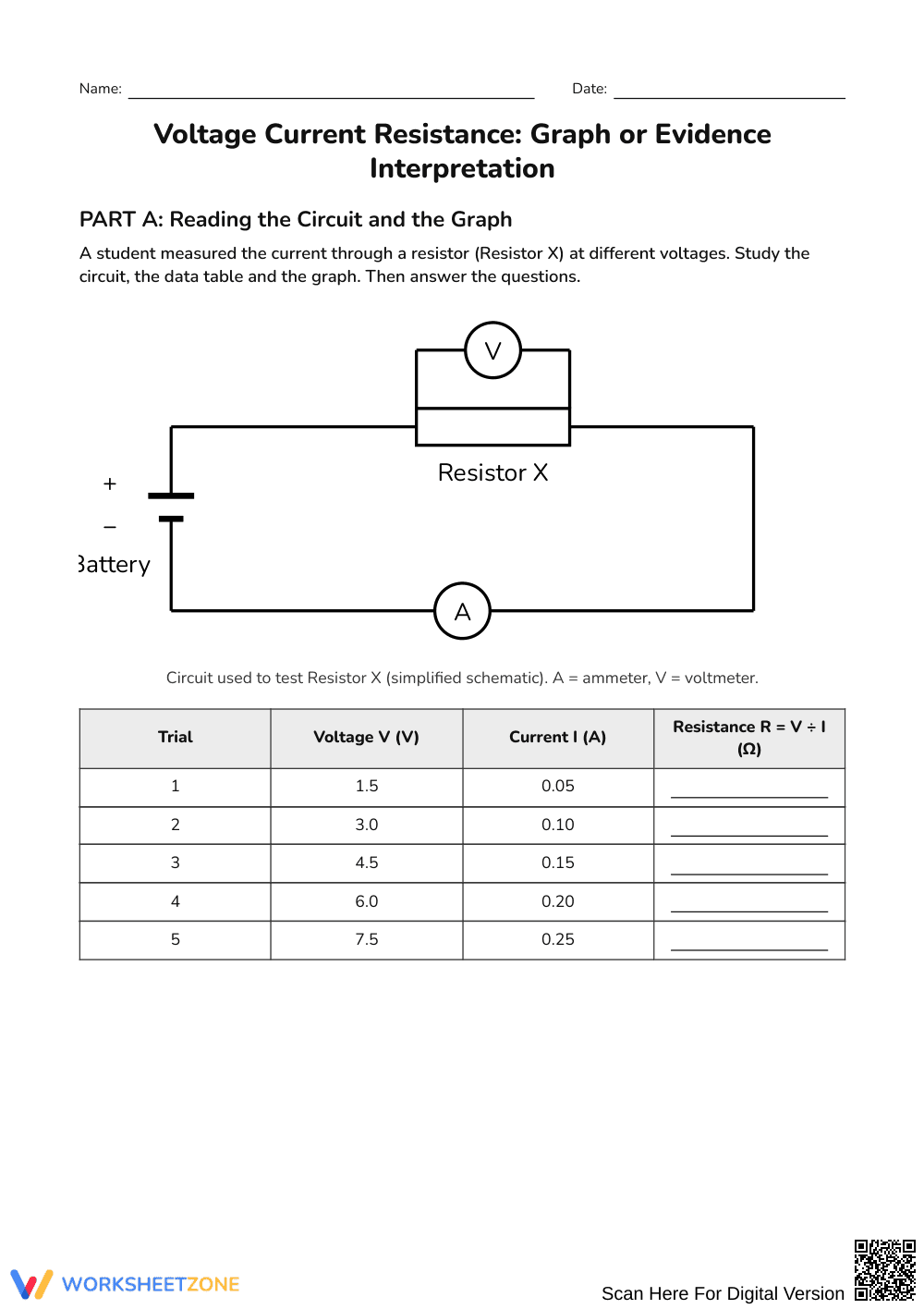
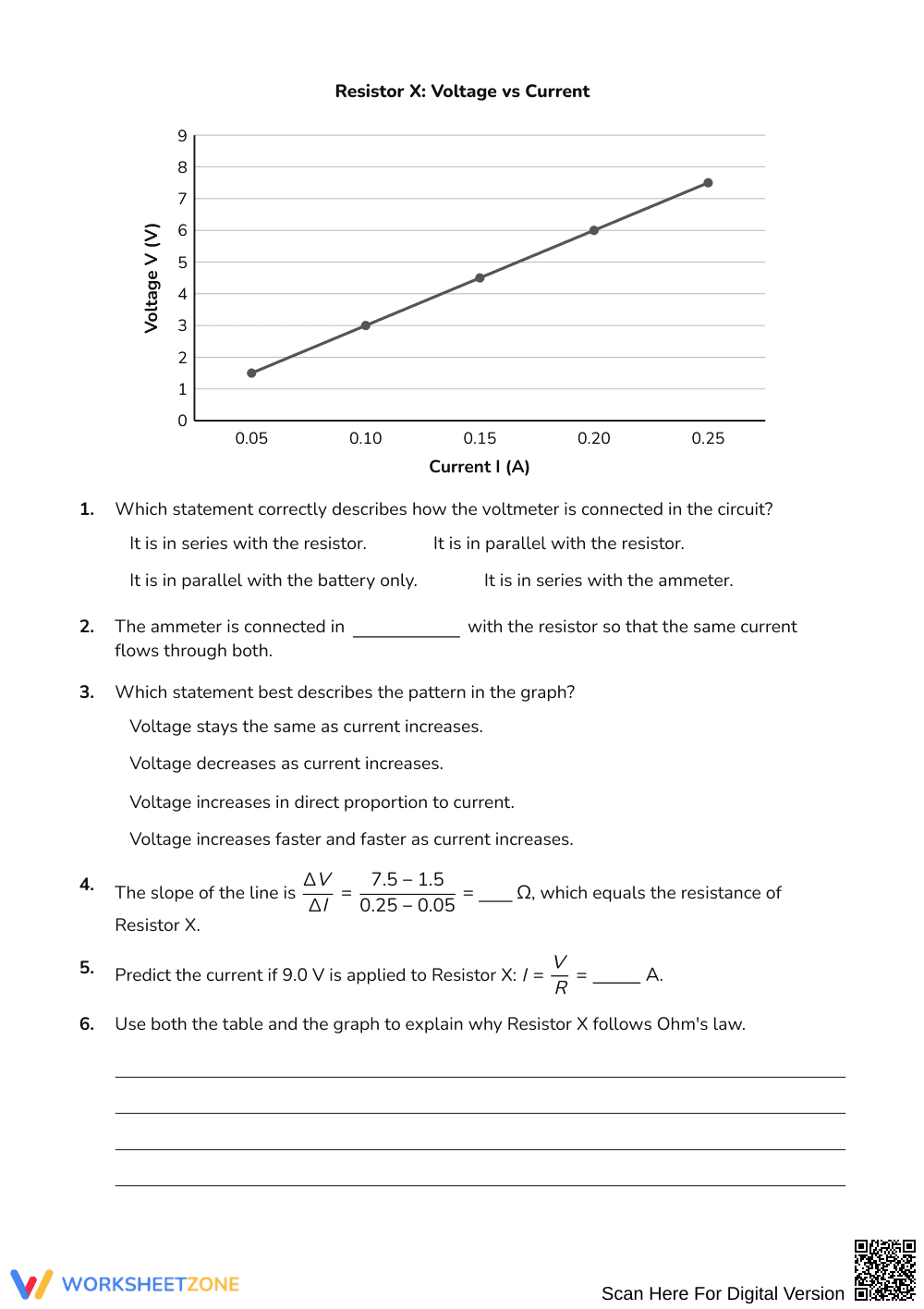
This 3-page printable set delivers 17 focused tasks structured around experimental schematics, data tables, and coordinate graphs. Students examine circuit diagrams with voltmeters and ammeters, calculate resistance ratios from tabular data, evaluate linear graphs, and contrast multi-resistor configurations. A complete 3-page teacher answer key provides full step-by-step mathematical calculations and explanatory rationale for rapid grading.
Skill Progression
- Guided Practice: Tasks 1–5 guide students through circuit schematic interpretation and tabular ratio calculation, establishing how linear slope correlates to electrical resistance.
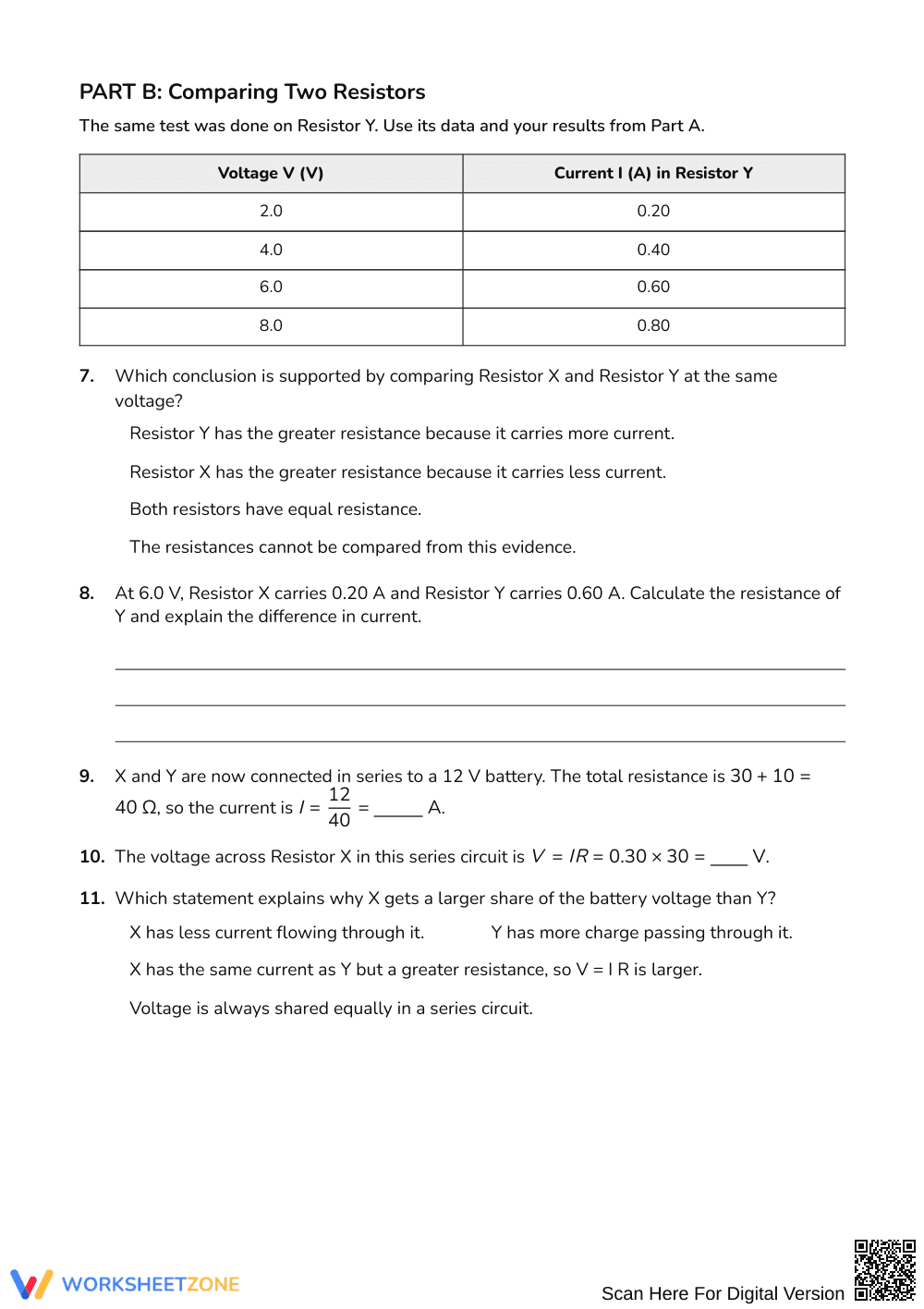
- Supported Practice: Tasks 6–11 prompt learners to extrapolate values at higher voltages and compare the slope and current throughput of two distinct resistors.
- Independent Practice: Tasks 12–17 require unassisted multi-step calculations to determine equivalent resistance, total current, and voltage drops across series loads.
This sequence embodies a gradual-release instructional model, transitioning students from scaffolded data reading to rigorous independent circuit calculations.
Standards Alignment
This resource aligns with high school physical science standards for electrical circuits. Students analyze and interpret empirical data to support claims regarding the relationship between potential difference, current, and resistance in closed loops. Educators can copy this instructional focus directly into daily lesson plans, departmental pacing guides, and IEP progress notes.
How to Use It
Deploy this worksheet immediately following direct instruction on Ohm's law or as a follow-up assessment after a laboratory investigation. During independent work, monitor whether students divide voltage by current rather than inverting the ratio when determining resistance from graph axes. Most students will complete the full 17-problem investigation within 35 to 45 minutes of class time.
Who It's For
This resource serves general science, physical science, and introductory physics classrooms covering DC electrical circuits. It offers built-in scaffolding through organized tables for striving learners while offering analytical depth for advanced students. Pair this activity with an interactive circuit simulation or physical breadboard lab to solidify concrete conceptual understanding.
According to Fisher & Frey (2014), purposeful skill acquisition relies on structured cognitive progression where instructional responsibility shifts systematically from explicit modeling to independent execution. This 3-page physical science worksheet exemplifies this evidence-based pedagogy by guiding secondary students through 17 sequenced tasks centered on Ohm's law and V-I graph interpretation. Learners transition from reading scaffolded schematics and structured data tables to independently calculating resistance values, comparing multi-component circuits, and determining series voltage distributions. By integrating visual circuit diagrams, coordinate graphs, and numerical calculations within a single instructional sequence, the worksheet reinforces multi-modal scientific reasoning. Research affirms that isolating targeted analytical skills through scaffolded practice strengthens conceptual transfer and boosts quantitative problem-solving accuracy in physics. This resource provides secondary science educators with a verified tool that reinforces conceptual comprehension while supporting rigorous, standards-focused formative assessment.


