




























Views
Downloads



Essential Net Accumulation Worksheet | Grade 12 Calculus

Paste this activity's link or code into your existing LMS (Google Classroom, Canvas, Teams, Schoology, Moodle, etc.).
Students can open and work on the activity right away, with no student login required.
You'll still be able to track student progress and results from your teacher account.
This calculus practice activity trains students to calculate definite integrals in applied contexts and interpret net accumulation with appropriate dimensional units. High school seniors connect rate equations to overall physical quantities, integrating polynomials, exponentials, and trigonometric functions while tracking initial values, net change, and contextual constraints across engineering, physics, and resource-management scenarios.
At a Glance
- Grade: 12 · Subject: Calculus
- Standard: Definite Integrals — Calculate accumulation from rates of change and interpret units in context
- Skill Focus: Interpret Net Accumulation with Units
- Format: 5 pages · 10 problems · Answer key included · PDF
- Best For: AP Calculus review or independent practice
- Time: 45–60 minutes
What's Inside
The resource spans 5 pages featuring 10 rigorous contextual word problems organized into three sequential sections, followed by a complete 2-page worked answer key. Students begin with a structured Net Change Theorem reference box and a worked model problem highlighting unit cancellation. Problems include tabular rate data requiring trapezoidal approximations, net displacement versus total distance comparisons, and multi-variable optimization constraints.
Skill Progression
- Guided Practice (Part A, Problems 1–2): Students apply direct accumulation models to power and dispensing rates with explicit formula setups, reinforcing baseline integration and unit multiplication.
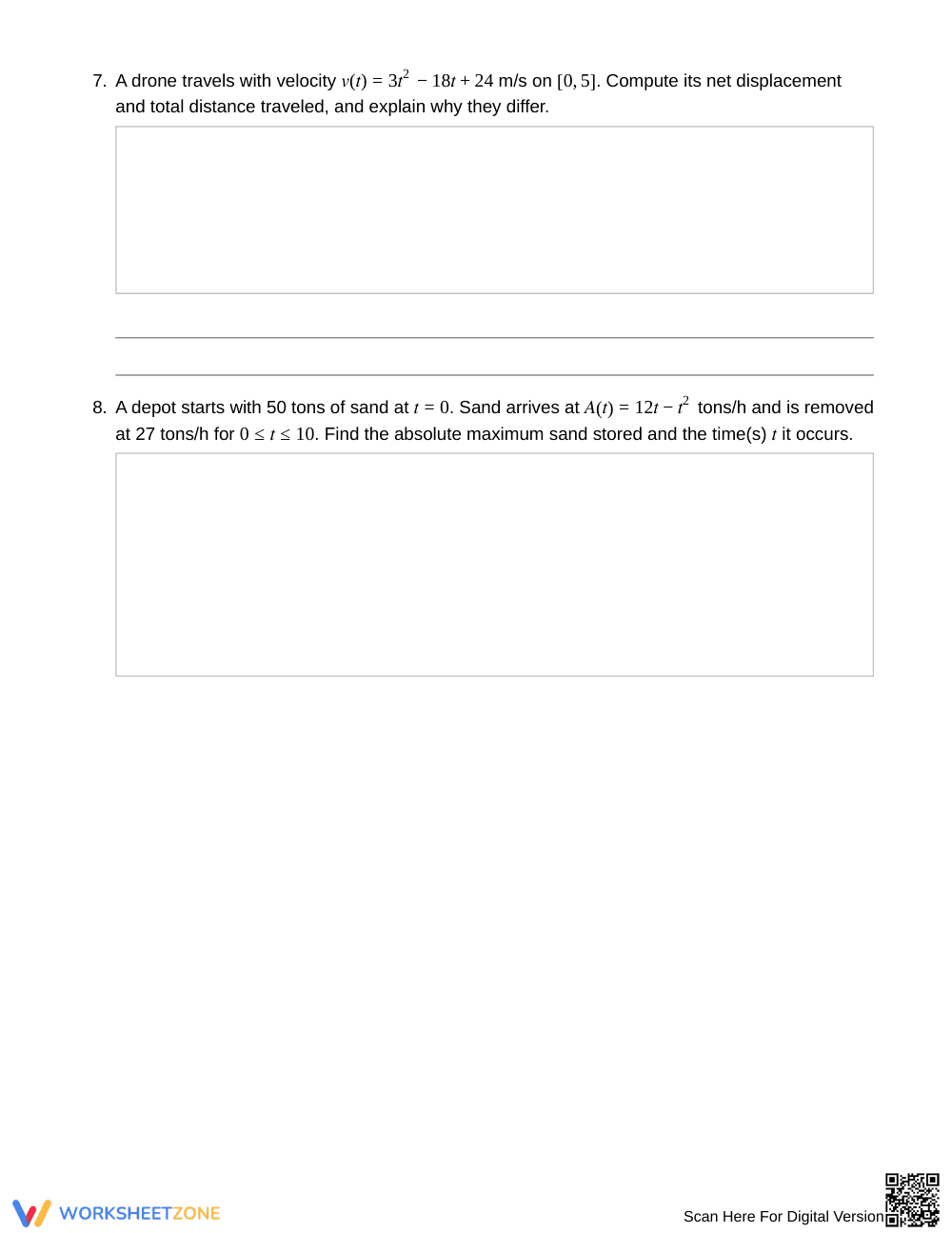
- Supported Practice (Part B, Problems 3–8): Learners manage multi-step scenarios requiring initial condition addition, piecewise recovery drains, numerical integration via trapezoidal sums, and displacement analysis.
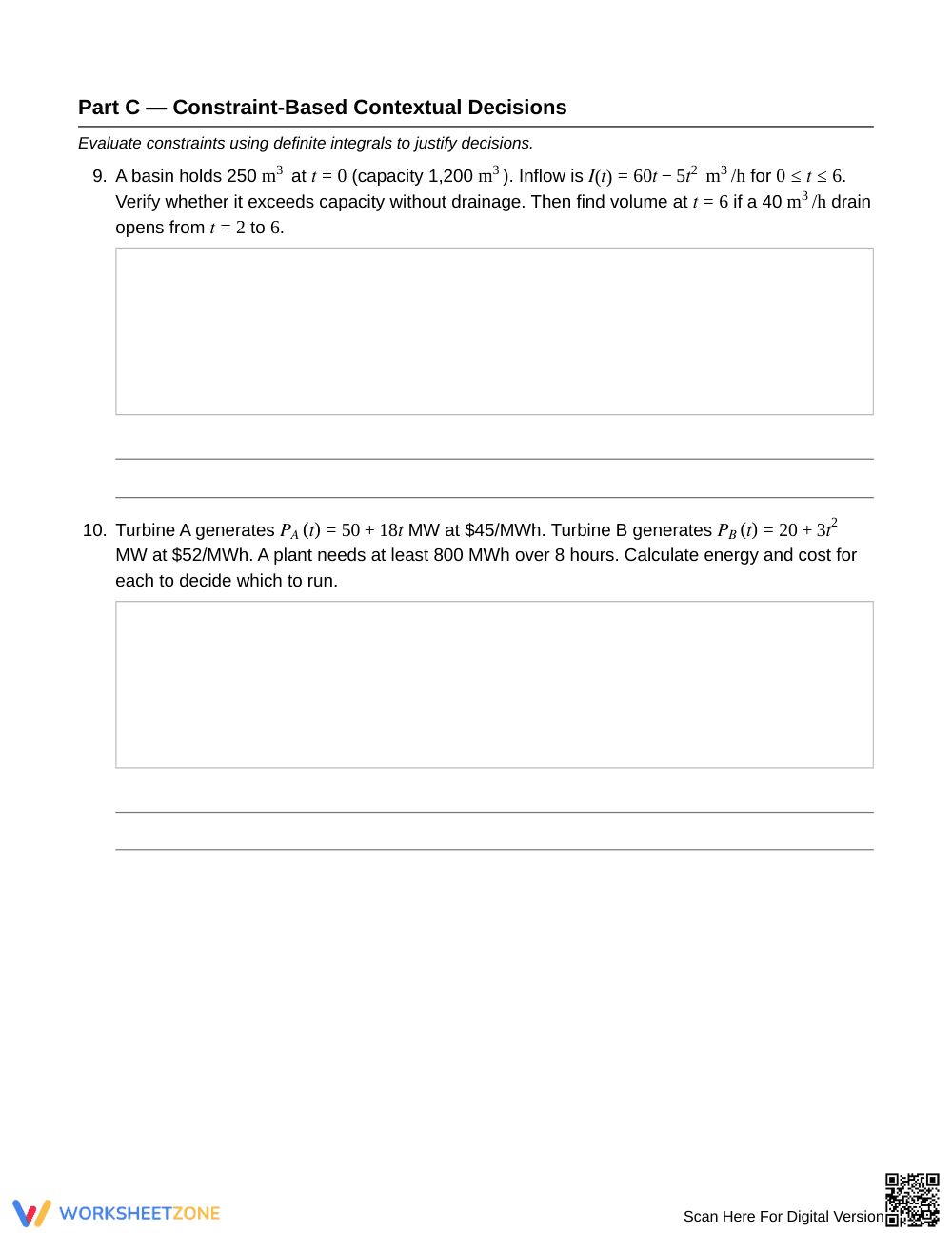
- Independent Practice (Part C, Problems 9–10): Students formulate constraint-based decisions, evaluating reservoir overflow thresholds and performing comparative cost-efficiency analyses between industrial turbines.
This deliberate sequence mirrors the gradual-release framework, moving learners from formulaic integration to autonomous mathematical modeling.
Standards Alignment
This worksheet targets core advanced calculus competencies covering the Net Change Theorem, definite integrals as accumulation functions, and dimensional analysis in physical systems. Students must explain how integrating a rate of change over time yields total accumulation plus initial conditions. Both standard descriptions can be copied directly into lesson plans, IEP goals, or district curriculum mapping tools.
How to Use It
Deploy this resource during the second half of an integral calculus unit after direct instruction on the Fundamental Theorem of Calculus. Use Part A as an in-class check for understanding to verify that students correctly multiply rate units by time units before proceeding. Alternatively, assign Parts B and C as a collaborative problem-solving workshop where partners justify boundary conditions and graph behaviors. Expect completion within 45 to 60 minutes.
Who It's For
This printable is designed for Grade 12 AP Calculus AB, BC, or dual-enrollment college calculus students preparing for free-response exam sections. Pair this resource with a visual Riemann sum anchor chart or graphical accumulation demonstration to reinforce conceptual understanding for emerging learners.
According to Fisher & Frey (2014), purposeful scaffolding through guided, collaborative, and independent modeling phases builds deep conceptual transfer in advanced mathematics. When twelfth-grade calculus students evaluate rates of change using the Net Change Theorem, dimensional analysis serves as an essential metacognitive checkpoint. Calculating definite integrals within applied settings—such as fluid dynamics, energy usage, and kinetic velocity—ensures students treat calculus as an authentic analytical discipline rather than mechanical computation. Working through 10 multi-step applications reinforces the vital relationship between rate derivatives and accumulated quantities. By explicitly verifying units and testing realistic constraints, learners achieve the fluency required for collegiate STEM coursework and advanced placement exams.


