

































Essential Negative Inequalities Worksheet | Grade 7 Math

Paste this activity's link or code into your existing LMS (Google Classroom, Canvas, Teams, Schoology, Moodle, etc.).
Students can open and work on the activity right away, with no student login required.
You'll still be able to track student progress and results from your teacher account.
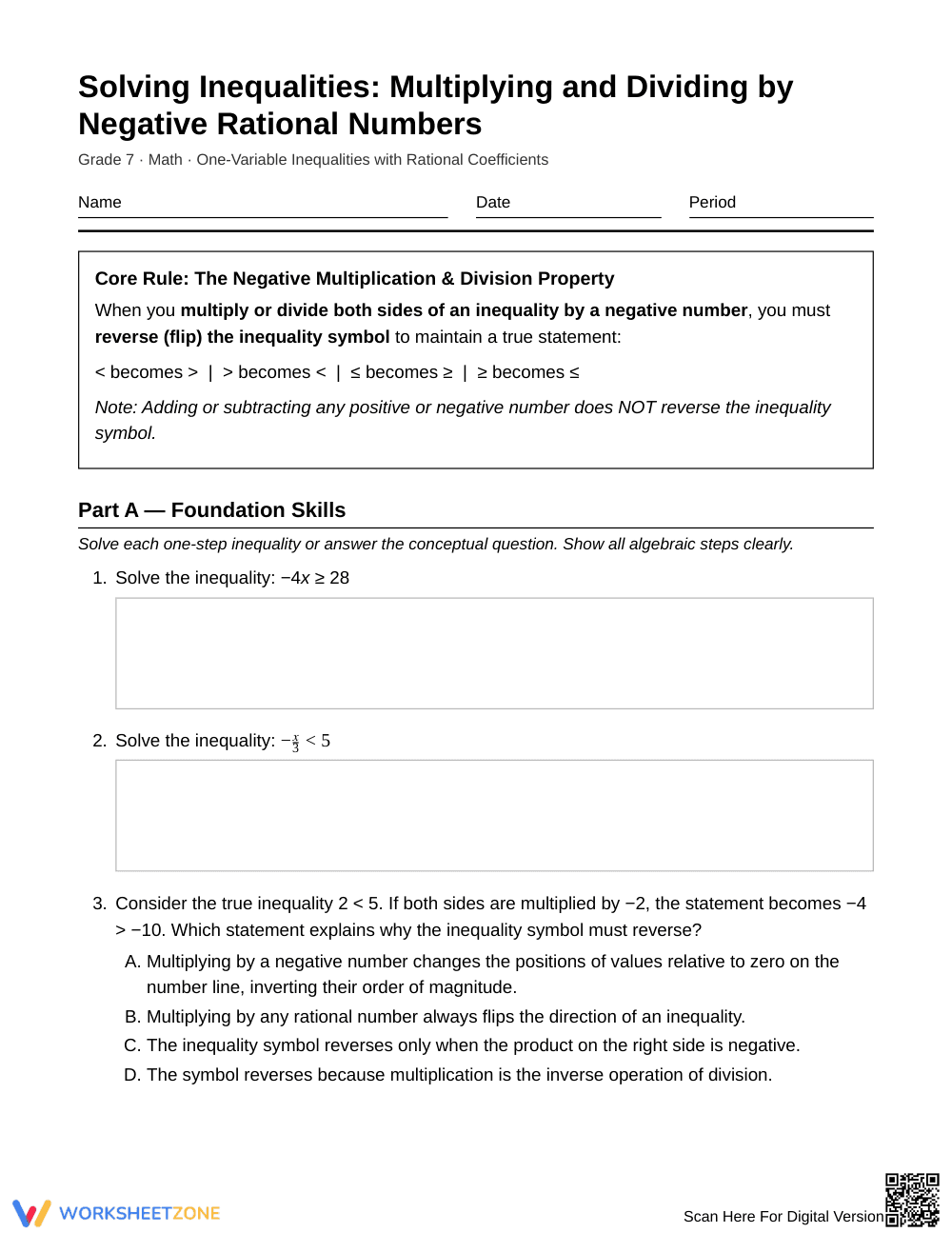
This targeted algebra worksheet builds fluency in solving one-variable inequalities when multiplying or dividing by negative rational numbers. Students learn why the inequality sign flips through conceptual proofs, apply the rule across multi-step equations, and solve real-world constraint problems with complete accuracy.
At a Glance
- Grade: 7 · Subject: Math
- Standard:
7.EE.B.4— Solve multi-step linear inequalities with rational coefficients and graph solution sets- Skill Focus: Multiplying and dividing inequalities by negative numbers
- Format: 5 pages · 18 problems · Answer key included · PDF
- Best For: Independent practice and error analysis
- Time: 40–50 minutes
What's Inside
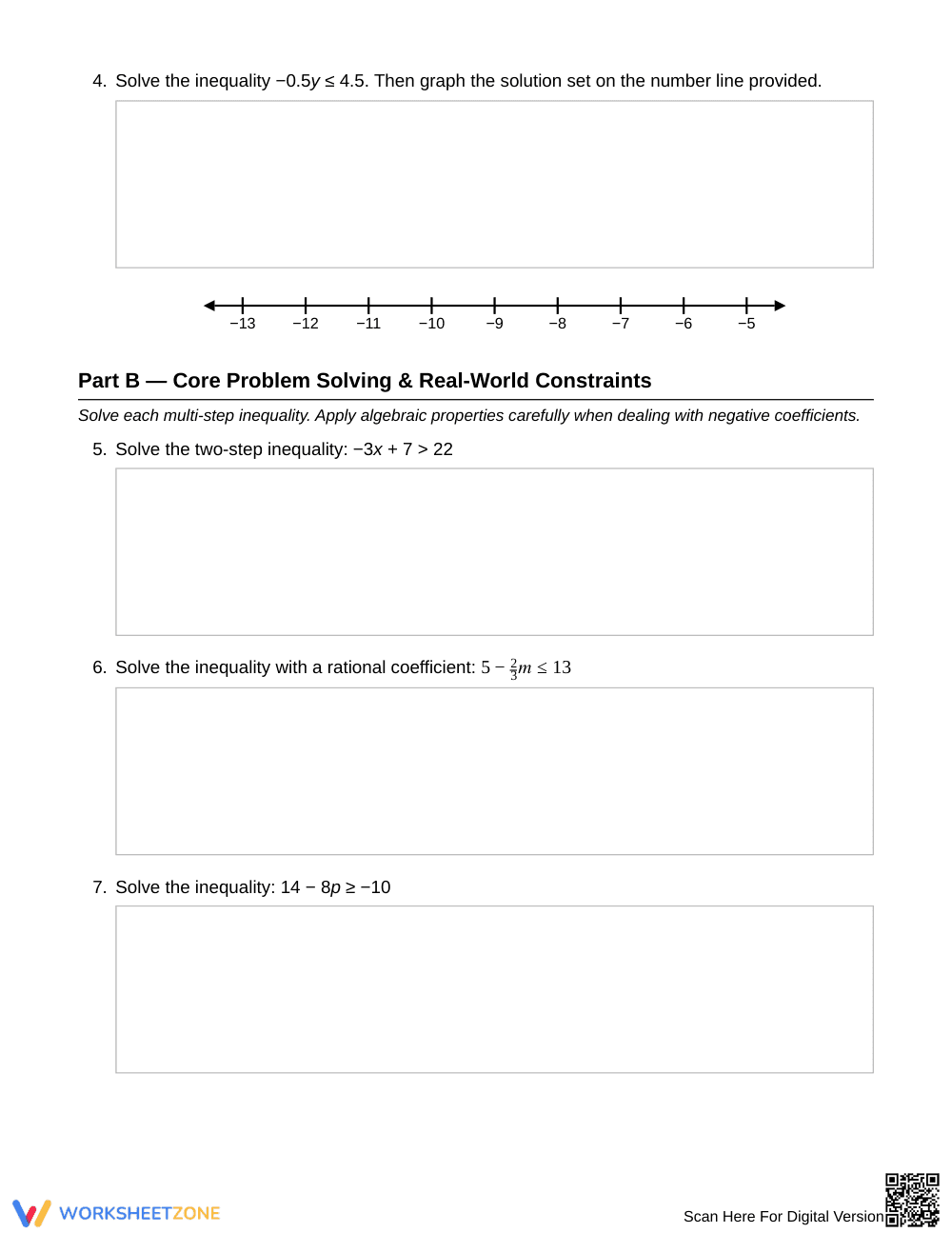
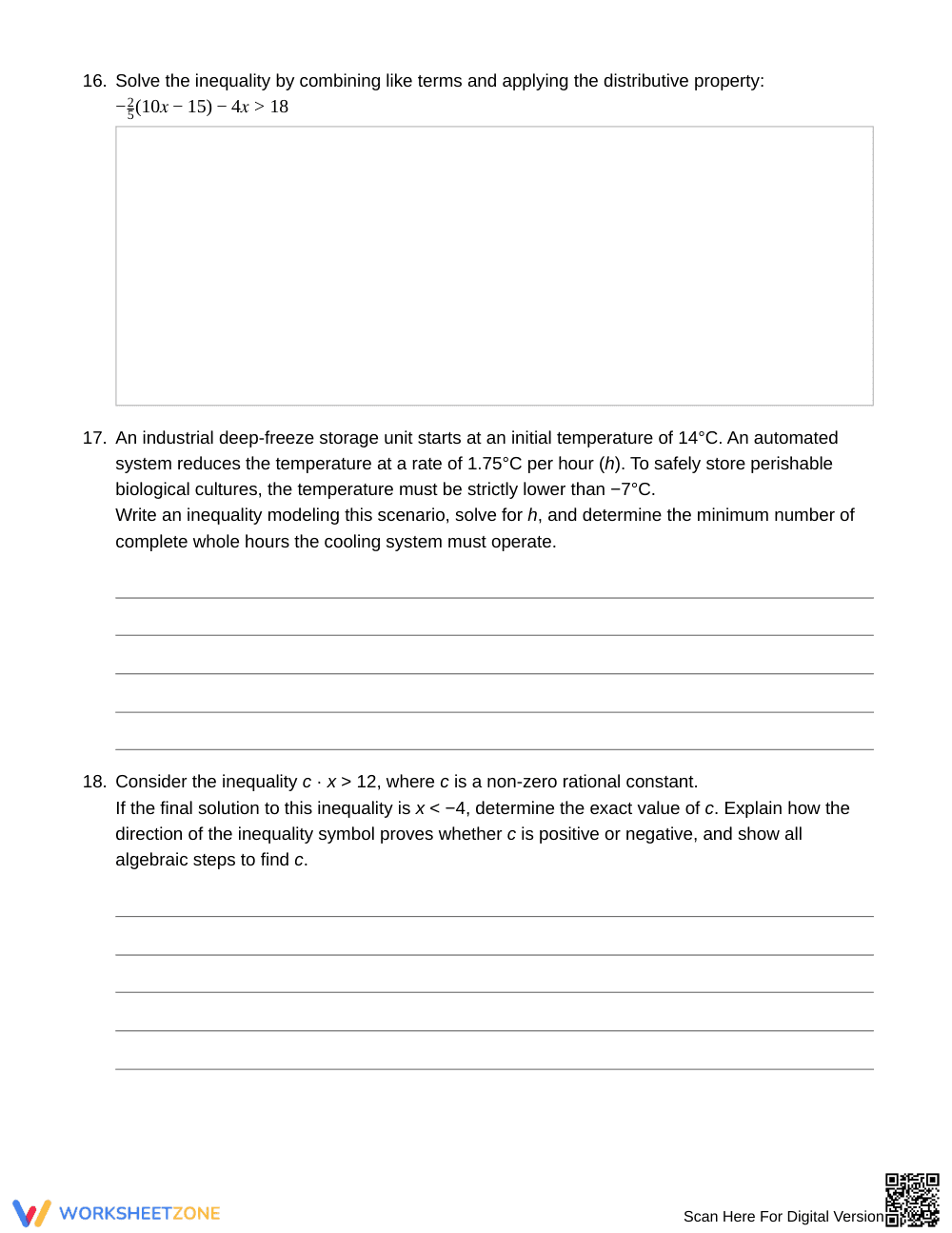
The 5-page printable resource includes 18 structured problems divided across three difficulty tiers, backed by an explicit core rule summary box. It features one-step foundation items, number line graphing, multi-step equations with fractions and decimals, real-world modeling scenarios, targeted student error analysis, and a comprehensive 5-page step-by-step answer key.
Skill Progression
- Guided Practice (Part A — 4 problems): Focuses on foundational one-step inequalities, conceptual multiple-choice reasoning on number line magnitude inversion, and graphing solutions on a number line.
- Supported Practice (Part B — 10 problems): Challenges students with two-step inequalities, rational coefficients, the distributive property, error analysis tasks, and real-world word problems involving ocean probes and lunch budgets.
- Independent Practice (Part C — 4 problems): Extends mastery through multi-step inequalities with variables on both sides, combined like terms, temperature modeling, and algebraic proof with unknown constants.
This structured progression reflects the gradual-release framework, moving learners smoothly from direct conceptual understanding to independent problem solving.
Standards Alignment
Aligned to 7.EE.B.4: Use variables to represent quantities in a real-world or mathematical problem, and construct simple equations and inequalities to solve problems by reasoning about the quantities. Both standard codes can be copied directly into lesson plans, IEP goals, or district curriculum mapping tools.
How to Use It
Deploy this resource during the direct instruction phase of an inequalities unit or as post-lesson independent practice. During classwork, conduct a formative check on Part B Item 12 (Error Analysis) to identify whether students remember to reverse inequality signs before moving to Part C. Expect the full 18-task set to take 40 to 50 minutes.
Who It's For
Designed for Grade 7 general mathematics students, advanced Grade 6 learners, or Grade 8 students needing targeted algebraic remediation. Pair this practice set with an anchor chart illustrating negative number line reflections or a teacher-led worked example review.
According to research from Fisher & Frey (2014) on effective instructional design, structured scaffolding that integrates targeted error analysis enables middle school learners to internalize complex algebraic rules more reliably than unguided repetitive drill. This Grade 7 mathematics resource directly addresses the core operational demands of standard 7.EE.B.4 by targeting the common misconception surrounding the multiplication and division property of inequalities. By combining explicit rule boxes, number line representations, and word problems with negative rational coefficients, the 18 problems provide a clear developmental pathway toward algebraic fluency. Teachers can implement these five pages for remediation, core instruction, or progress monitoring to ensure students consistently identify when and why to reverse inequality symbols during multi-step problem solving.


