




























Views
Downloads



Essential Naming Compounds Worksheet | Grade 11 Chemistry

Paste this activity's link or code into your existing LMS (Google Classroom, Canvas, Teams, Schoology, Moodle, etc.).
Students can open and work on the activity right away, with no student login required.
You'll still be able to track student progress and results from your teacher account.
This 5-page chemistry worksheet builds complete fluency in naming ionic and covalent compounds using systematic IUPAC nomenclature conventions. Students analyze theoretical bonding models, calculate cation oxidation states, balance polyatomic formulas, and evaluate synthetic laboratory scenarios across 12 rigorous problems to master chemical formula writing.
At a Glance
- Grade: 11 · Subject: Chemistry
- Standard: Systematic Chemical Nomenclature — Name ionic and covalent compounds and write chemical formulas using IUPAC rules
- Skill Focus: Chemical nomenclature and formula writing
- Format: 5 pages · 12 problems · Answer key included · PDF
- Best For: High school chemistry unit review and practice
- Time: 45–60 minutes
What's Inside
This resource provides a comprehensive student packet featuring a concise Nomenclature & Bonding Quick Reference summary at the top of page one, followed by three distinct problem sections. The 5-page document includes 12 multi-part analytical questions and formulation exercises, paired with a complete 3-page teacher answer key detailing step-by-step oxidation state derivations, charge-balancing calculations, and scientific explanations.
Skill Progression
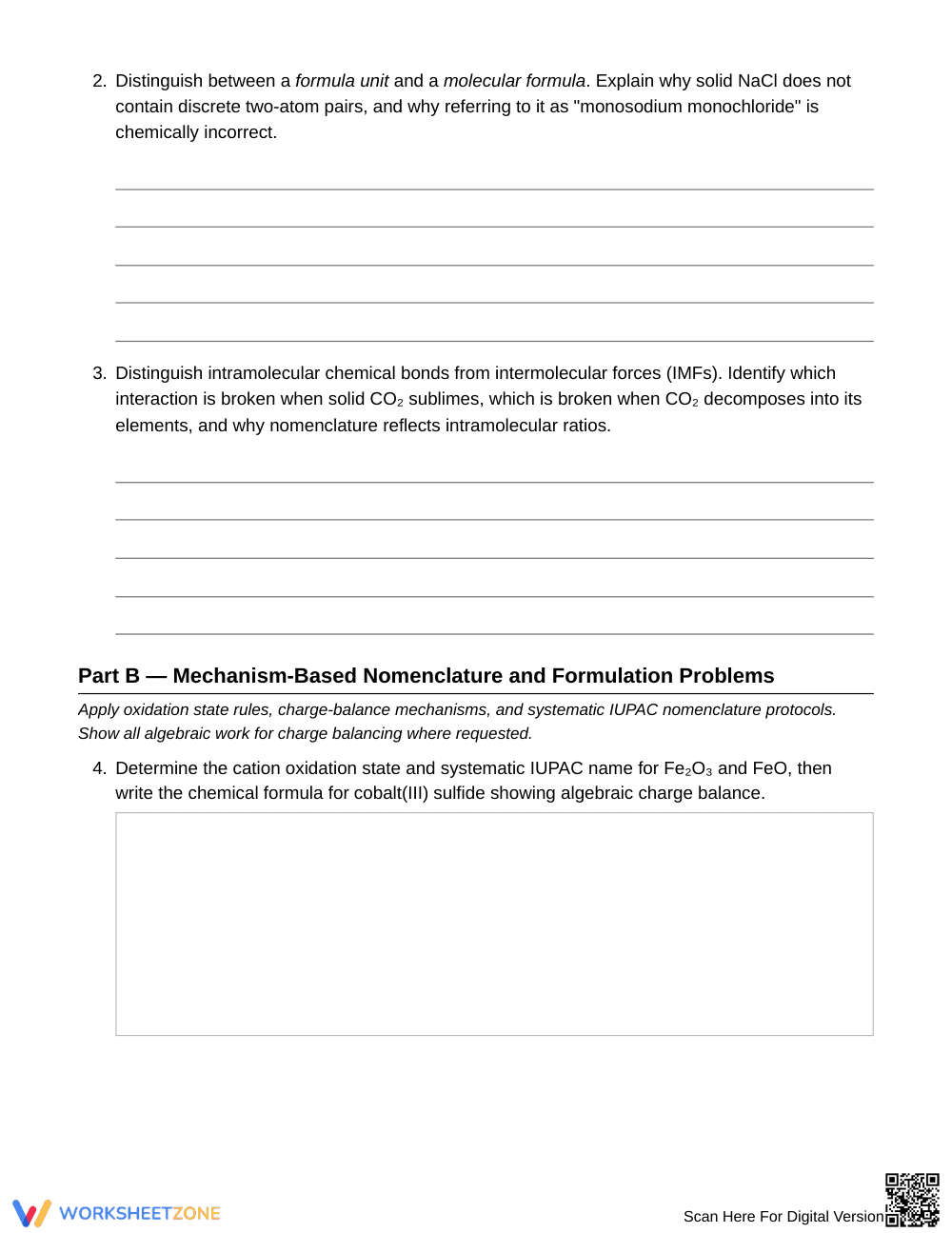
- Guided practice (Part A, 3 tasks): Students review conceptual rules and explain foundational differences between Stock system Roman numerals, molecular Greek prefixes, formula units, and intermolecular forces.
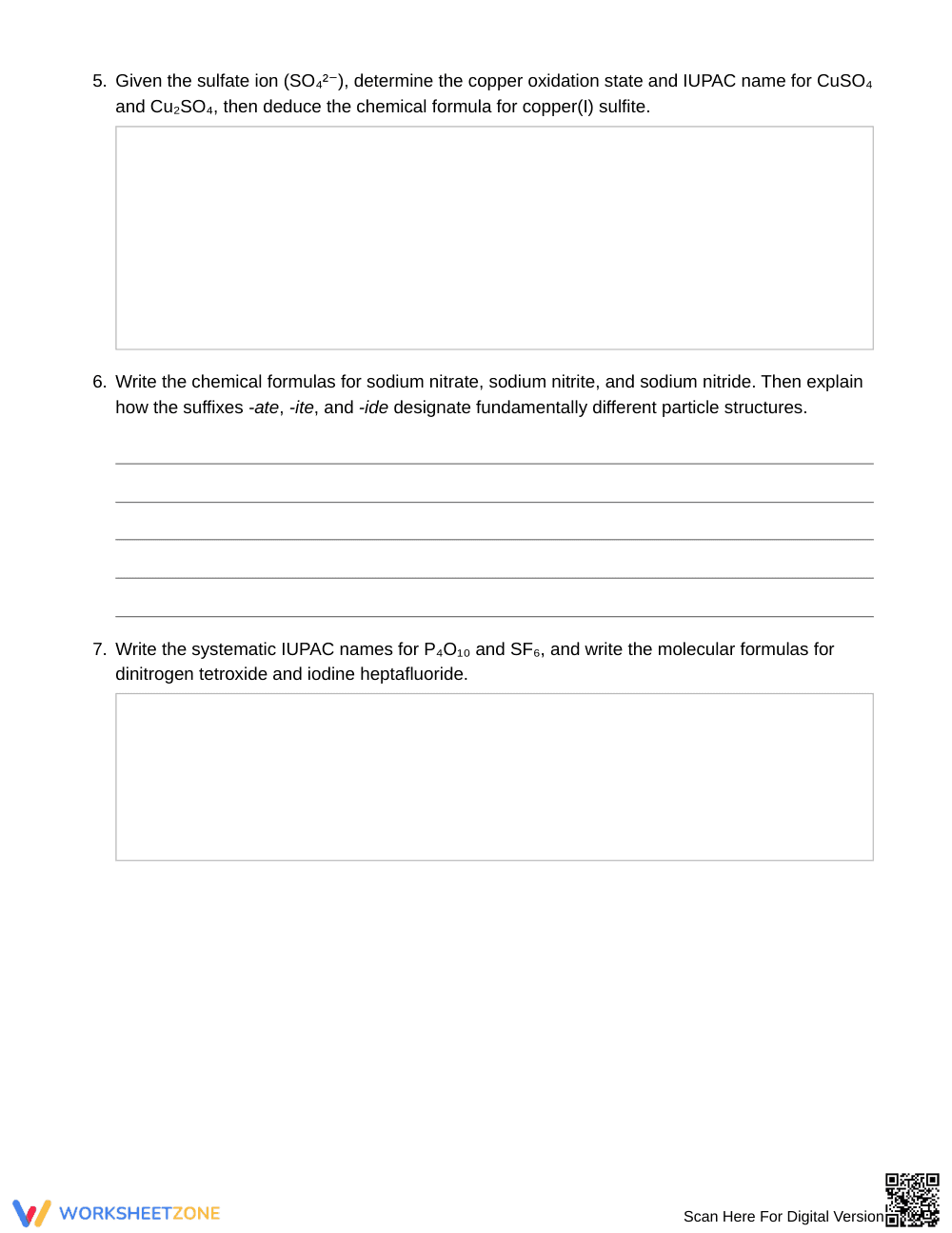
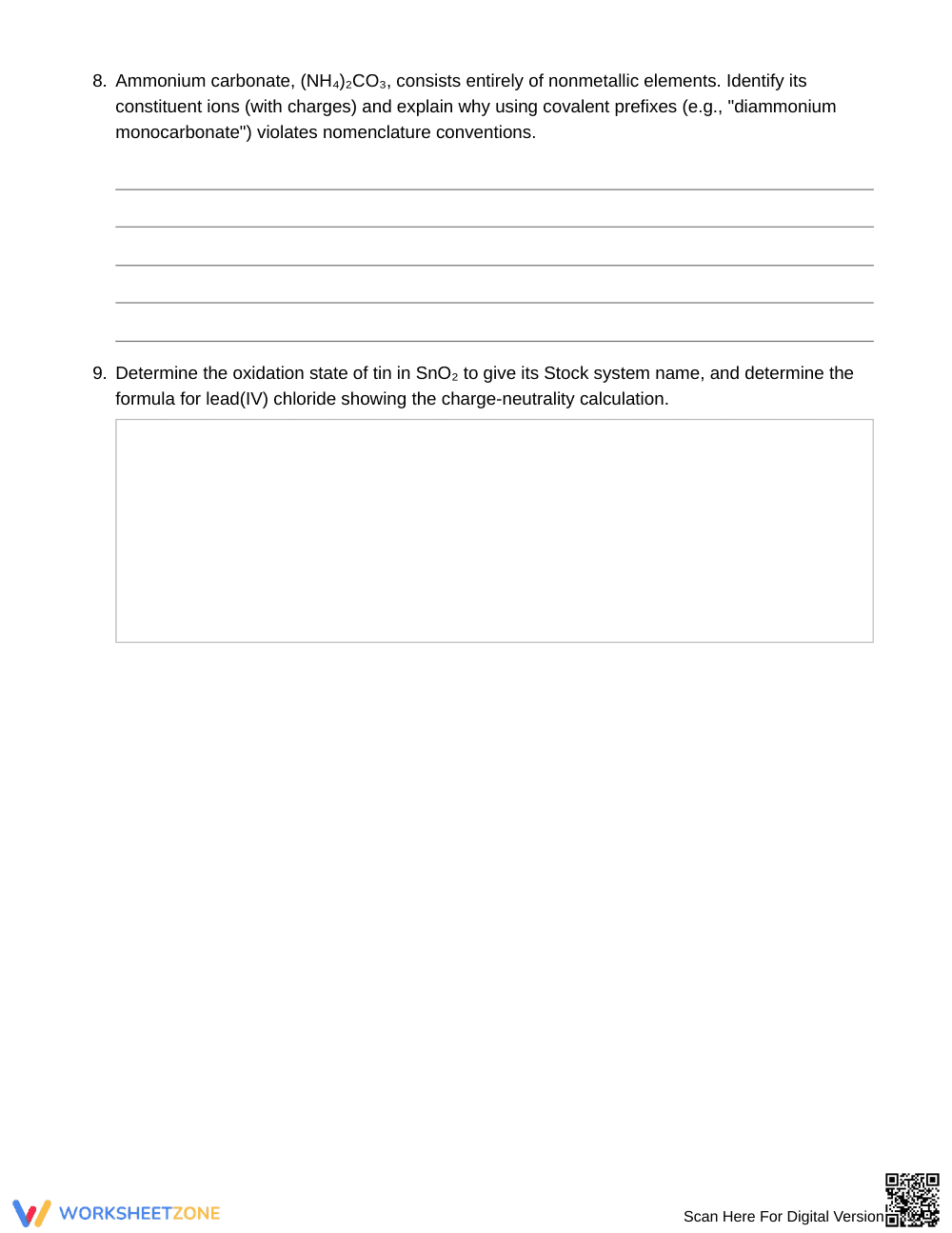
- Supported practice (Part B, 6 tasks): Learners apply systematic IUPAC protocols to determine transition metal oxidation states, construct charge-balanced formulas for polyatomic and binary compounds, and translate names to molecular formulas.
- Independent practice (Part C, 3 tasks): Students evaluate synthetic spectroscopy data to deduce unknown transition metal salts, contrast physical properties like melting points, and identify student misconceptions.
This sequence embodies the gradual release of responsibility model, guiding high school learners from foundational nomenclature concepts toward unassisted chemical reasoning.
Curriculum and Standards Alignment
This worksheet aligns with high school chemistry standards governing chemical bonding, matter interactions, and IUPAC nomenclature. Students construct formulas and systematically name binary ionic lattices, variable-charge transition metal compounds, polyatomic salts, and binary molecular substances. Teachers can incorporate these learning objectives directly into district curriculum maps, lesson plans, and chemistry unit syllabi.
How to Use It
Deploy this worksheet after direct instruction on ionic lattice energy, polyatomic ions, and covalent bonding models. During class, circulate while students complete Part B to check whether they correctly calculate variable cation charges rather than assuming Roman numerals reflect subscript values. For an optimal 45 to 60 minute session, assign Parts A and B for collaborative partner work and reserve Part C for summative individual assessment.
Who It's For
This resource supports on-level, honors, and AP Chemistry students mastering chemical formula translation. Visual scaffolds and reference tables assist developing learners, while analytical anomaly tasks challenge advanced thinkers. Pair this worksheet with a physical periodic table and an interactive polyatomic ion nomenclature chart for maximum instructional impact.
Systematic chemical nomenclature requires high school learners to connect macroscopic chemical names with microscopic bonding models and symbolic formulas. According to Fisher & Frey (2014), structured instructional practice that shifts systematically from conceptual framework analysis to independent mechanistic problem-solving significantly strengthens student retention and conceptual transfer in secondary science classrooms. This 12-problem chemistry worksheet develops precision in IUPAC naming conventions by requiring students to distinguish ionic formula units from discrete covalent molecules, compute variable transition metal oxidation states, and identify structural errors in student-generated chemical formulas. By integrating explicit structural reference guides with rigorous scaffolded application tasks across 5 comprehensive pages, learners cultivate durable scientific literacy, analytical precision, and representational competence. Chemistry educators can directly utilize these 12 multi-part tasks to evaluate foundational bonding comprehension and prepare students for advanced stoichiometry and chemical reaction units.


