































Essential Mythical Motifs Word Search | Grades 7–8 ELA

Paste this activity's link or code into your existing LMS (Google Classroom, Canvas, Teams, Schoology, Moodle, etc.).
Students can open and work on the activity right away, with no student login required.
You'll still be able to track student progress and results from your teacher account.
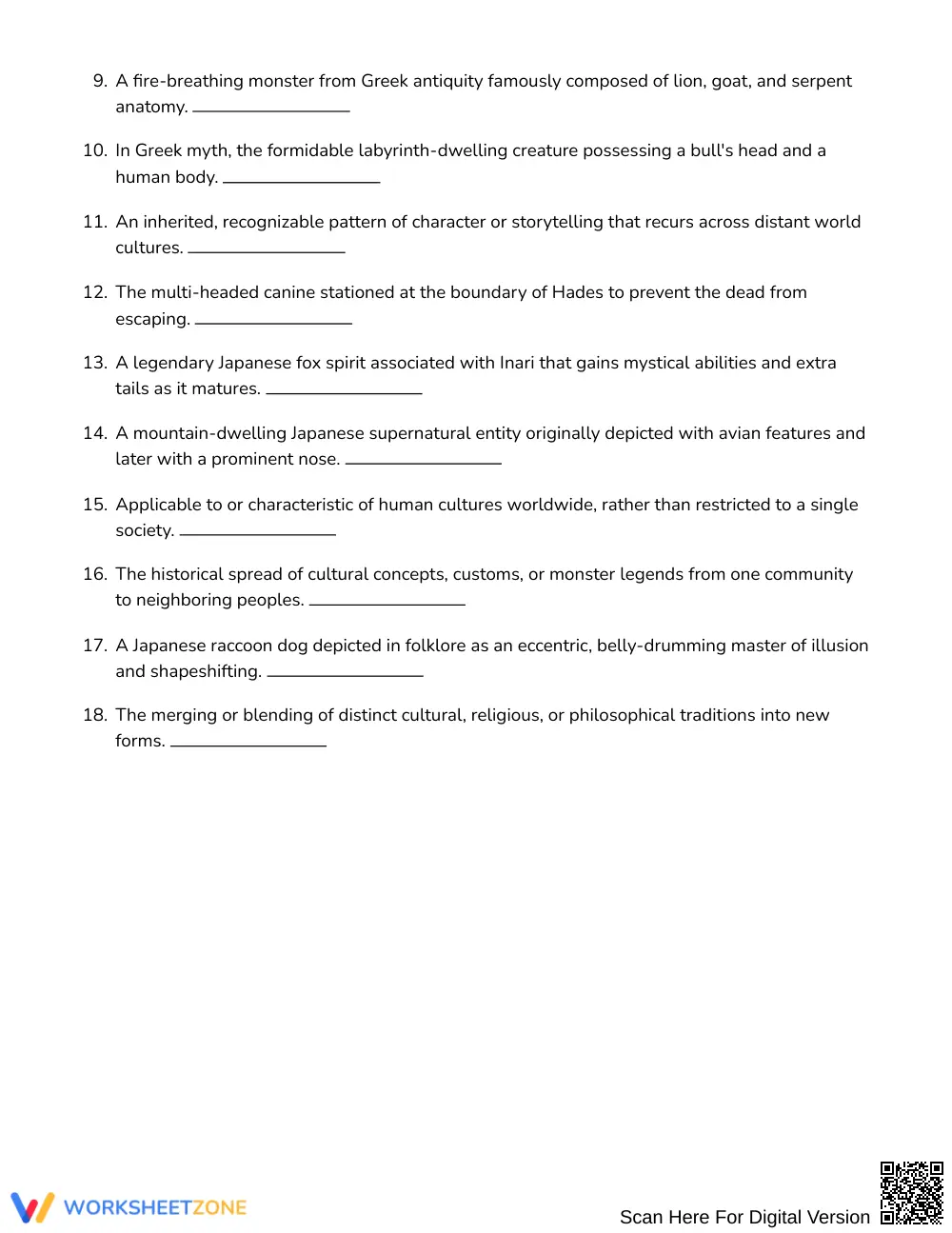
This Grades 7–8 English Language Arts word search strengthens vocabulary retention by prompting learners to compare cross-cultural narrative motifs without conflating distinct folklore traditions. Students analyze rigorous definitions to identify critical analytical terms and legendary creatures before finding each hidden word in the grid, reinforcing comparative reading skills.
At a Glance
- Grade: Grades 7–8 · Subject: English Language Arts
- Standard: Not standards-assessed — vocabulary enrichment
- Skill Focus: Comparing cultural motifs without merging traditions
- Format: 3 pages · 18 words · Answer key included · PDF
- Best For: Cumulative unit review, literacy stations, or sub plans
- Time: 25–35 minutes of independent or partner puzzle solving
What's Inside
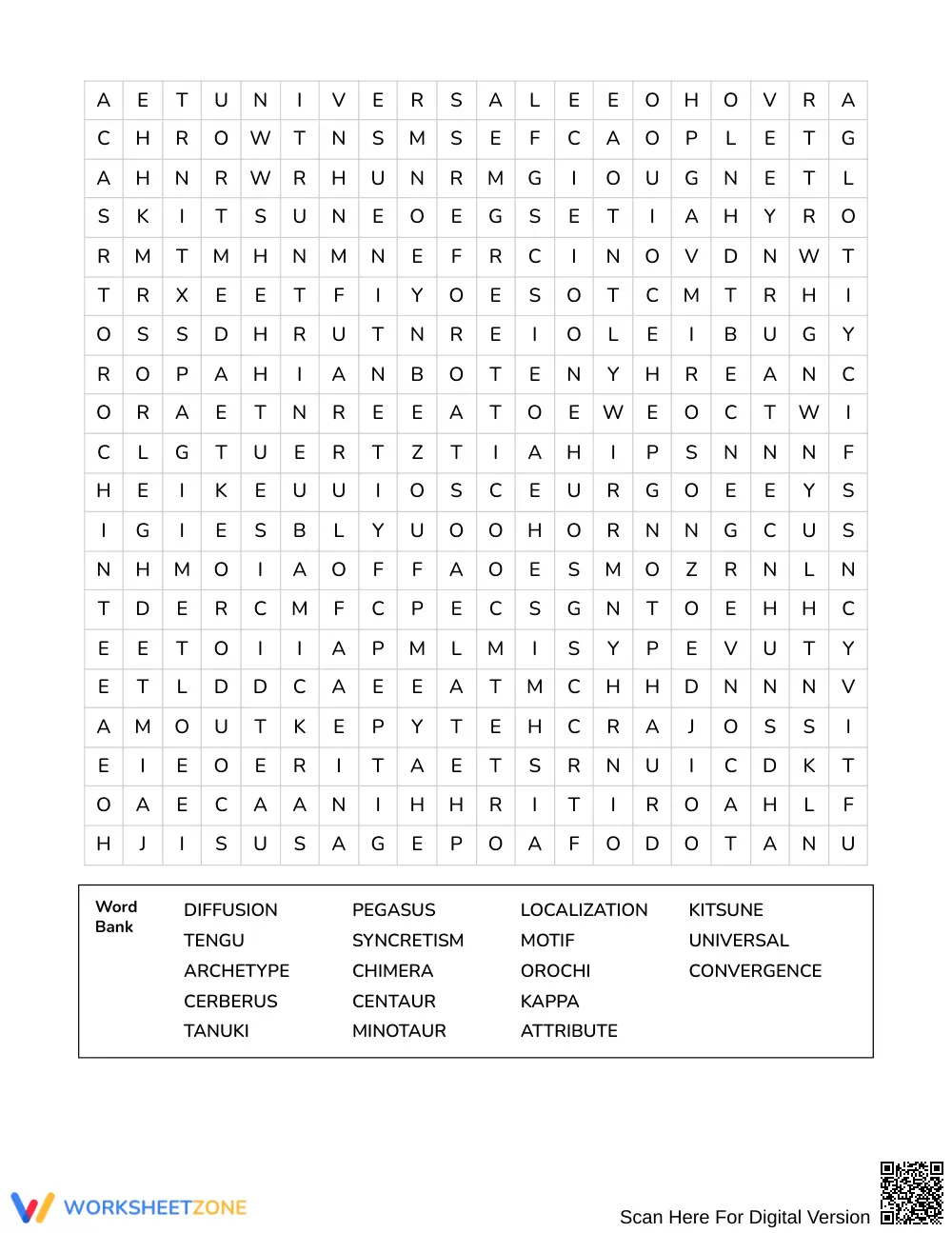
The 3-page printable activity features 18 clues paired with a shuffled word bank and a dense puzzle grid. Rather than simply scanning for letter sequences, students read academic definitions for folklore concepts and mythological entities from Greek and Japanese lore. A 4-page answer key provides complete grid solutions with every term highlighted.
How the Puzzle Works
This puzzle challenges students across a substantial 20 x 20 letter grid. Words run in all 8 possible directions: north, northeast, east, southeast, south, southwest, west, and northwest. Students read each clue to determine the correct concept—such as diffusion, archetype, or syncretism—or creature, then locate the term in the shuffled bank before circling it within the grid.
Standards Alignment
This activity serves strictly as vocabulary enrichment and is not aligned to a specific Common Core State Standards code. It functions as a targeted cross-disciplinary review tool designed to build academic literacy in world literature and cultural anthropology, encouraging middle school readers to analyze recurring folklore elements accurately.
How to Use It
Deploy this word search after direct instruction during a comparative mythology or world folklore unit to consolidate specialized terminology. Alternatively, use it as a mid-unit review station where student pairs collaborate to solve clues before searching the grid. During the activity, circulate and observe whether students rely on the definitions to deduce terms or search letters randomly; students struggling to match clues like localization or syncretism may need targeted concept review. The full puzzle requires approximately 25 to 35 minutes to complete.
Who It's For
This activity is designed for Grades 7–8 students engaged in reading units on world mythology, folklore, or narrative archetypes. For differentiation, provide developing readers with highlighters to match clue keywords with the shuffled word bank, while advanced students can explain cultural contrasts between paired entities like the Minotaur and Orochi. It pairs naturally with a comparative reading passage on Greek and Japanese legendary beasts or an anchor chart tracking cross-cultural storytelling motifs.
Designed for Grades 7–8 ELA, this 3-page word search serves as targeted vocabulary enrichment rather than a standards-assessed test instrument, prioritizing conceptual precision in comparative mythology. By asking learners to distinguish narrative motifs across Greek and Japanese traditions without conflating separate cultural frameworks, the resource reinforces critical reading comprehension and domain-specific terminology. According to Fisher & Frey (2014), intentional vocabulary acquisition requires students to encounter academic terms within meaningful contexts and engage in deliberate retrieval practice to solidify long-term semantic memory. Working through 18 definitional clues across an 8-directional 20 x 20 puzzle grid compels students to actively retrieve abstract analytical concepts—such as diffusion, convergence, and syncretism—alongside concrete legendary figures. This structured vocabulary reinforcement bridges introductory myth study and advanced literary analysis, ensuring that middle school readers retain precise cultural vocabulary necessary for rigorous cross-textual comparison.


