































Essential Momentum vs Energy Worksheet | Grade 12 Physics

Paste this activity's link or code into your existing LMS (Google Classroom, Canvas, Teams, Schoology, Moodle, etc.).
Students can open and work on the activity right away, with no student login required.
You'll still be able to track student progress and results from your teacher account.
This Grade 12 physics resource targets common misconceptions in collision mechanics, training students to evaluate flawed claims and correctly apply momentum and energy conservation laws. Students analyze realistic collision scenarios, calculate impulse from force-time graphs, and perform multi-step corrections across 8 rigorous diagnostic problems.
At a Glance
- Grade: 12 · Subject: Physics
- Standard:
Mechanics — Collisions— Distinguish vector momentum conservation from scalar mechanical energy dissipation in interactions- Skill Focus: Momentum vs. energy conservation error diagnosis
- Format: 5 pages · 8 problems · Answer key included · PDF
- Best For: AP Physics review, misconception remediation, and exam prep
- Time: 45–60 minutes
What's Inside
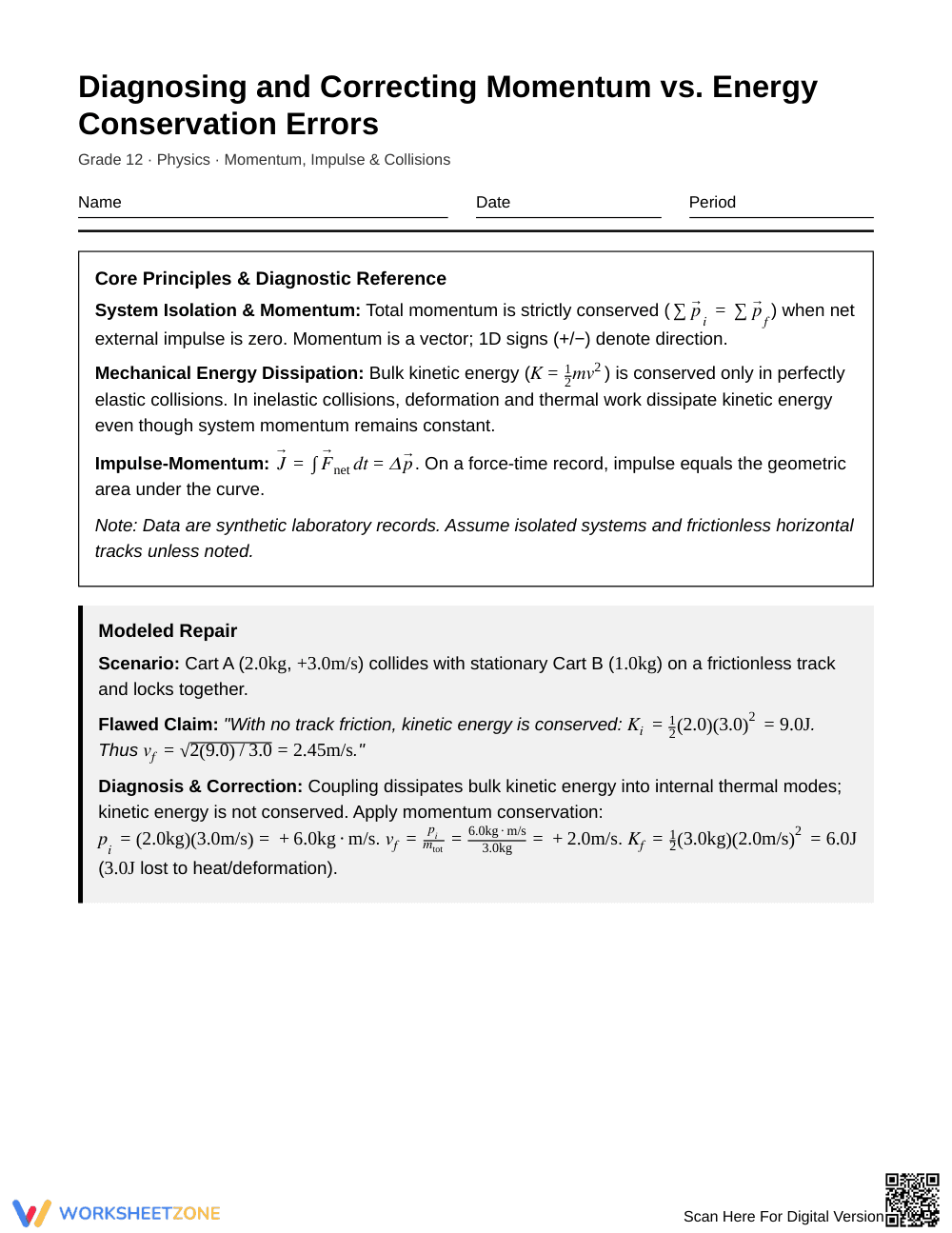
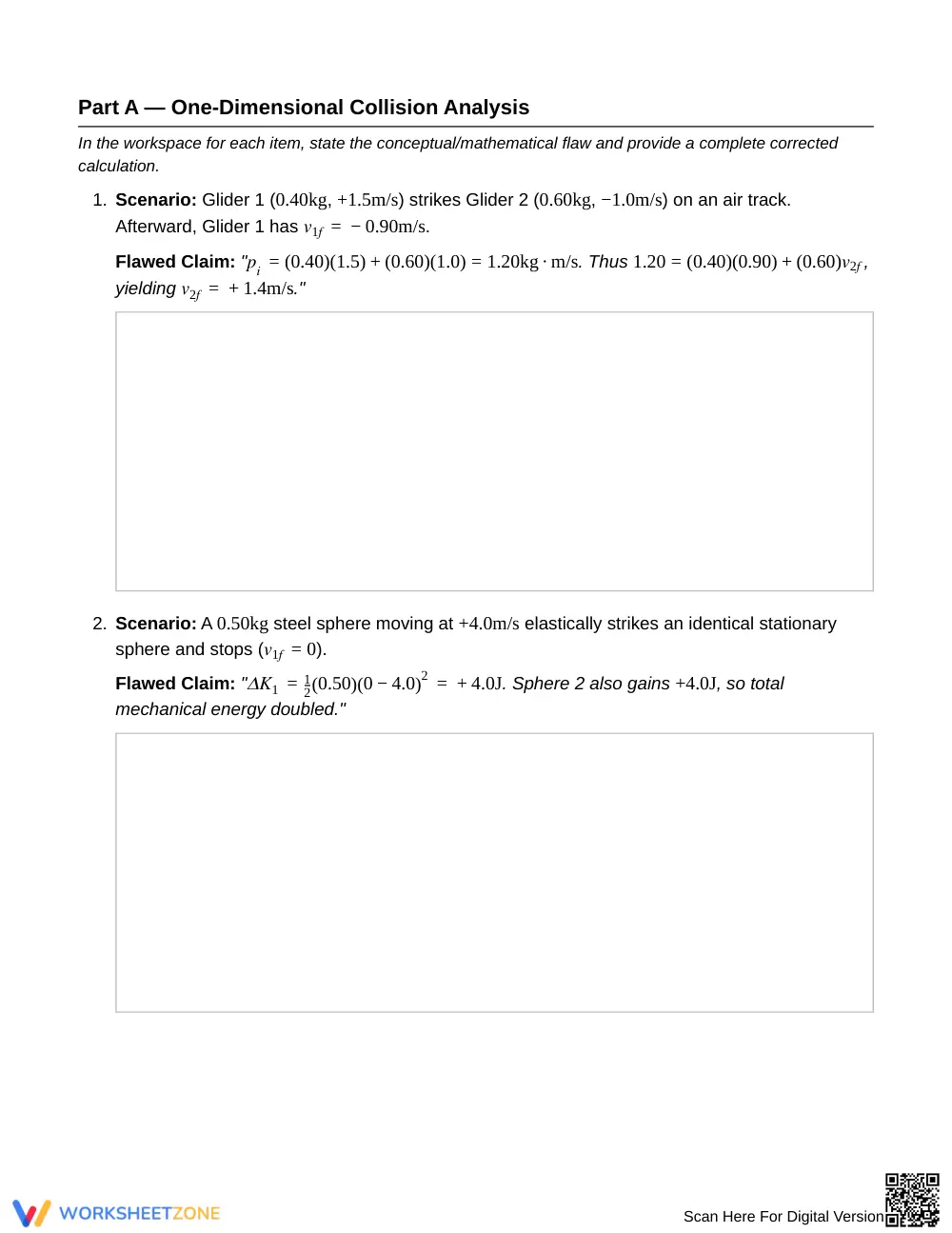
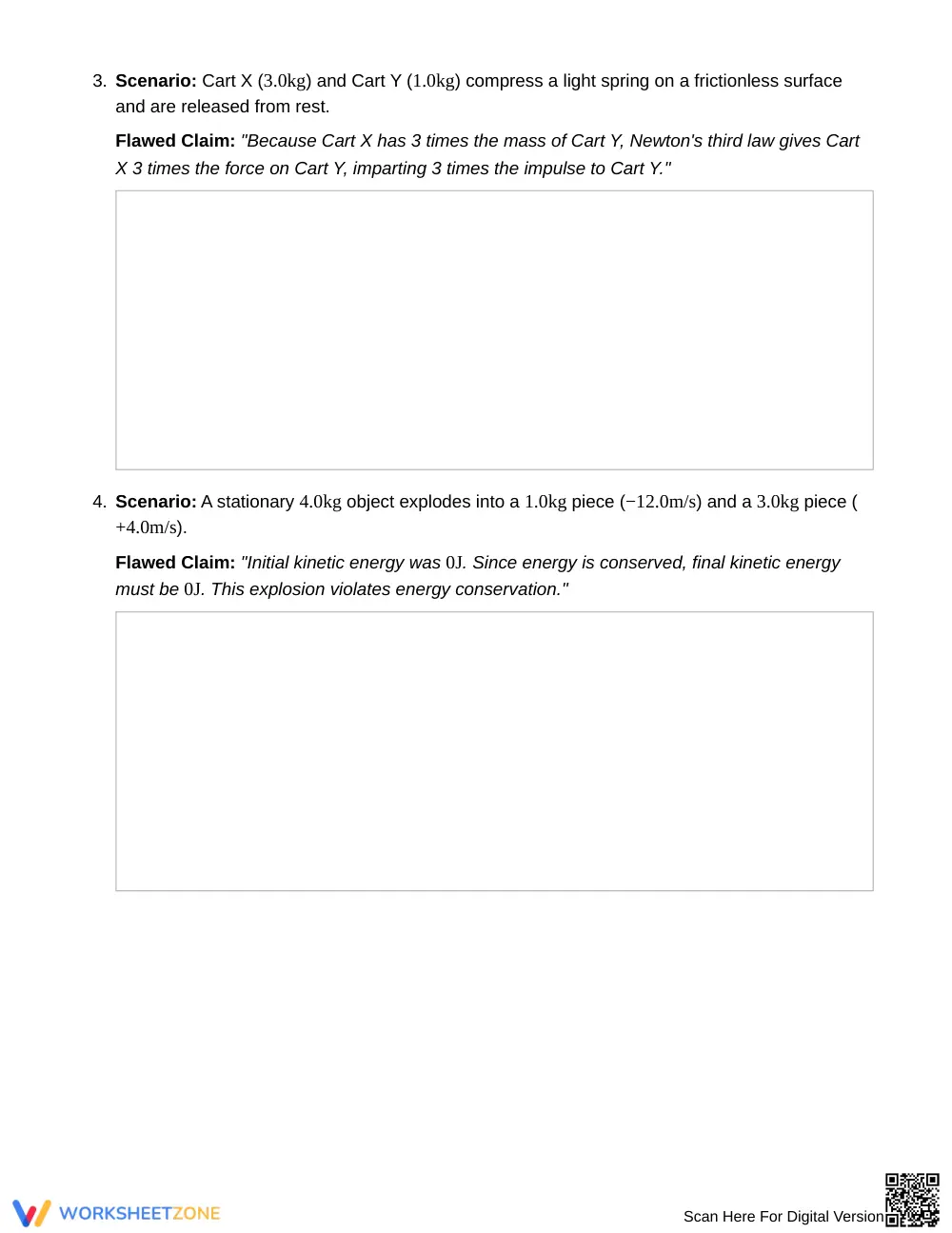
The 5-page printable includes a reference summary of core diagnostic principles, a fully worked error-repair model, and 8 structured student tasks divided into two distinct analytical sections. Part A covers 1D collision calculations and explosive separation, while Part B addresses impulse-momentum relations, sign conventions, and variable-force records. A complete 2-page step-by-step answer key is provided.
Skill Progression
- Guided Practice: A complete modeled repair illustrates how to isolate flawed assumptions, compute true system momentum, and calculate thermal kinetic energy loss.
- Supported Practice: Four Part A scenarios require students to identify sign errors, spring recoil relations, and kinetic energy gains across elastic and inelastic collisions (Problems 1–4).
- Independent Practice: Four Part B scenarios challenge students to analyze force-time areas, directional impulse vectors, and rocket propulsion mechanics without external scaffolding (Problems 5–8).
This structure follows a gradual-release model that equips high school seniors to audit complex physics solutions independently.
Standards Alignment
This activity aligns with high school advanced mechanics standards governing linear momentum, external impulse, and mechanical energy transformations in closed systems. Students verify that total momentum remains strictly conserved in isolated interactions while kinetic energy dissipates during inelastic collisions. Both standard codes and core learning objectives can be copied directly into lesson plans, IEP goals, or district curriculum mapping tools.
How to Use It
Deploy this worksheet after direct instruction on the impulse-momentum theorem and elastic collisions. For formative assessment, examine student work on Problem 6 to verify whether learners treat momentum as a signed vector rather than a scalar speed. The complete set requires 45 to 60 minutes of active analytical work during class or as focused homework.
Who It's For
Designed for Grade 12 AP Physics and advanced mechanics students who need targeted remediation on collision theory. Pair this resource with laboratory cart collision data or force sensor graphs to reinforce analytical skills.
According to Fisher & Frey (2014), explicit error analysis and guided modeling accelerate conceptual mastery by requiring learners to articulate the physical boundary conditions of mathematical formulas. This Grade 12 mechanics worksheet targets the distinction between vector momentum conservation and scalar kinetic energy dissipation across 8 multi-step diagnostic problems. By actively refuting flawed calculations—such as treating inelastic collision energy as conserved or misinterpreting force-time impulse areas—students build robust conceptual frameworks essential for advanced scientific problem-solving. Structured workspaces and a complete 2-page answer key support rigorous independent practice and reliable formative evaluation.


