





























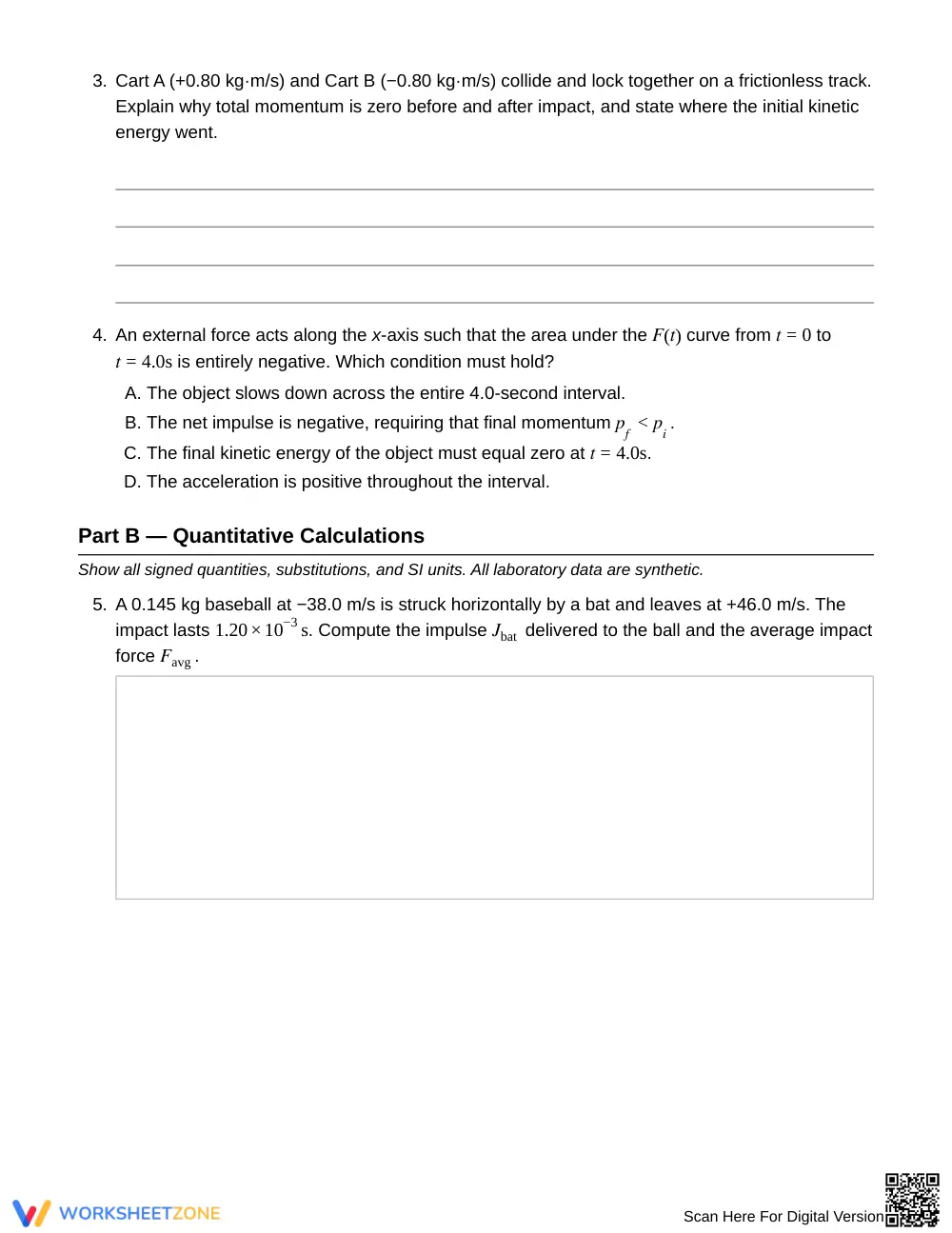
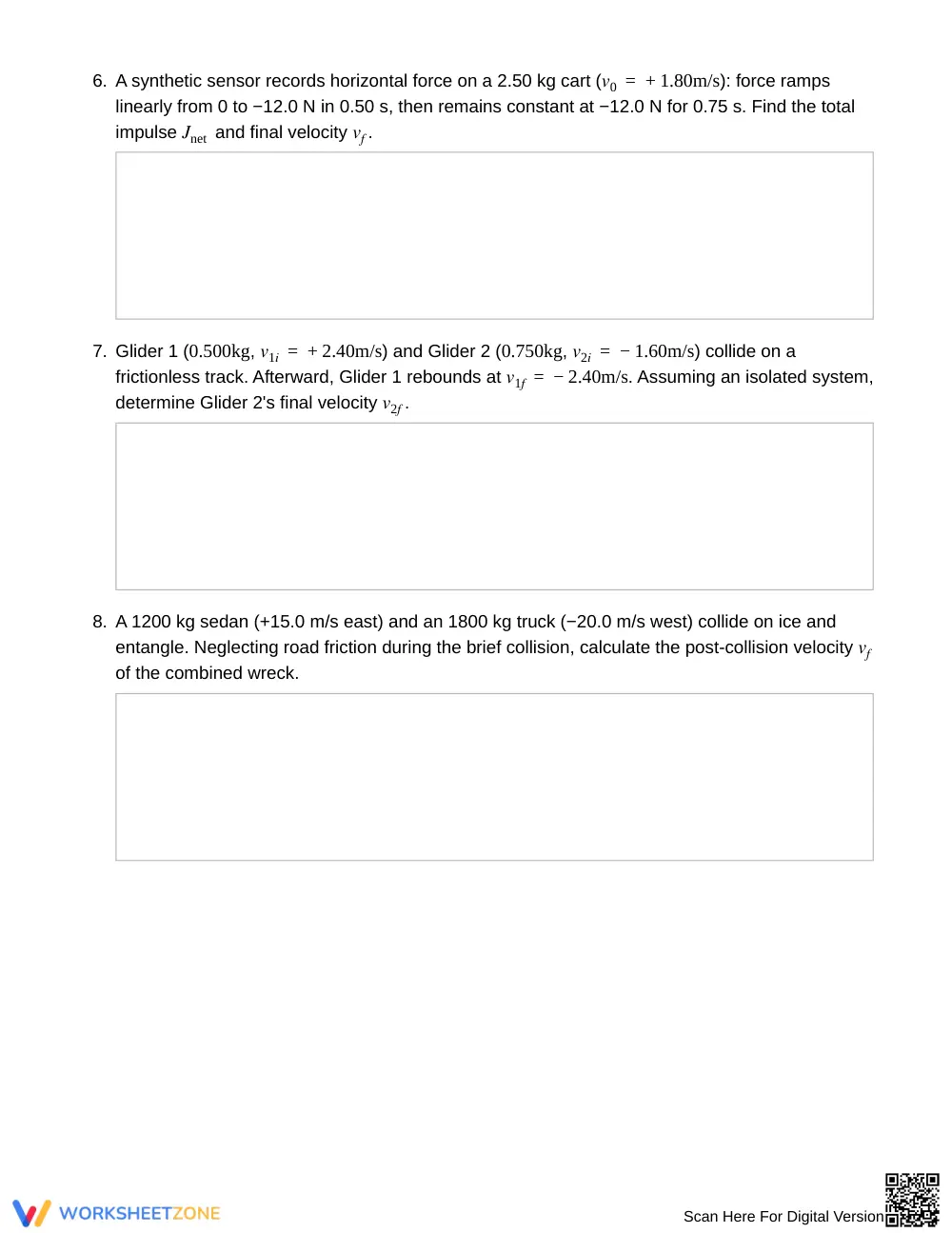


Essential Momentum & Impulse Worksheet | Grade 12 Physics

Paste this activity's link or code into your existing LMS (Google Classroom, Canvas, Teams, Schoology, Moodle, etc.).
Students can open and work on the activity right away, with no student login required.
You'll still be able to track student progress and results from your teacher account.
This Grade 12 physics worksheet helps advanced students master linear momentum, impulse, and collisions using signed vector conventions. Across 12 multi-step problems, learners distinguish vector momentum from kinetic energy, analyze force-time functions, calculate collision outcomes, and critique non-physical claims using conservation laws.
At a Glance
- Grade: 12 · Subject: Physics
- Standard: Momentum Mechanics — Apply signed impulse and momentum conservation principles to one-dimensional collisions
- Skill Focus: Momentum and Impulse as Signed Quantities
- Format: 5 pages · 12 problems · Answer key included · PDF
- Best For: AP and Honors physics mechanics practice
- Time: 45–60 minutes
This 5-page resource provides 12 rigorous items in three sections, supported by a 3-page complete answer key. Students solve conceptual questions, graphical force integrals, 1D collision calculations, and claim-critique prompts. A reference header defines coordinate sign conventions, linear momentum, impulse integrals, and kinetic energy relationships.
Skill Progression
- Guided Practice (Part A, 4 items): Identifies sign errors, contrasts momentum with kinetic energy, and interprets directional impulse from force graphs.
- Supported Practice (Part B, 6 items): Solves quantitative problems involving baseball impacts, piecewise force functions, inelastic collisions, and vertical impulse with gravity.
- Independent Practice (Part C, 2 items): Evaluates flawed claims using conservation laws and Newton's third law.
This sequence follows a gradual-release model, moving from qualitative sign conventions to multi-step proofs.
Standards Alignment
This worksheet aligns with high school physics standards for linear momentum and impulse mechanics. Students determine momentum changes, relate net impulse to external forces, and evaluate kinetic energy conservation in collisions. Supporting standards address Newton's third law action-reaction pairs during collisions. Both standard codes can be copied directly into lesson plans, IEP goals, or district curriculum mapping tools.
How to Use It
Use this worksheet after direct instruction on the impulse-momentum theorem. Assign Part A for a mid-lesson check on coordinate conventions, followed by Parts B and C for independent or partner practice. Formatively check whether students maintain negative signs on rebound velocities. Completion takes 45 to 60 minutes.
Who It's For
Designed for Grade 12 AP Physics and Honors Physics students mastering 1D vector mechanics. Advanced students engage with the conservation proofs in Part C, while formula references scaffold quantitative steps. Pair this resource with dynamic collision cart labs or force sensor data activities.
Mastering momentum and impulse as signed vector quantities requires students to coordinate algebraic signs with spatial directions, calculate impulse from time-dependent forces, and evaluate kinetic energy conservation in isolated collisions. According to instructional frameworks in Fisher & Frey (2014), structured problem sets that move systematically from conceptual error analysis to quantitative modeling and evidentiary critique significantly enhance student transfer in upper-level STEM disciplines. This Grade 12 physics worksheet provides rigorous practice with 12 structured tasks spanning qualitative sign verification, piecewise force integration, vertical cushion dynamics, and collision impossibility proofs. By requiring explicit direction-sign designations and kinetic energy calculations, the material directly targets common physics misconceptions where students treat vector momentum as a scalar magnitude. The accompanying 3-page step-by-step answer key supports targeted feedback, making this resource an effective tool for AP and advanced mechanics preparation.


