




























Views
Downloads



Essential Meniscus & Unit Errors Worksheet | Grade 8 Science

Paste this activity's link or code into your existing LMS (Google Classroom, Canvas, Teams, Schoology, Moodle, etc.).
Students can open and work on the activity right away, with no student login required.
You'll still be able to track student progress and results from your teacher account.
Master physical measurement precision and liquid density calculations with targeted laboratory error analysis. This comprehensive five-page science resource guides eighth-grade students through identifying common laboratory pitfalls, including parallax distortion, inverted formulas, and volumetric displacement inaccuracies, ensuring rigorous procedural fluency across twelve focused analytical tasks.
At a Glance
- Grade: 8 · Subject: Physical Science
- Standard: Physical Properties — Measure volume, calculate density, and evaluate experimental measurement errors accurately
- Skill Focus: Correct Meniscus and Unit Errors
- Format: 5 pages · 12 problems · Answer key included · PDF
- Best For: Lab skill reinforcement and assessment
- Time: 40–50 minutes
What's Inside: Students begin with a structured reference sheet containing standard fluid and solid density reference tables alongside a fully modeled diagnostic repair example. The activity features eight flawed student lab scenarios requiring systematic error diagnosis, followed by four multi-step quantitative problems involving fluid column stratification, displacement with measurement uncertainty, and SI unit conversions.
Skill Progression
- Guided Practice: A complete diagnostic worked example demonstrates how to catch parallax viewing errors and formula inversions before calculating accurate liquid density.
- Supported Practice (Tasks 1–8): Eight structured lab scenarios challenge learners to isolate specific measurement mistakes, such as top-rim meniscus readings, uncalibrated tare weights, and improper unit conversions.
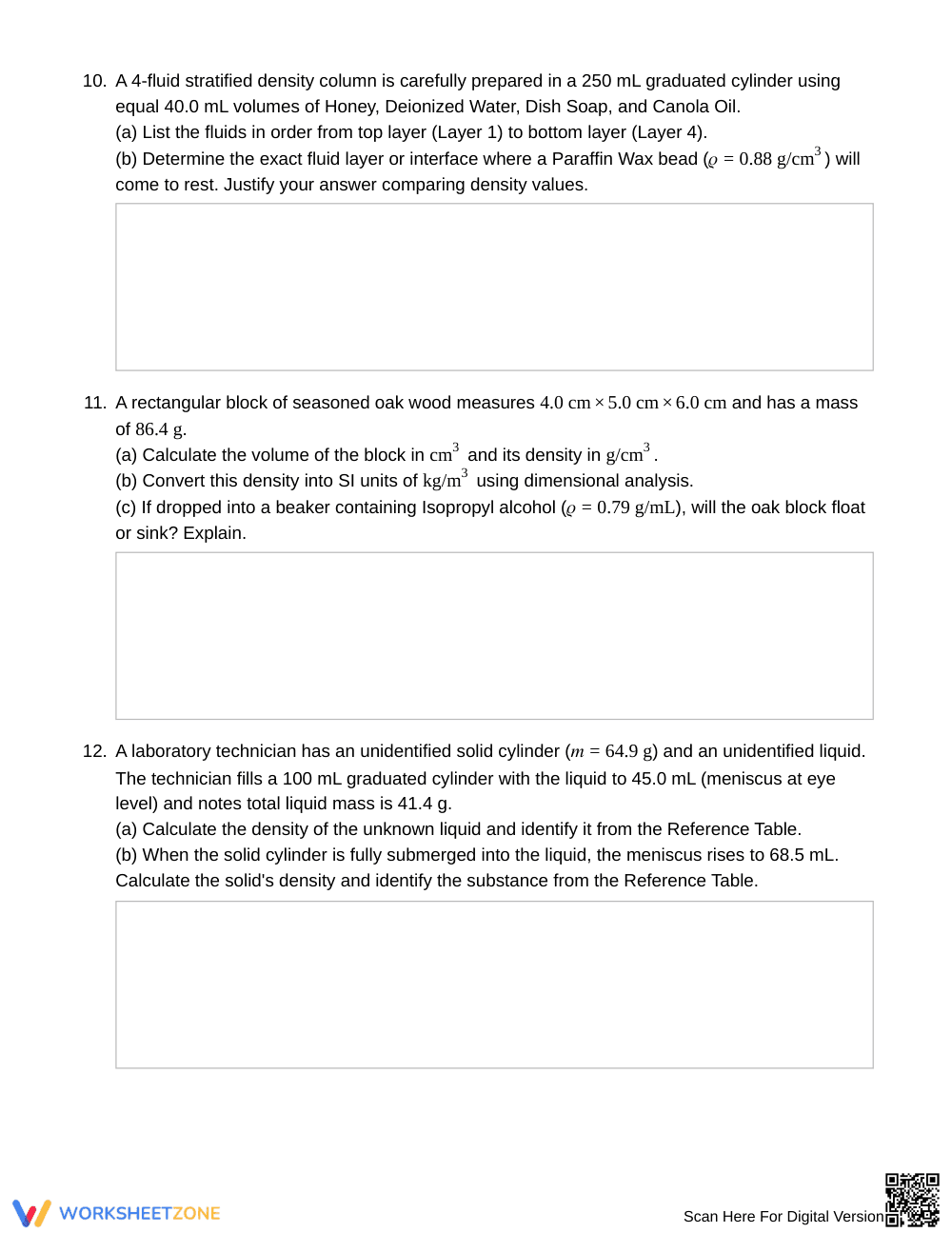
- Independent Practice (Tasks 9–12): Four comprehensive multi-step word problems require independent calculation of displaced volume, fluid column stratification ordering, and multi-variable substance identification.
This structured progression reflects the gradual release model, moving students from guided diagnostic reasoning to autonomous problem-solving.
Standards Alignment
This resource aligns with middle school physical science standards for characteristic properties of matter, volume displacement, and mathematical data analysis. Students apply quantitative formulas, convert metric units ($1\text{ g/cm}^3 = 1{,}000\text{ kg/m}^3$), and analyze how density governs multi-fluid layering. Both standard physical science objectives can be copied directly into lesson plans, IEP goals, or district curriculum mapping tools.
How to Use It
Deploy this worksheet after direct instruction on graduated cylinder measurement and density equations. Use Part A as a collaborative partner activity where students critique flawed reasoning, then assign Part B for independent evaluation. During the session, check whether students correctly distinguish mass from volume when setting up ratios. Expect completion within 40 to 50 minutes.
Who It's For
Designed for Grade 8 physical science and introductory chemistry classes, this activity supports general education students and emerging scientists needing structured calculation scaffolds. Pair this printable with a hands-on density column lab or graduated cylinder measurement demonstration for maximum conceptual impact.
According to Fisher & Frey (2014), explicit error analysis and structured problem-solving tasks significantly strengthen procedural accuracy and conceptual retention in adolescent science learners. This Grade 8 physical science resource equips students to diagnose flawed lab reports, interpret graduated cylinder meniscus curves correctly, and convert metric density units systematically across 12 rigorous tasks. By evaluating realistic lab scenarios—including parallax viewing errors, buoyant volume discrepancies, and tare mass omissions—learners build essential critical-thinking habits necessary for standard laboratory science curricula. Complete with a comprehensive three-page solution key and reference data table, this five-page instructional tool provides clear benchmarks for formative evaluation, lab preparation, and data interpretation across middle school physical science classrooms.


