































Essential Measurement Conversion Worksheet | Grade 4 Math

Paste this activity's link or code into your existing LMS (Google Classroom, Canvas, Teams, Schoology, Moodle, etc.).
Students can open and work on the activity right away, with no student login required.
You'll still be able to track student progress and results from your teacher account.
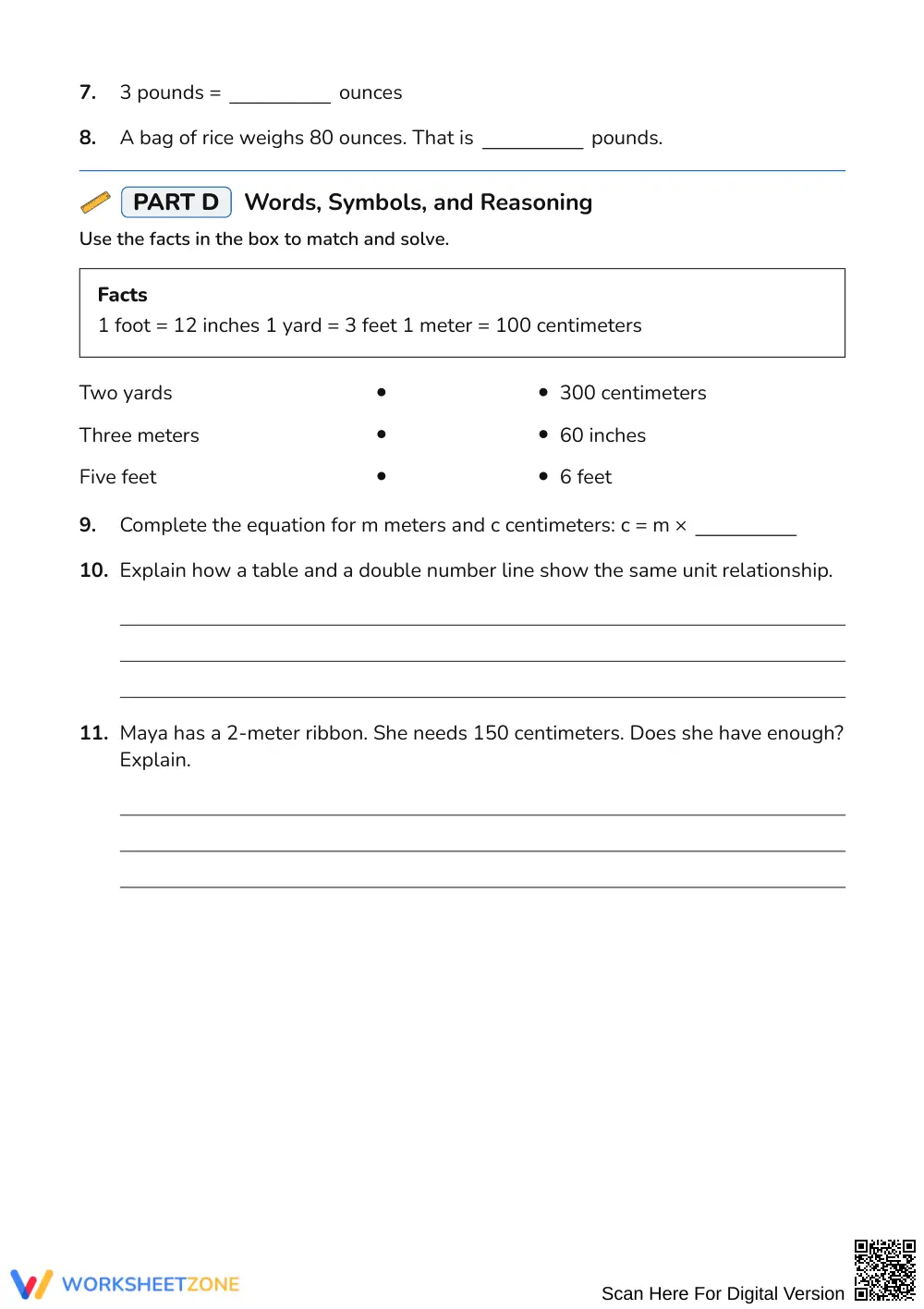
This 3-page Grade 4 math worksheet builds conceptual understanding and procedural fluency with measurement conversions across customary and metric systems. Students analyze conversion tables, double number lines, bar graphs, and written equations across 17 structured problems to recognize relative unit sizes and accurately convert larger measurement units into smaller equivalent units.
At a Glance
- Grade: 4 · Subject: Math
- Standard:
4.MD.A.1— Convert larger measurement units into smaller equivalent units within a single system- Skill Focus: Measurement Conversion: Multiple Representations
- Format: 3 pages · 17 problems · Answer key included · PDF
- Best For: Small group intervention and independent skills practice
- Time: 30–45 minutes
What's Inside
This 3-page printable resource delivers 17 structured math problems organized across four progressive parts. Students examine customary length tables converting feet to inches, double number lines linking gallons and quarts, and bar graphs representing pounds and ounces. The worksheet also features a reference facts box, algebraic conversion equations, and a comprehensive 3-page answer key.
Skill Progression
- Guided practice (Tasks 1–5): Students examine completed conversion tables, identify multiplicative rules, and analyze common additive errors through structured prompts.
- Supported practice (Tasks 6–10): Learners interpret visual double number lines and bar graphs with moderate scaffolding to determine equivalent capacity and weight values.
- Independent practice (Tasks 11–17): Students work independently to match measurement equivalents, generate algebraic equations, and solve real-world word problems without visual aids.
This progression mirrors the gradual-release framework, guiding students smoothly from supported visual exploration to independent mathematical reasoning.
Standards Alignment
This worksheet aligns directly to `4.MD.A.1`: Know relative sizes of measurement units within one system of units, including km, m, cm; kg, g; lb, oz.; l, ml; hr, min, sec; and record measurement equivalents in a two-column table. In addition, supporting standard `4.OA.A.2` reinforces multiplicative comparisons during unit conversions. Both standard codes can be copied directly into lesson plans, IEP goals, or district curriculum mapping tools.
How to Use It
Incorporate this worksheet immediately following direct instruction on relative unit sizes as paired partner practice or an independent mastery check. During work time, formatively assess whether students apply multiplicative scaling or mistakenly add conversion factors when completing conversion equations. The activity requires approximately 30 to 45 minutes of total instructional time.
Who It's For
This resource targets fourth-grade students developing proportional reasoning skills, fifth-grade math intervention groups reviewing foundational unit relationships, and multilingual learners supported by visual dual-scale representations. Pair this worksheet directly with a classroom measurement anchor chart or physical balance scales to reinforce concrete mathematical understanding.
According to Fisher & Frey (2014), the gradual release of responsibility model systematically fosters student autonomy through intentional shifts from teacher modeling to collaborative visual analysis and autonomous execution. This Grade 4 mathematics resource directly aligns with standard 4.MD.A.1 by establishing foundational conceptual connections before requiring abstract computation. Fourth-grade students frequently confuse additive and multiplicative relationships when converting units of measurement. By presenting unit relationships through structured tables, double number lines, and bar charts, the worksheet provides concrete visual representations that reinforce proportional thinking. Students analyze the invariant ratio between units such as feet and inches or gallons and quarts, verifying that each larger unit comprises a fixed multiple of smaller units. Rigorous error analysis prompts further solidify conceptual mastery by requiring learners to diagnose and explain misconceptions, preparing them thoroughly for complex multi-step conversions and real-world measurement applications across upper elementary curricula.


