































Essential Measurement Conversion: One-Step Applications

Paste this activity's link or code into your existing LMS (Google Classroom, Canvas, Teams, Schoology, Moodle, etc.).
Students can open and work on the activity right away, with no student login required.
You'll still be able to track student progress and results from your teacher account.
This Grade 5 math worksheet builds fluency in one-step measurement conversions across customary and metric systems. Students practice selecting correct operations, reading visual representations, and solving contextual problems. Structured exercises guide learners to accurately convert units of length, weight, and capacity with confidence and computational accuracy.
At a Glance
- Grade: 5 · Subject: Math
- Standard:
5.MD.A.1— Convert standard measurement units within a single measurement system to solve problems- Skill Focus: One-Step Measurement Conversions
- Format: 2 pages · 17 problems · Answer key included · PDF
- Best For: Independent practice and skills reinforcement
- Time: 25–35 minutes
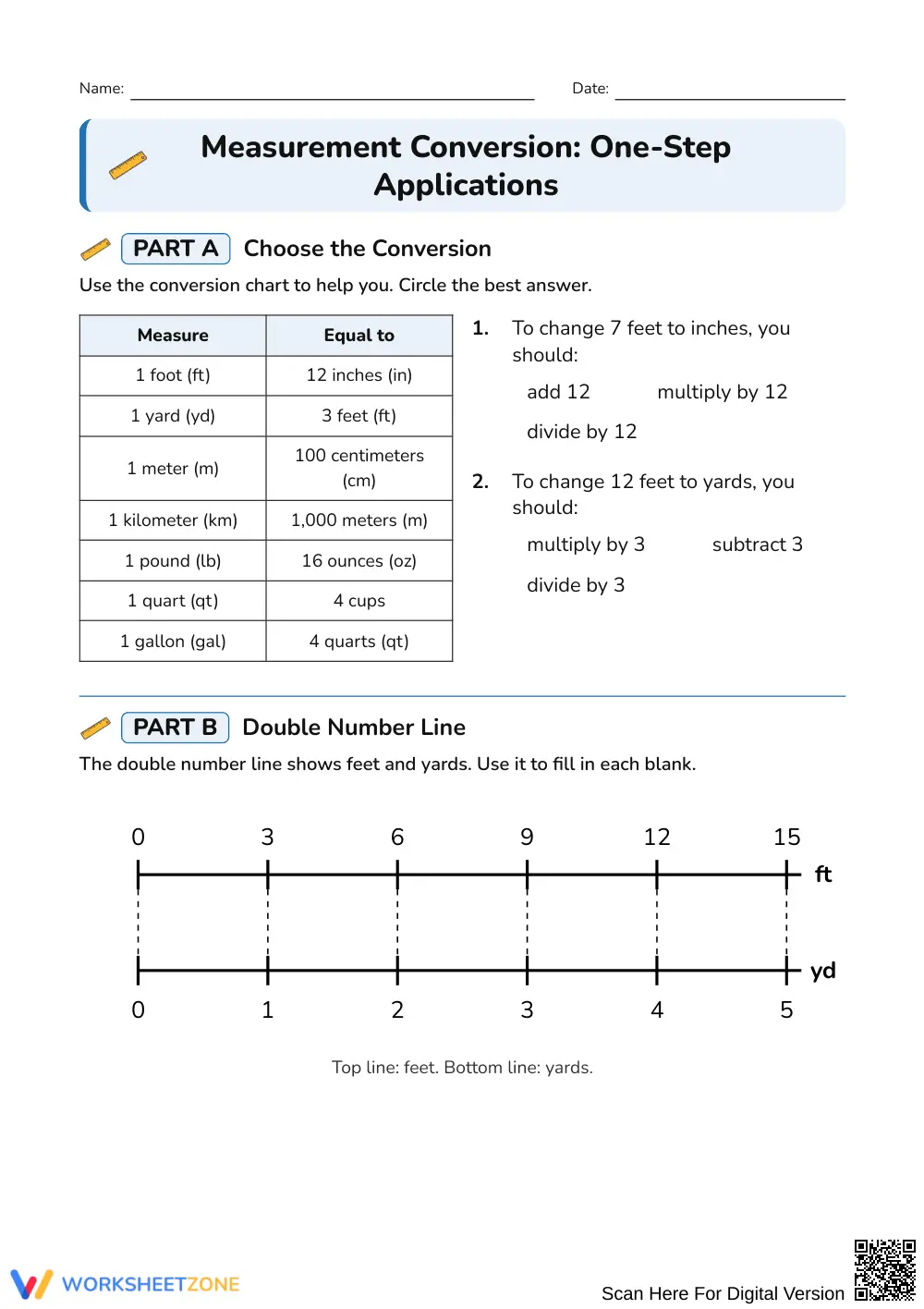
Across two structured pages, this resource delivers 17 targeted tasks accompanied by a clear reference conversion chart and visual scaffolding. Students encounter multiple-choice operation prompts, double number lines linking feet and yards, function tables specifying operations, and contextual word problems. The resource concludes with an error-analysis item and includes a complete two-page answer key showing step-by-step solutions.
- Guided practice: Initial problems provide a reference conversion chart and focused prompts where students identify whether to multiply or divide when changing between larger and smaller units.
- Supported practice: Intermediate tasks use visual double number lines and input-output conversion tables to reinforce proportional relationships across metric and customary values.
- Independent practice: Final contextual word problems and an error-analysis prompt require students to select operations and calculate converted values independently.
This structured progression follows the gradual-release model, transitioning students smoothly from conceptual orientation to independent procedural execution.
This worksheet aligns directly to primary standard `5.MD.A.1`: Convert among different-sized standard measurement units within a given measurement system, and use these conversions in solving real-world problems. It also reinforces foundational work under supporting standard `5.NBT.B.5` by applying multi-digit multiplication and division strategies to practical measurement contexts. Both standard codes can be copied directly into lesson plans, IEP goals, or district curriculum mapping tools.
Use this activity immediately after direct instruction on unit relationships as targeted independent practice, or deploy it during math workshop rotations to reinforce conceptual understanding. When circulating during classwork, observe whether students identify whether they are moving from a larger unit to a smaller unit before picking an operation. Typical completion time ranges between 25 and 35 minutes.
Designed primarily for fifth-grade general education classrooms, this resource supports tier-2 intervention groups, resource room instruction, and English learners needing concrete visual representations. Pair this printable worksheet with a classroom measurement anchor chart or hands-on manipulatives like rulers and balances for students requiring concrete tactile reinforcement.
According to research highlighted in Fisher & Frey (2014), structured instructional materials that scaffold problem-solving through visual modeling and explicit gradual release substantially accelerate student mastery in procedural mathematics. This worksheet directly supports standard 5.MD.A.1 by guiding Grade 5 learners through one-step measurement conversion applications across both customary and metric systems. By embedding double number lines, reference conversion tables, and targeted error-analysis tasks, the resource enables students to systematically connect mathematical operations with unit changes. Formative checkpoints embedded throughout the 17 problems allow educators to quickly diagnose whether student misconceptions stem from incorrect arithmetic operations or flawed proportional reasoning. The predictable format promotes student autonomy, making the two-page document an efficient, research-grounded asset for standard-aligned elementary mathematics curricula.


