


























Views
Downloads




Essential Limiting Cases Worksheet | Grade 12 Physics
Paste this activity's link or code into your existing LMS (Google Classroom, Canvas, Teams, Schoology, Moodle, etc.).
Students can open and work on the activity right away, with no student login required.
You'll still be able to track student progress and results from your teacher account.
This advanced kinematics worksheet equips Grade 12 physics students to defend analytical claims using limiting-case analysis and signed multi-stage motion models. Learners extract boundary conditions across acceleration stages, verify state continuity, and refute flawed conceptual arguments using rigorous calculus-based and algebraic reasoning across eight high-demand problems.
At a Glance
- Grade: 12 · Subject: Physics
- Standard: Advanced Physics Kinematics — Defend kinematic claims and equations using signed vectors and physical limiting cases
- Skill Focus: Defend a Kinematic Result with Limits
- Format: 4 pages · 8 problems · Answer key included · PDF
- Best For: AP or advanced physics problem-solving
- Time: 45–60 minutes
What's Inside
The four-page printable worksheet contains eight multi-part analytical problems divided into three structured sections: identifying evidence, constructing mechanisms, and refuting competing claims. It includes a reference framework for signed 1D motion equations, synthetic rocket sled scenario data, and a complete two-page step-by-step answer key showing all derivations and limit evaluations.
Skill Progression
- Guided Practice (Part A, Problems 1–2): Students extract signed parameters from scenario data to determine stage-boundary transition conditions ($x_1$, $v_1$) and solve quadratic coordinate crossings with explicit sign conventions.
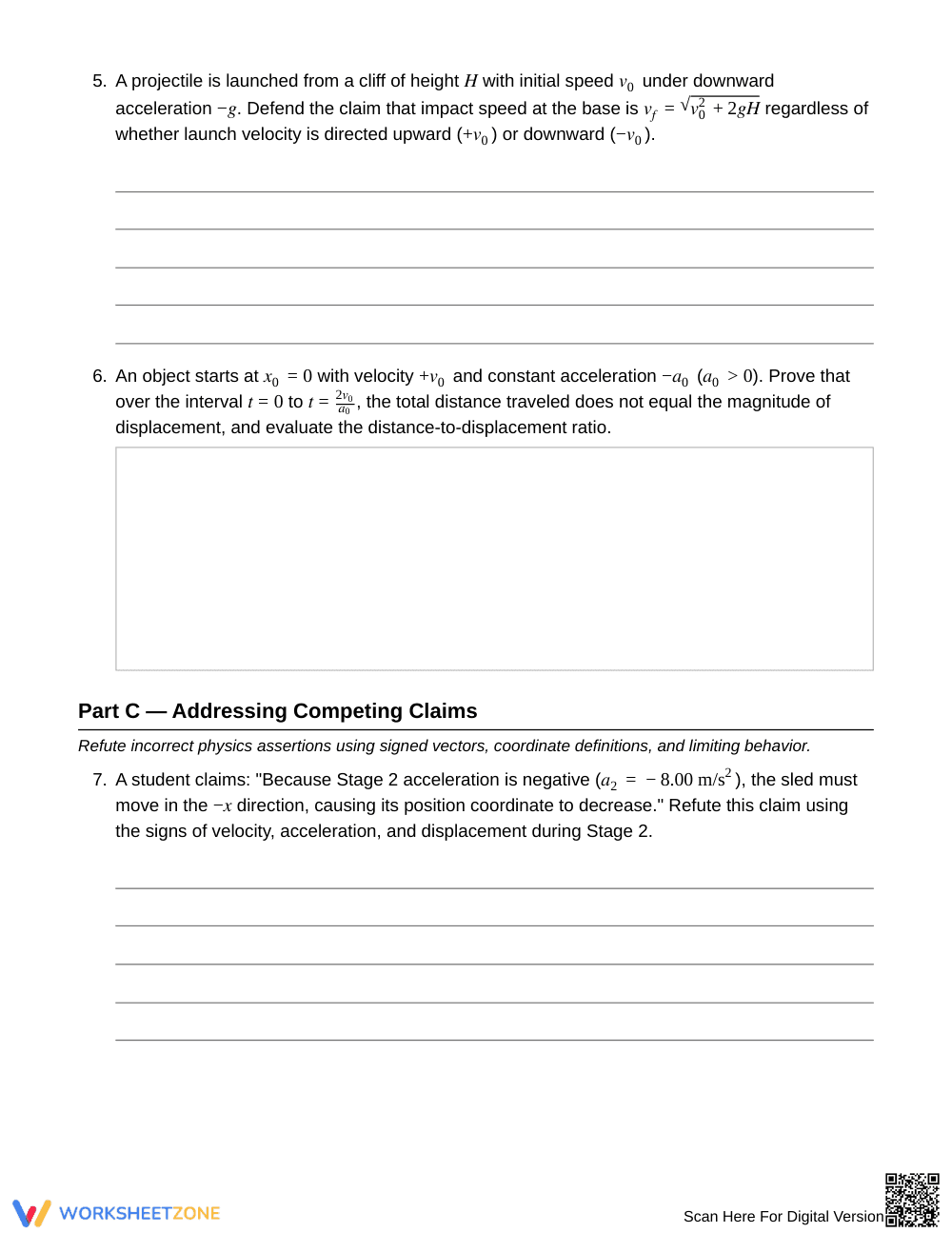
- Supported Practice (Part B, Problems 3–6): Learners construct algebraic derivations for multi-stage stopping distance and defend general formulas by taking physical limits ($a_2 \to \infty$, $a_2 \to 0$, and launch direction invariance).
- Independent Practice (Part C, Problems 7–8): Students independently evaluate and refute common misconceptions regarding negative acceleration and invalid stopping-time formulas using limiting behavior.
This sequence follows a gradual-release model, moving students from basic parameter extraction to rigorous physical argumentation and error refutation.
Standards Alignment
This resource aligns with advanced high school and introductory college physics standards for one-dimensional mechanics. Students demonstrate mastery by applying mathematical representations of acceleration, evaluating coordinate constraints, and testing edge cases through asymptotic analysis. These outcomes integrate into advanced mechanics syllabi, AP Physics C course progressions, and district STEM curriculum maps.
How to Use It
Use this worksheet following direct instruction on multi-stage kinematics and limiting-case analysis. For formative assessment, observe whether students evaluate $a_2 \to \infty$ in Part B as an instantaneous stop ($x_{\text{total}} \to \frac{1}{2}a_1 t_1^2$) or merely manipulate symbols without physical justification. Allocate 45 to 60 minutes for individual or paired completion.
Who It's For
Designed for Grade 12 AP Physics, honors physics, and dual-enrollment mechanics students who require practice with symbolic justification beyond numerical plugging. Pair this worksheet with a motion sensor lab investigation or a direct instruction lesson on asymptotic analysis in kinematics.
According to research by Fisher & Frey (2014), structured argumentation and analytical defense tasks deepen conceptual retention in secondary STEM by requiring students to justify mathematical models through physical mechanisms. This Grade 12 physics worksheet operationalizes those principles across 8 rigorous kinematics tasks centered on limiting-case validation, boundary continuity, and conceptual refutation. By analyzing a two-stage rocket sled scenario, students move beyond rote computation to examine asymptotic behaviors, such as infinite deceleration limits and directional velocity independence in projectile impact speeds. The included 2-page answer key provides complete analytical proofs and limiting evaluations, giving educators an evidence-aligned resource for advanced problem-solving practice and diagnostic assessment in one-dimensional classical mechanics.


