




























Views
Downloads



Essential Light Shadows Word Search | Grades 7–8 Science

Paste this activity's link or code into your existing LMS (Google Classroom, Canvas, Teams, Schoology, Moodle, etc.).
Students can open and work on the activity right away, with no student login required.
You'll still be able to track student progress and results from your teacher account.
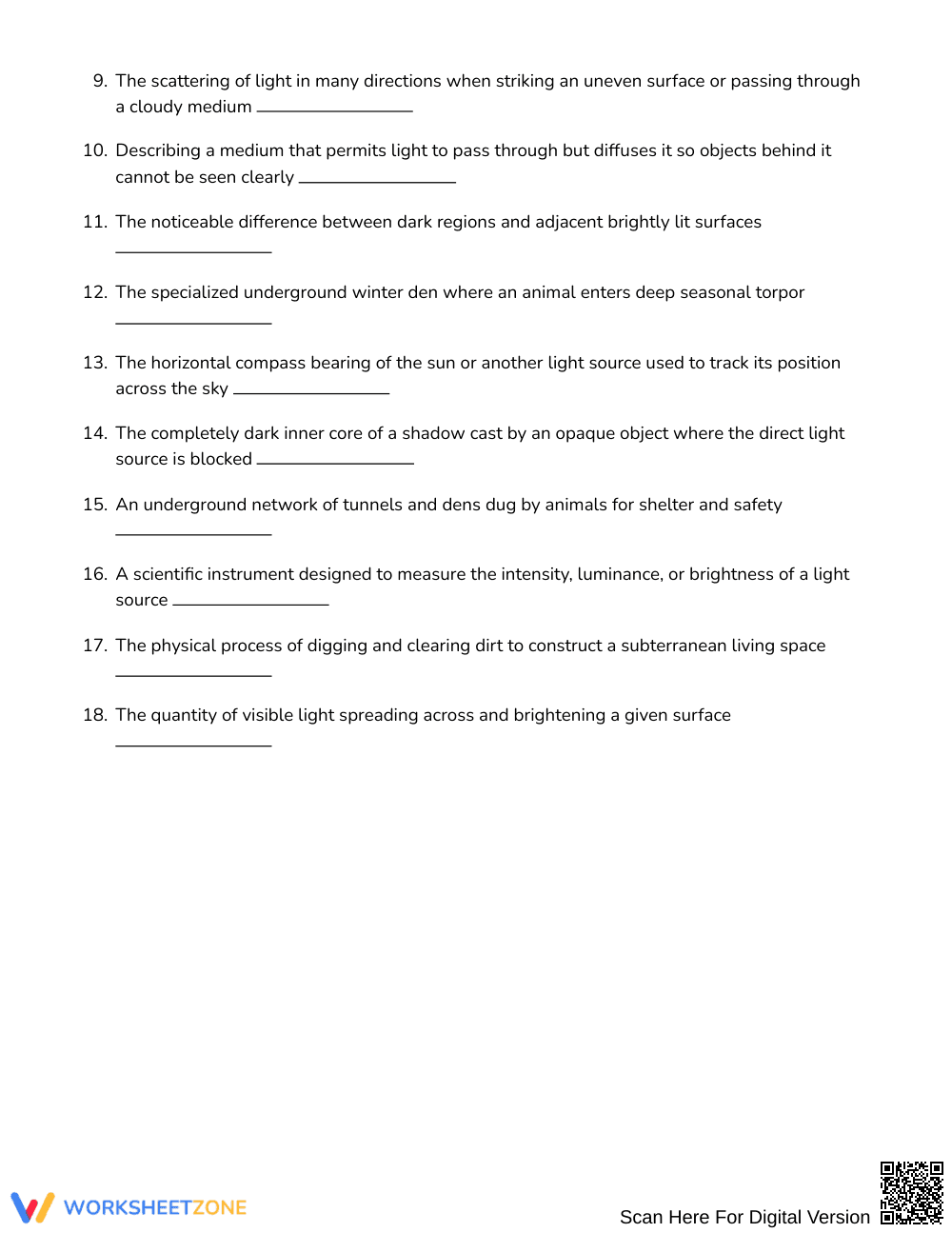
This Groundhog Day science word search reinforces light, shadow, and burrowing terminology for middle school learners. Students solve definitions and locate 18 specialized terms across a dense grid, consolidating optics concepts and seasonal animal behaviors. The activity strengthens academic vocabulary retention while serving as an engaging cumulative review for physical science units.
At a Glance
- Grade: Grades 7–8 · Subject: Science
- Standard: Not standards-assessed — vocabulary enrichment
- Skill Focus: light shadows and observation
- Format: 3 pages · 18 words · Answer key included · PDF
- Best For: Vocabulary review and fast-finisher activity
- Time: 25–35 minutes
What's Inside: The printable PDF package spans 3 student pages accompanied by a comprehensive 4-page answer key. Rather than a simple search-and-find task, the worksheet challenges students with context-rich definition clues for 18 core vocabulary terms, connecting wave physics (such as reflection, refraction, and umbra) to seasonal biological behaviors (including hibernaculum and excavation).
Puzzle Structure and Mechanics
Students navigate a challenging 20 × 20 letter grid containing hidden scientific terminology. Words run in all 8 compass directions: north, northeast, east, southeast, south, southwest, west, and northwest. A shuffled word bank pairs with detailed definition clues, requiring students to match scientific meanings to targeted terms before locating them within the dense grid.
Standards Alignment
This activity provides targeted vocabulary enrichment and is not aligned to a specific state science standard. It supplements core units in optics, wave behavior, and ecology by reinforcing precise domain-specific literacy. Teachers can incorporate these terminology exercises alongside general curricular units covering energy, sound, and light.
How to Use It
Deploy this word search during an introductory lesson on shadow formation or as an engaging Groundhog Day thematic review after direct instruction on optics. As students work, circulate to observe whether they identify terms directly from the optical clues or rely on word-length patterns. The puzzle requires approximately 25 to 35 minutes of focused independent or partner completion time.
Who It's For
Designed for middle school learners in Grades 7–8, this resource supports general science classes, physical science units, and life science review. For students requiring reading support, encourage collaborative pair work or clue highlighting. Pair this puzzle with an optics ray-diagram lesson or a hands-on investigation of opaque versus translucent materials.
Domain-specific vocabulary acquisition is foundational to conceptual understanding in middle school physical and life sciences. While this exercise is designated as unaligned vocabulary enrichment rather than a standards-assessed measure, it directly targets scientific literacy regarding light shadows and observation. According to Fisher & Frey (2014), intentional exposure to academic terminology within meaningful contexts significantly improves comprehension of complex informational texts. By requiring students to interpret detailed clues—such as differentiating umbra from penumbra or reflection from refraction—before scanning the letter matrix, the puzzle reinforces cognitive retrieval rather than passive recognition. This dual-demand structure bridges disciplinary literacy and content knowledge across multi-day science units. Educators can utilize the 18 targeted terms to gauge student comfort with optical properties and biological adaptations prior to formal summative assessments, establishing a reliable lexical foundation for upcoming laboratory investigations and analytical tasks.


