


























Views
Downloads



Essential Library Routines Word Search | Grades 4–5 ELA
Paste this activity's link or code into your existing LMS (Google Classroom, Canvas, Teams, Schoology, Moodle, etc.).
Students can open and work on the activity right away, with no student login required.
You'll still be able to track student progress and results from your teacher account.
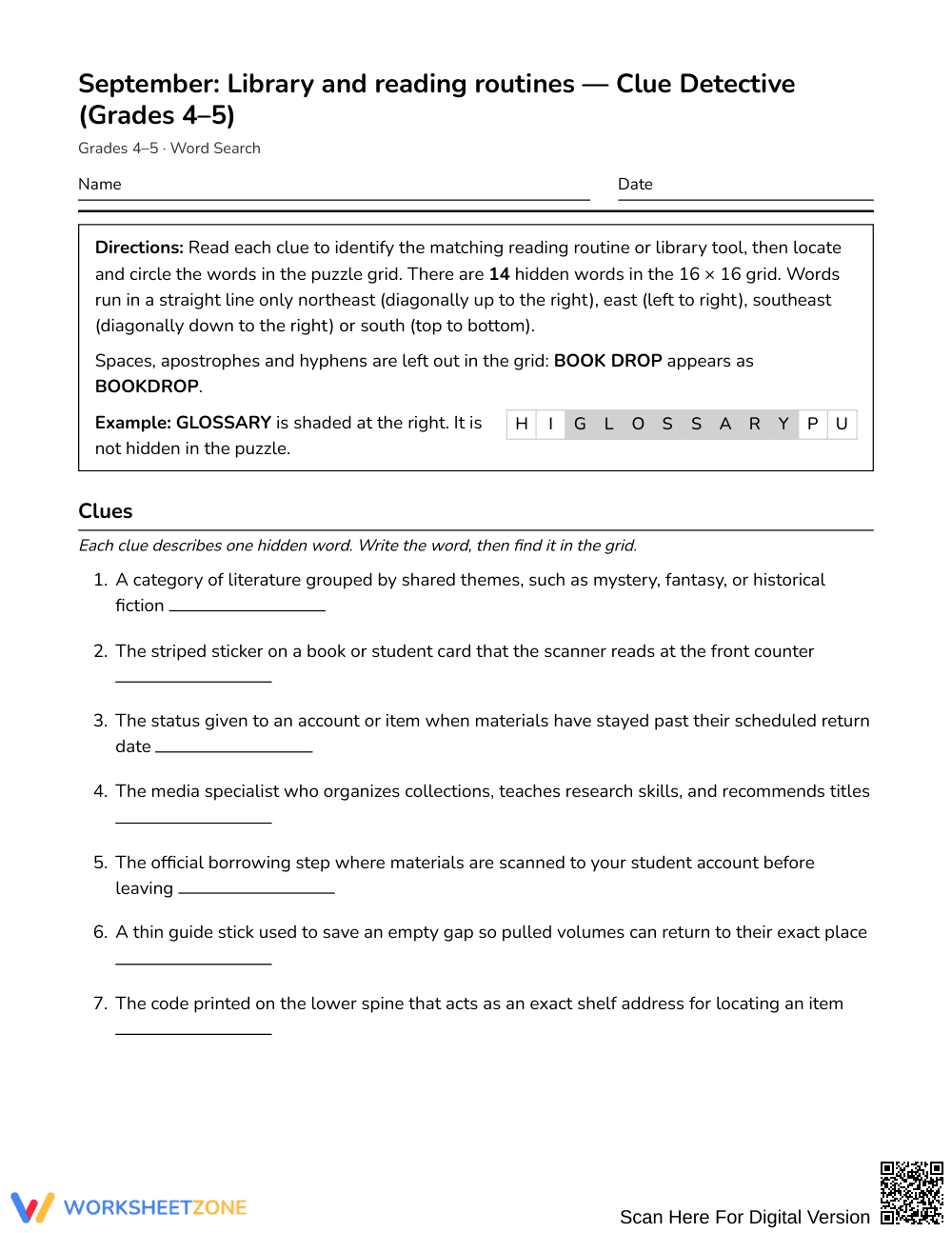
This Grades 4–5 library routines word search builds foundational media center vocabulary through engaging clue-based discovery. Students read informational definitions to identify key terms, then track down each target term within the puzzle grid. The activity reinforces essential orientation routines and library navigation concepts during back-to-school media center lessons.
At a Glance
- Grade: Grades 4–5 · Subject: ELA
- Standard: Not standards-assessed — vocabulary enrichment
- Skill Focus: Library and reading routines
- Format: 3 pages · 14 words · Answer key included · PDF
- Best For: Library orientation and early finisher review
- Time: 20–30 minutes
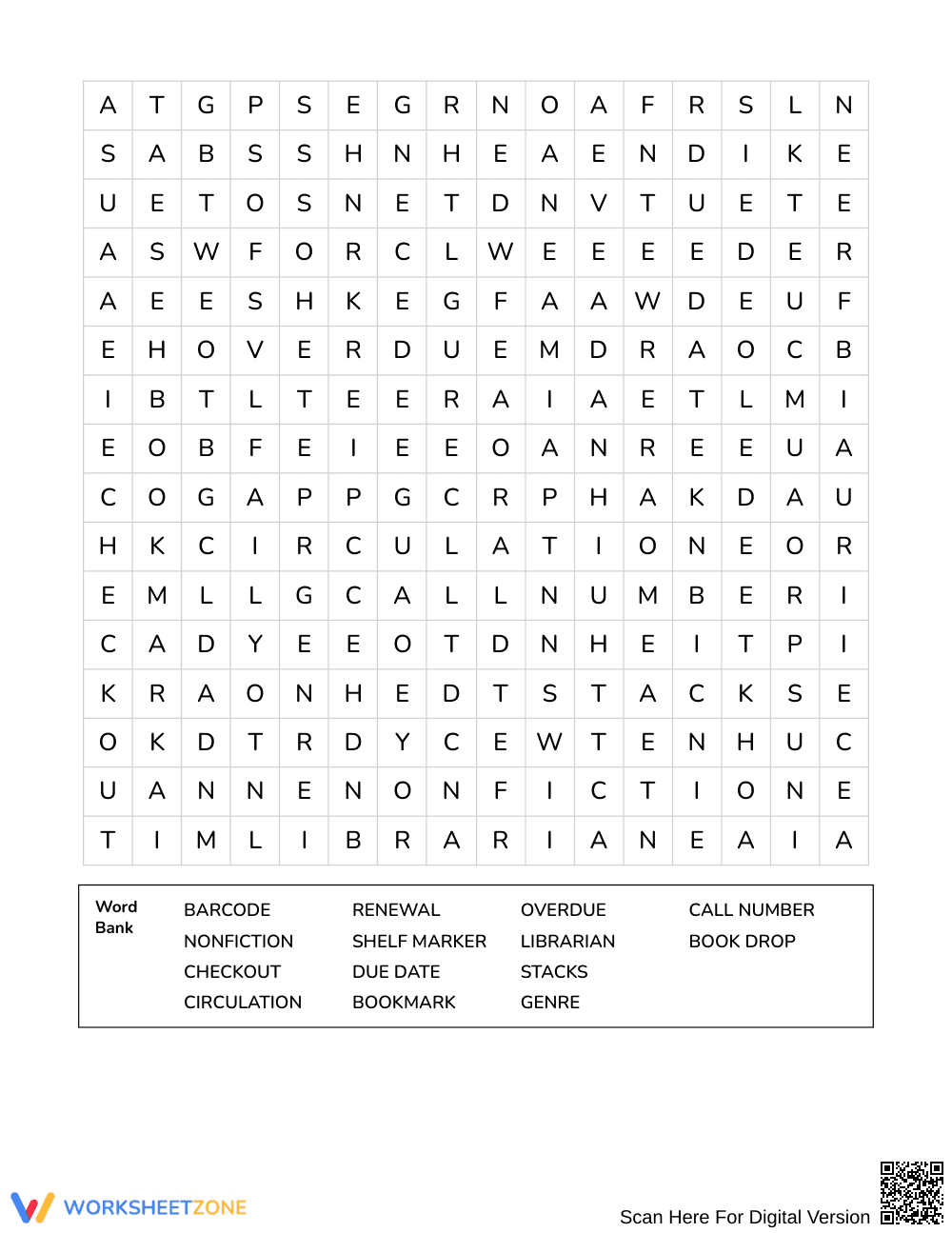
The 3-page printable resource includes a complete clue-driven puzzle sheet alongside comprehensive reference solutions. Students encounter 14 targeted vocabulary terms paired with descriptive clues explaining essential library operations, shelving procedures, and borrowing policies. An accompanying 3-page answer key provides teacher solutions showing exact coordinate highlights for fast grading and independent student self-checks.
This vocabulary challenge operates as a clue detective activity built on a 16 × 16 letter grid. Rather than searching from a simple list, learners read definitions for terms such as barcode, call number, and shelf marker before scanning the grid. The 14 words run across four distinct orientations: northeast, east, southeast, and south, supporting spatial processing and word recognition without backwards spelling.
This activity provides targeted vocabulary enrichment and media literacy support rather than assessing a discrete grade-level academic standard. The exercise strengthens domain-specific terminology that fourth- and fifth-grade learners encounter during library visits, catalog navigation, and independent reading checkout procedures across the academic school year.
Introduce this word search after completing direct instruction during an initial media center walkthrough or September library orientation. Alternatively, assign the activity as an engaging station during literacy center rotations. For a formative assessment check, monitor whether students can verbally connect terms like call number or circulation desk to physical library locations. Most students complete the full clue-and-search task within 20 to 30 minutes.
This resource supports upper elementary learners in grades 4 and 5 who are mastering independent library procedures. For students needing support, provide the completed terms in advance, while advanced learners can explain how specific terms connect to library organization. Pair this print-and-go puzzle with a physical library scavenger hunt or media center rule poster.
Domain-specific vocabulary acquisition forms the backbone of reading comprehension and autonomous research habits in upper elementary education. According to research by Fisher & Frey (2014), intentional exposure to technical terminology through varied, contextualized tasks helps students cement conceptual knowledge and build automatic retrieval pathways. This 14-word library routines puzzle reinforces media center terms, including call number, genre, and circulation, by coupling functional clue descriptions with focused visual search mechanics. Engaging fourth- and fifth-grade learners in definition analysis before letter searching ensures that students focus on semantic meaning rather than passive pattern matching. When students master foundational vocabulary associated with borrowing rules, shelving systems, and catalog tools, they gain confidence navigating physical media centers, locating appropriate informational texts, and sustaining independent reading routines across diverse academic content areas throughout the school year.


