


























Views
Downloads



Essential Interpreting Quotients Worksheet | Grade 6 Math
Paste this activity's link or code into your existing LMS (Google Classroom, Canvas, Teams, Schoology, Moodle, etc.).
Students can open and work on the activity right away, with no student login required.
You'll still be able to track student progress and results from your teacher account.
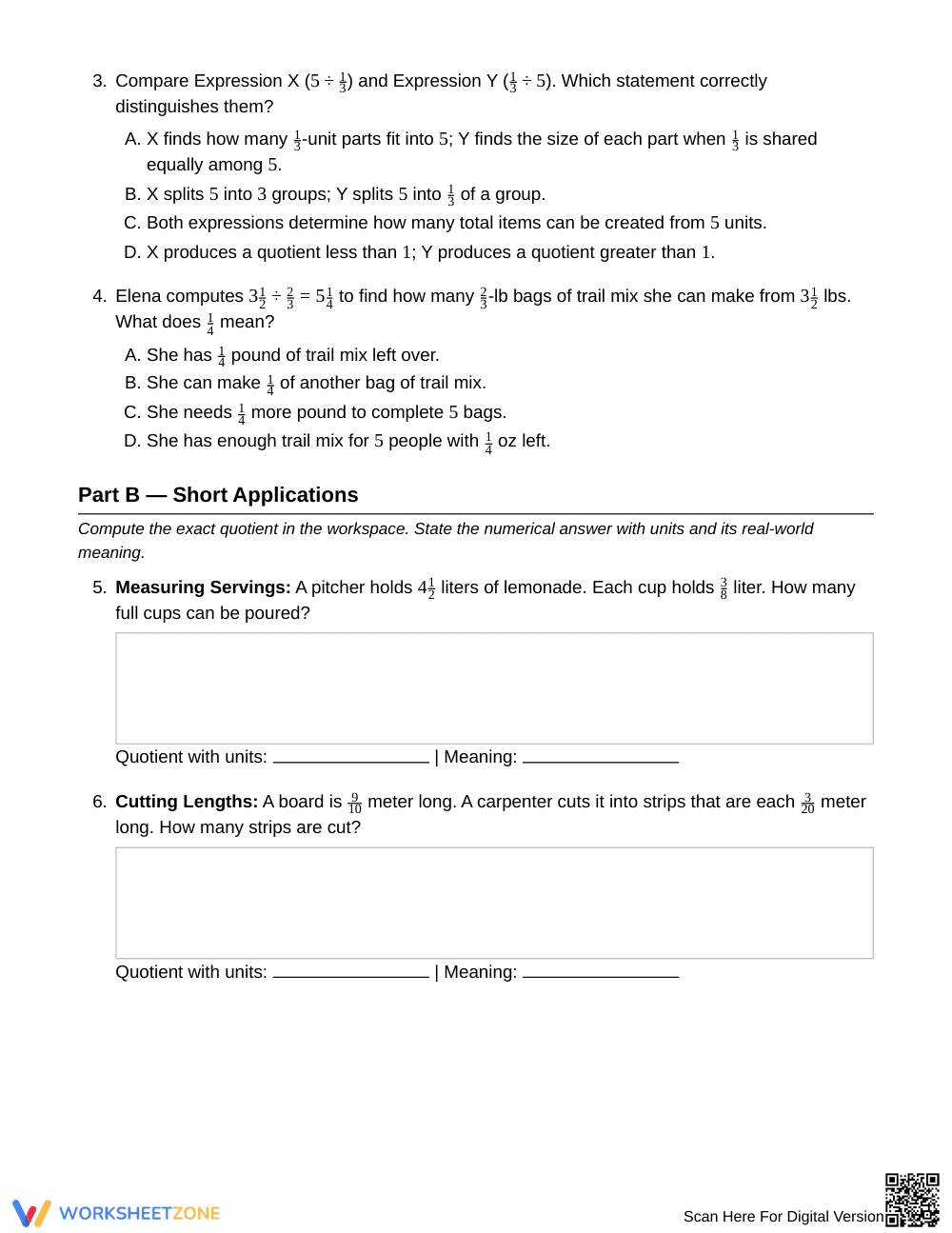
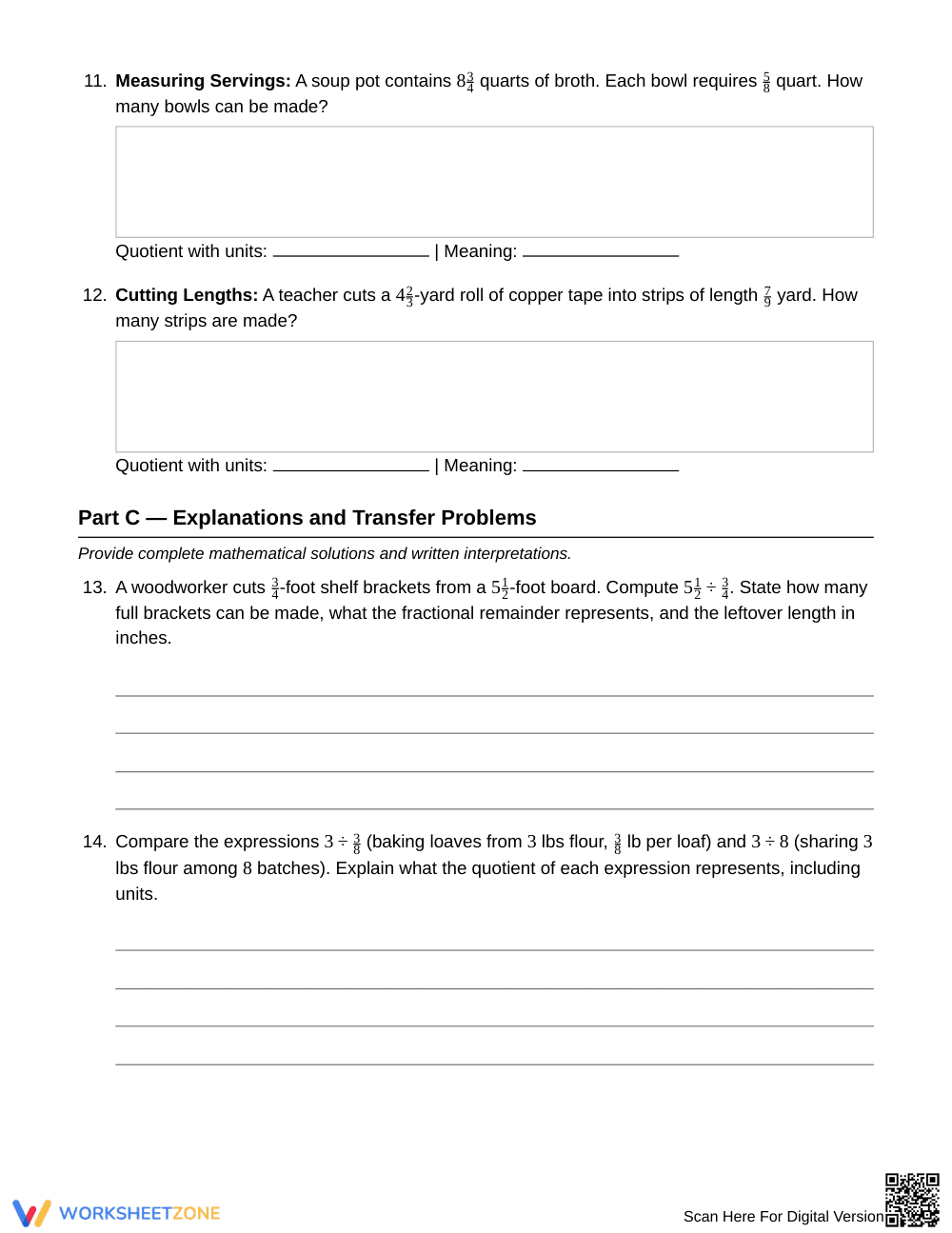
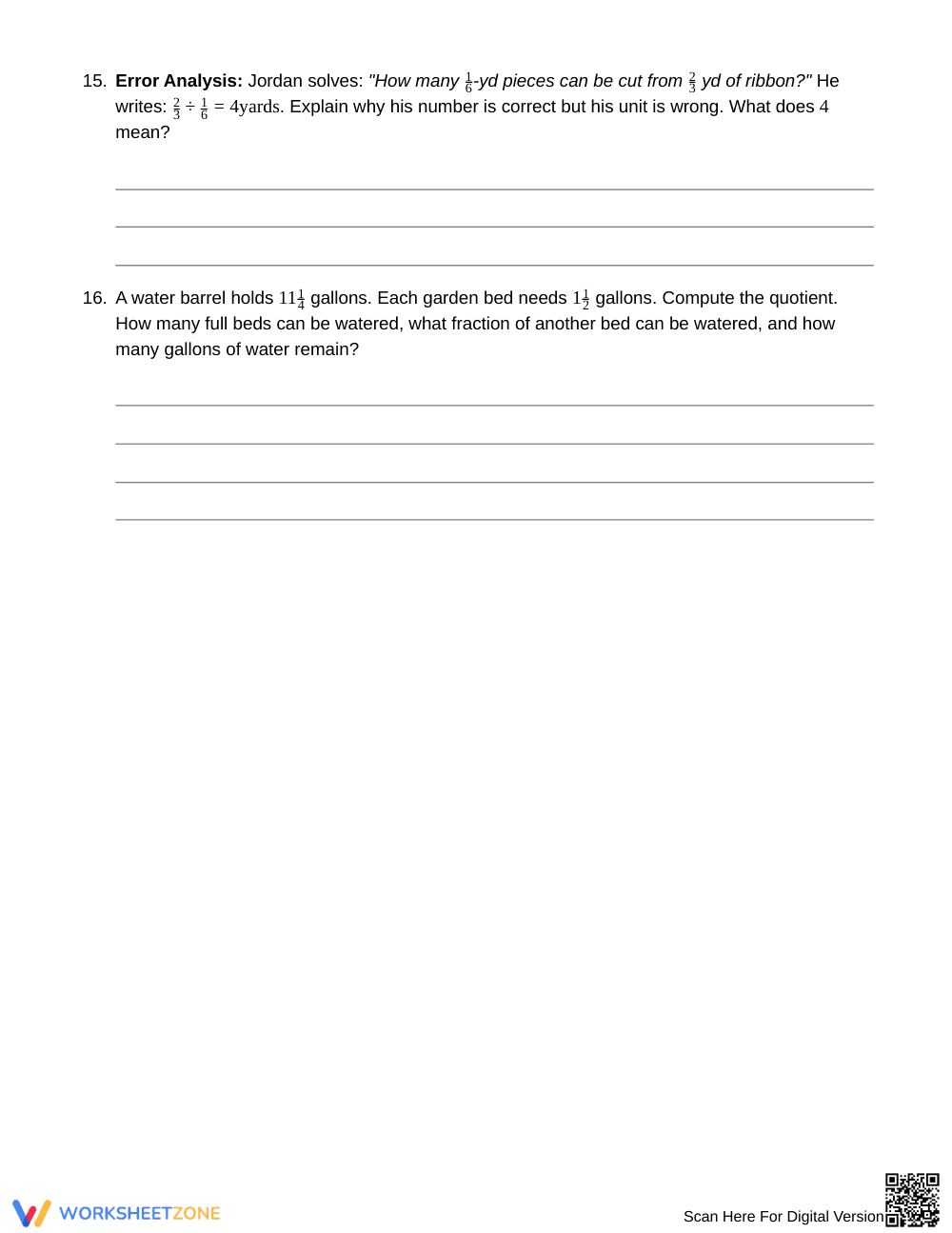
This 5-page fraction division worksheet helps Grade 6 students interpret the meaning of quotients and remainders in real-world word problems. Learners analyze contexts, compute exact fractions, assign correct measurement units, and explain whether quotients represent group sizes, portion totals, or fractional pieces.
At a Glance
- Grade: 6 · Subject: Math
- Standard:
6.NS.A.1— Interpret and compute fraction quotients to solve contextual word problems- Skill Focus: Identify What the Quotient Represents
- Format: 5 pages · 16 problems · Answer key included · PDF
- Best For: Guided practice and conceptual reinforcement
- Time: 40–50 minutes
The resource includes 16 structured tasks organized into three sections, supported by a reference box on measurement and partitive division. Students solve multiple-choice items, calculate quotients with real-world units, and complete written error analyses. A 2-page answer key provides complete computations and unit explanations.
Skill Progression
- Guided Practice (Part A — 4 Tasks): Focuses on conceptual identification through multiple-choice items distinguishing group counts from piece sizes.
- Supported Practice (Part B — 8 Tasks): Requires students to calculate exact quotients and define their physical meaning across real-world measurement scenarios.
- Independent Practice (Part C — 4 Tasks): Deepens understanding with multi-step contextual solutions, unit error analysis, and remainder interpretations.
This sequence follows a gradual-release model, advancing from conceptual classification to independent written explanations.
Standards Alignment
This worksheet aligns with primary standard 6.NS.A.1: Interpret and compute quotients of fractions, and solve word problems involving fraction division. The practice connects procedural calculations to conceptual interpretations. Both standard codes can be copied directly into lesson plans, IEP goals, or district curriculum mapping tools.
How to Use It
Implement this resource during post-instruction practice or small-group intervention. Have students complete Part A in pairs before independent work on Part B. For formative assessment, inspect Part C problem 3 to ensure students differentiate group counts from linear units. Completion takes approximately 40 to 50 minutes.
Who It's For
Designed for Grade 6 general math students and math intervention groups targeting fraction division standards. Pair this activity with visual fraction bar models or double number lines during direct instruction to reinforce group-to-part relationships.
According to research highlighted by Fisher & Frey (2014) on guided instructional release, middle school students build lasting conceptual understanding when mathematical tasks deliberately transition from conceptual categorization to procedural application and written error analysis. Standard 6.NS.A.1 requires sixth-grade learners not merely to compute fraction division via reciprocal multiplication, but to interpret what the quotient represents in context—distinguishing between the quantity of items created in measurement division and the portion allocated per group in partitive division. When students explicitly justify whether fractional remainders represent parts of a single unit or fractional parts of a serving, they eliminate recurring misconceptions identified in national assessments. This 16-task resource provides the structured scaffolding, context-rich scenarios, and analytical writing prompts necessary to ensure students connect mathematical procedures directly to physical problem realities across diverse multi-step applications.


