




























Views
Downloads

Essential Integration Errors Worksheet | Grade 12 Calculus

Paste this activity's link or code into your existing LMS (Google Classroom, Canvas, Teams, Schoology, Moodle, etc.).
Students can open and work on the activity right away, with no student login required.
You'll still be able to track student progress and results from your teacher account.
This targeted Grade 12 Calculus worksheet trains students to identify, diagnose, and correct widespread misconceptions in integral calculus. High school seniors analyze flawed student work to master antiderivative constants, initial value problems, and definite integral bound substitutions, building the precise analytic habits necessary for advanced mathematical evaluation and college coursework.
At a Glance
- Grade: 12 · Subject: Calculus
- Standard: Advanced Calculus — Evaluate integrals correctly by applying constants of integration and proper boundary substitutions
- Skill Focus: Correct Missing Constants and Bound Errors
- Format: 4 pages · 10 problems · Answer key included · PDF
- Best For: AP Calculus review and error remediation
- Time: 40–50 minutes
What's Inside
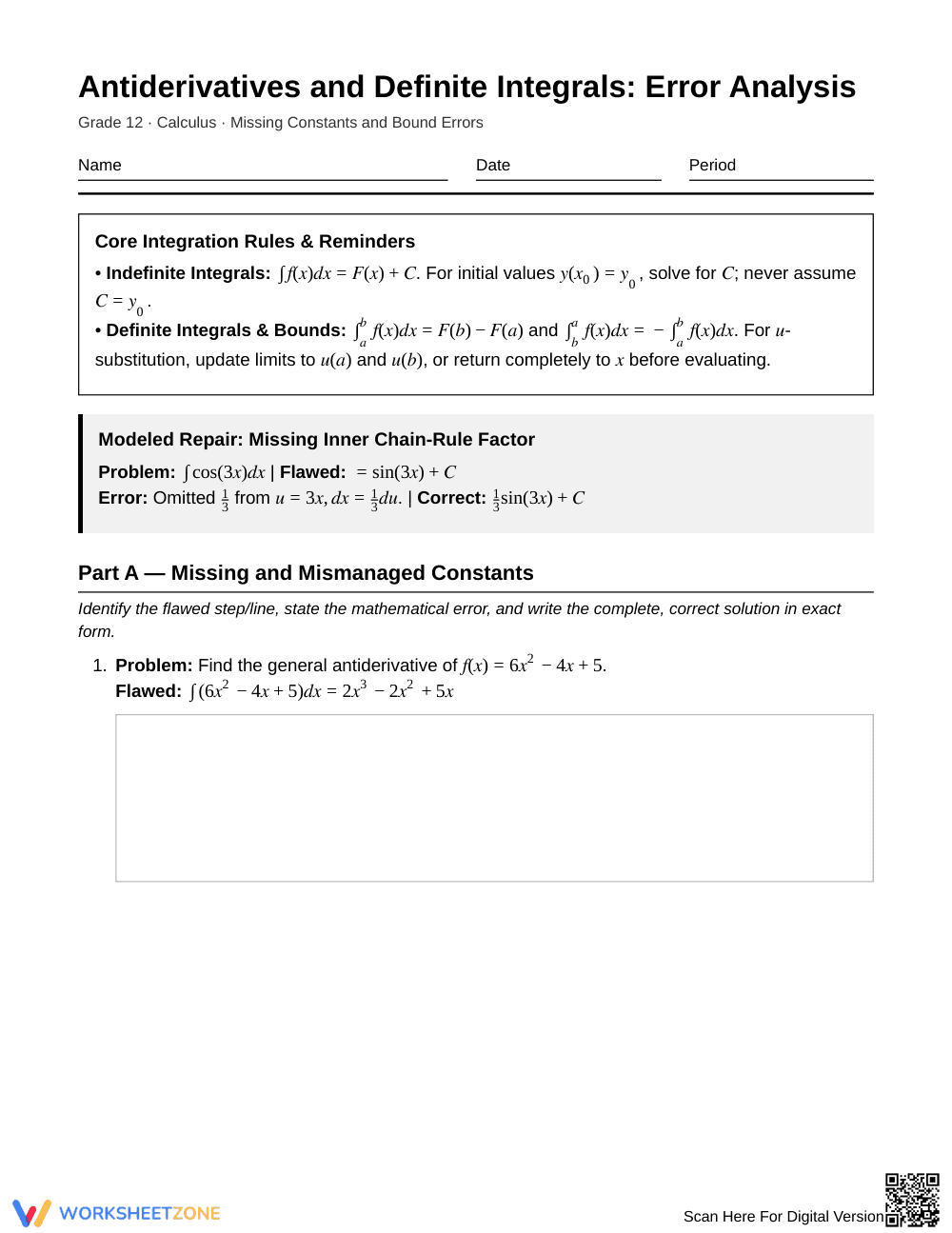
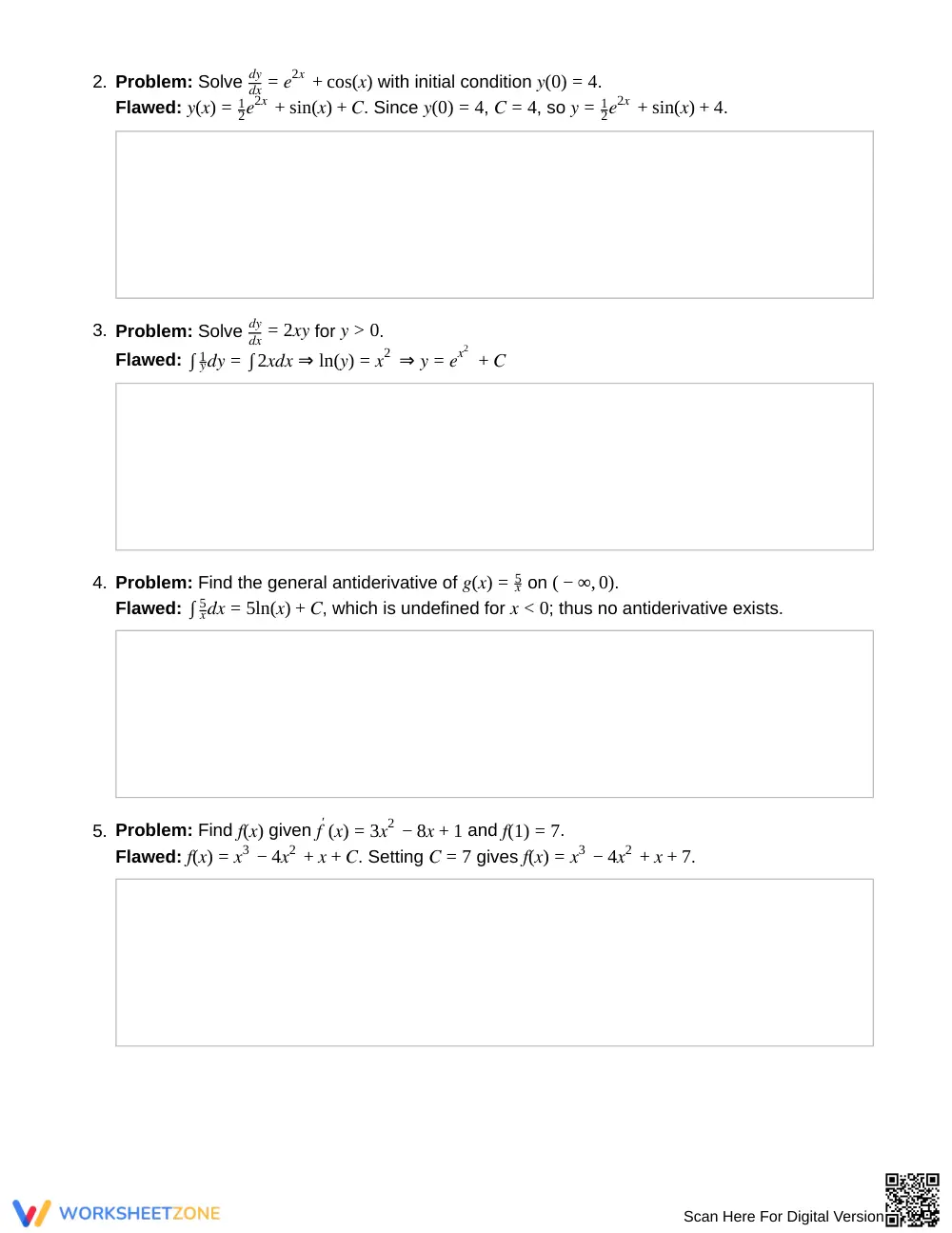
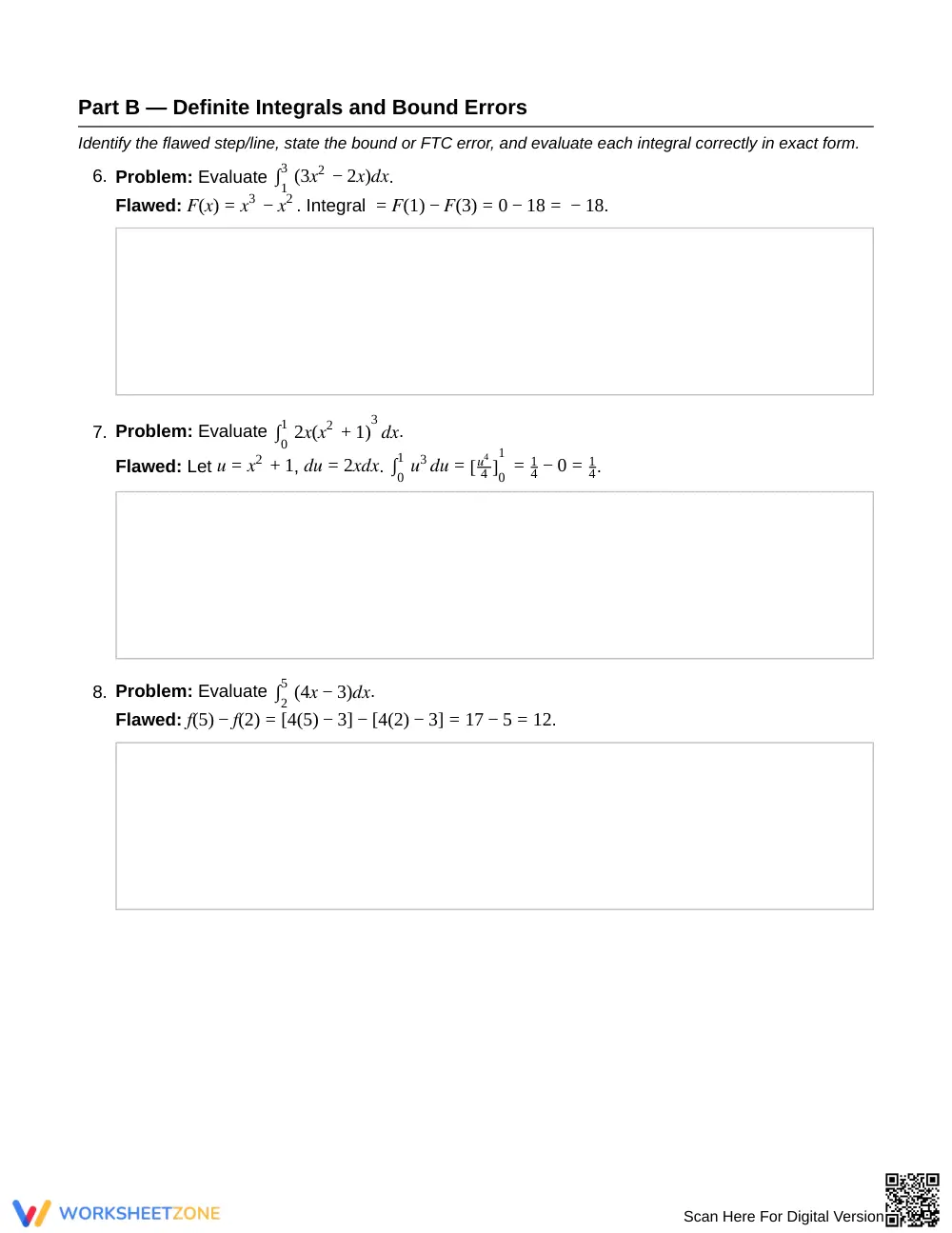
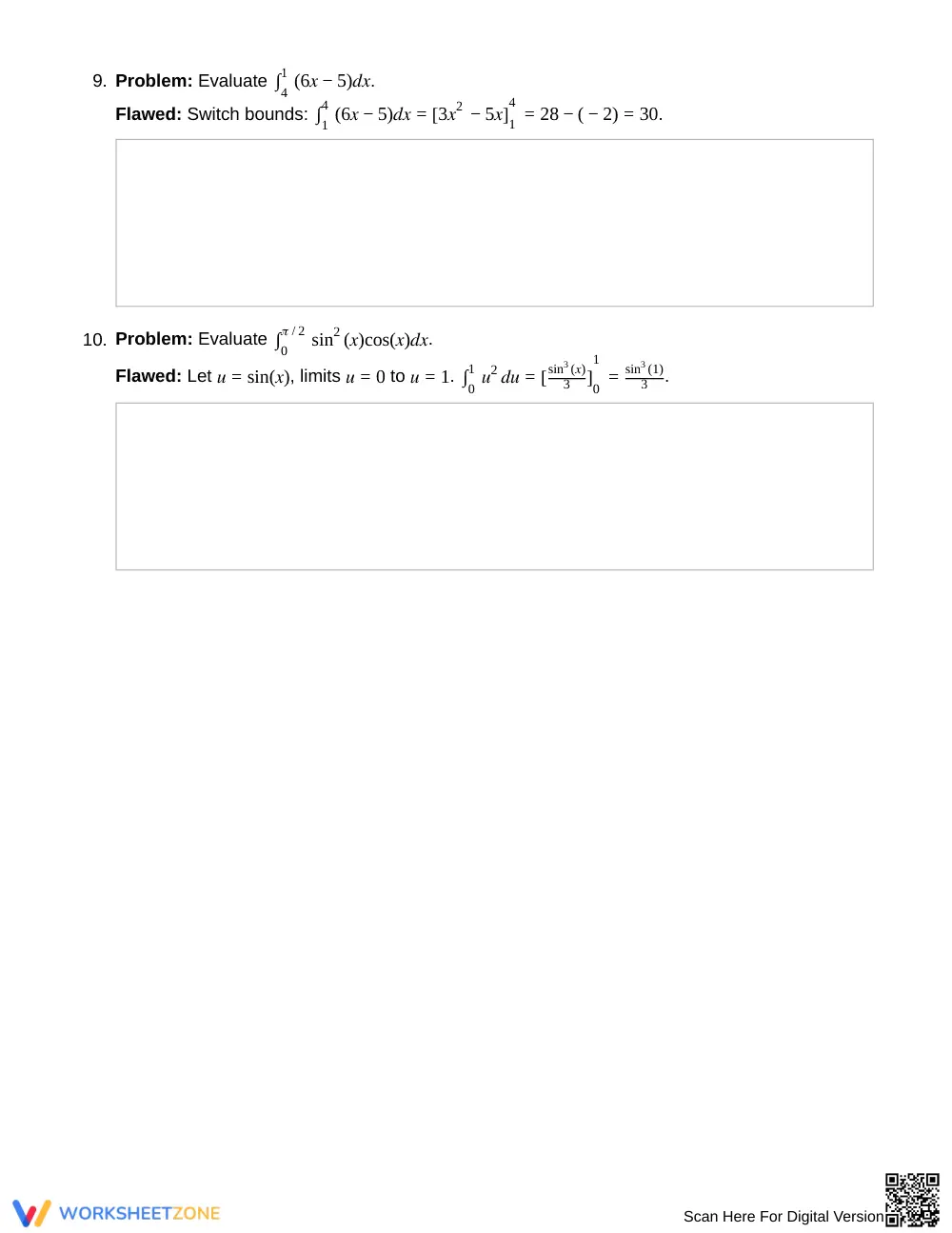
The four-page document features a reference header outlining core integration rules and a modeled error repair demonstrating how to handle inner chain-rule factors. Students then complete ten distinct error-analysis tasks divided across two themed sections: Part A targets missing constants of integration and initial conditions, while Part B addresses the Fundamental Theorem of Calculus and u-substitution bound adjustments. A comprehensive two-page answer key provides step-by-step corrections.
Skill Progression
- Guided Practice: A fully solved sample item demonstrates how to isolate flawed integration steps, write diagnostic explanations, and recalculate the exact antiderivative.
- Supported Practice: Part A features 5 structured problems requiring students to spot neglected constants of integration, evaluate initial conditions algebraically, and address domain restrictions.
- Independent Practice: Part B presents 5 complex definite integration tasks where learners repair inverted limits of integration, improper boundary changes in substitution, and incorrect evaluation formulas.
This deliberate sequence reflects the gradual-release framework, leading students from explicit error detection to autonomous repair.
Standards Alignment
This resource aligns directly with core advanced calculus competencies covering indefinite and definite integration. Students apply the Fundamental Theorem of Calculus, maintain algebraic rigor during u-substitution limit shifts, and preserve constants of integration across general solutions. These learning objectives can be copied directly into lesson plans, IEP goals, or district curriculum mapping tools.
How to Use It
Deploy this activity immediately after direct instruction on the Fundamental Theorem of Calculus to consolidate procedural accuracy. For formative assessment, observe whether students properly transform upper and lower limits during Part B u-substitutions rather than prematurely reverting back to the original variable. High school classes typically complete the 10 analysis tasks within 40 to 50 minutes.
Who It's For
Designed for Grade 12 Calculus and AP Calculus AB/BC students, this resource offers rigorous practice for learners who grasp basic integration formulas but commit mechanical sign or constant errors. Pair this worksheet directly with an integration by substitution anchor chart or a lecture on differential equations.
According to Fisher & Frey (2014), structured error analysis provides essential cognitive friction that shifts learners from rote formula execution to genuine conceptual understanding. When Grade 12 students actively audit flawed calculus procedures involving boundary adjustments and constants of integration, they internalize underlying theorems far more effectively than through repetitive computation alone. This 4-page worksheet guides learners through 10 carefully sequenced integration tasks, highlighting common pitfalls such as neglecting boundary transformations in substitution and confusing initial value coordinates with constant offsets. By requiring written mathematical diagnostics alongside full symbolic re-evaluations, the activity cultivates high-level metacognitive habits. Backed by instructional research, diagnosing non-examples strengthens procedural fluency, reinforces the Fundamental Theorem of Calculus, and prepares high school seniors for collegiate STEM coursework.


