


























Views
Downloads


Essential Inequality Endpoints Worksheet | Grade 6 Math
Paste this activity's link or code into your existing LMS (Google Classroom, Canvas, Teams, Schoology, Moodle, etc.).
Students can open and work on the activity right away, with no student login required.
You'll still be able to track student progress and results from your teacher account.
This 5-page Grade 6 math worksheet targets a critical algebra hurdle: distinguishing between strict and inclusive inequality endpoints on a number line. Students analyze misconceptions across 10 real-world constraints, evaluating boundary inclusion to write corrected inequalities and sketch precise open- or closed-circle graphs.
At a Glance
- Grade: 6 · Subject: Math
- Standard:
6.EE.B.8— Graph inequalities on number lines to represent real-world constraints- Skill Focus: Correcting open and closed endpoint errors
- Format: 5 pages · 10 problems · Answer key included · PDF
- Best For: Error analysis and targeted intervention
- Time: 25–35 minutes
What's Inside
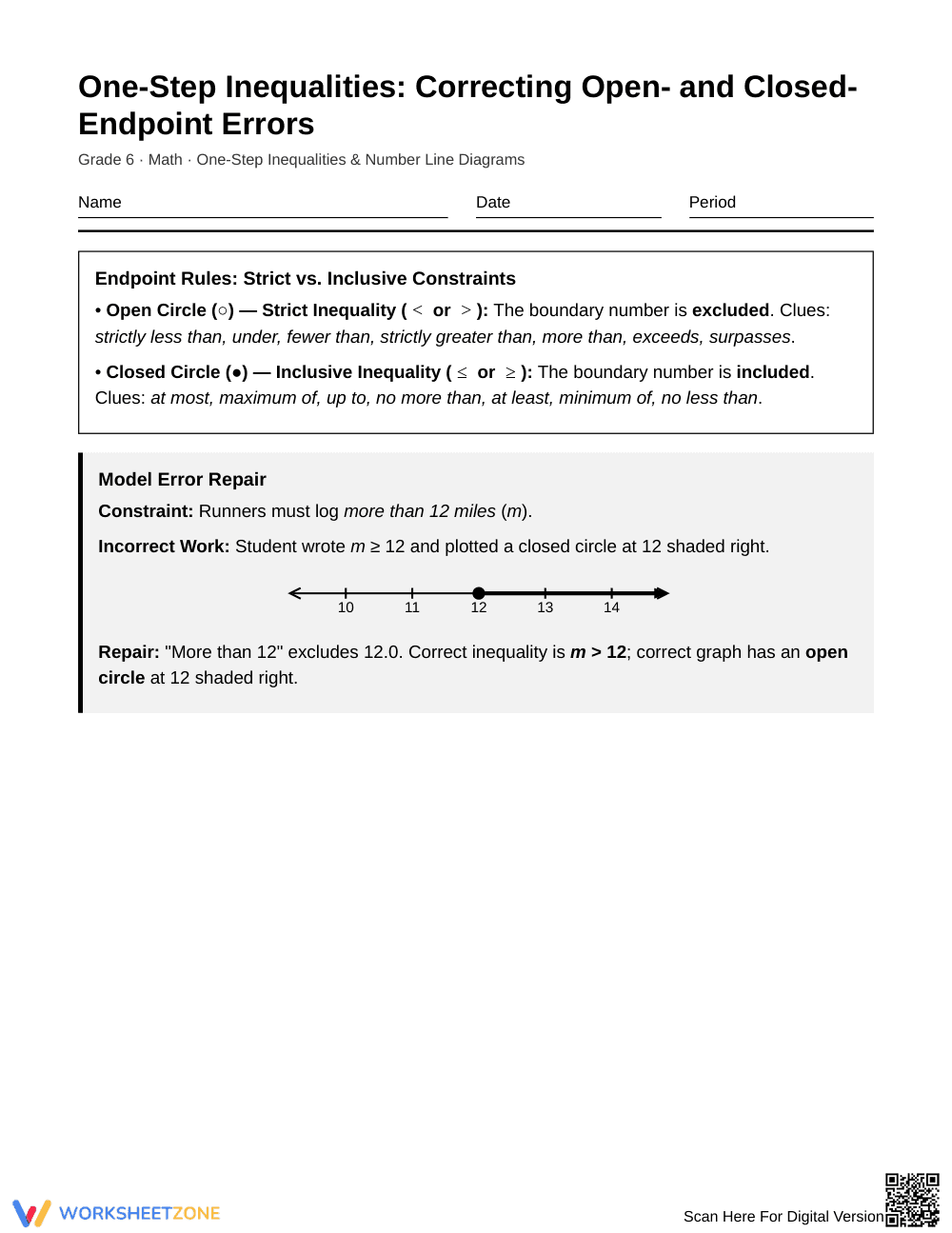
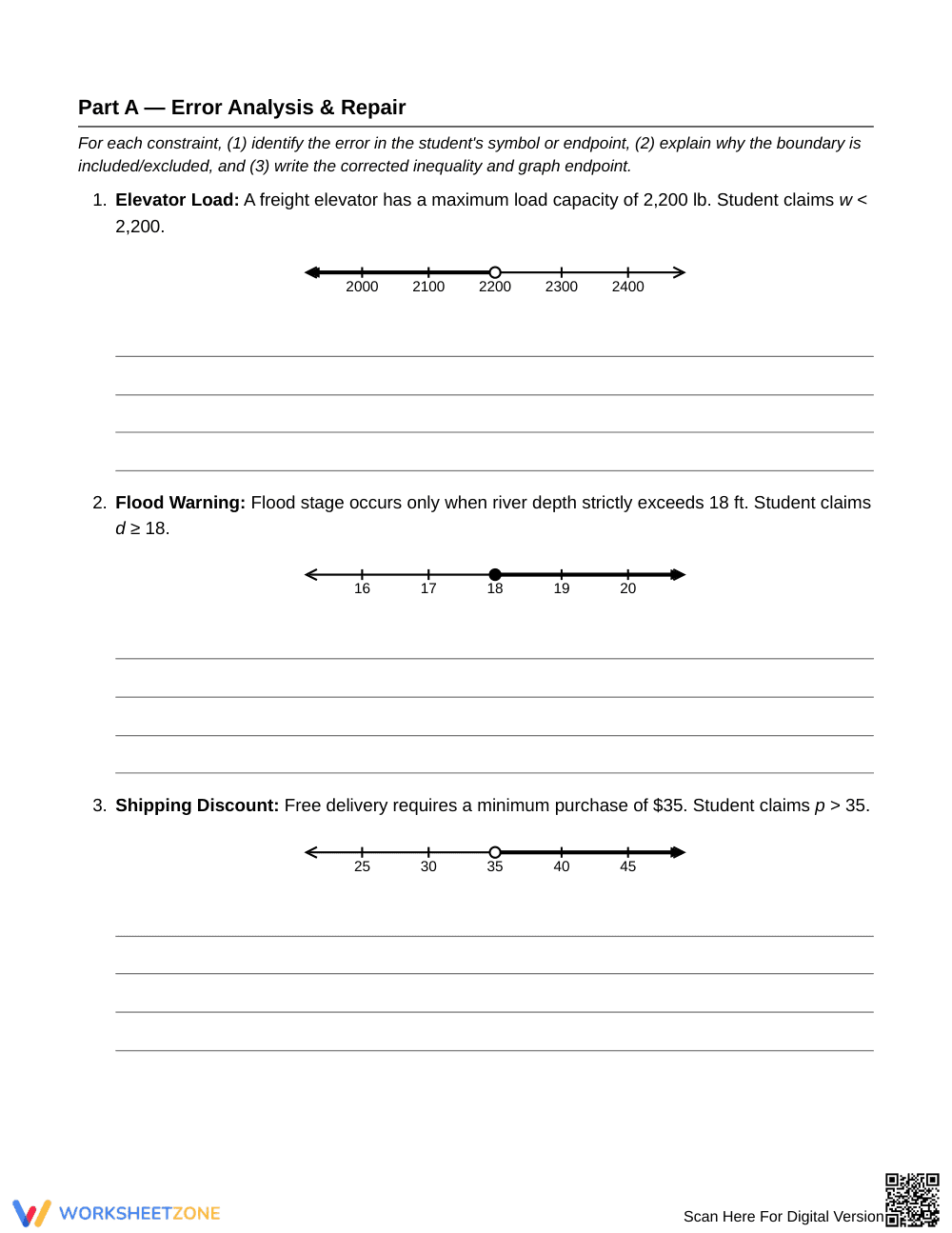
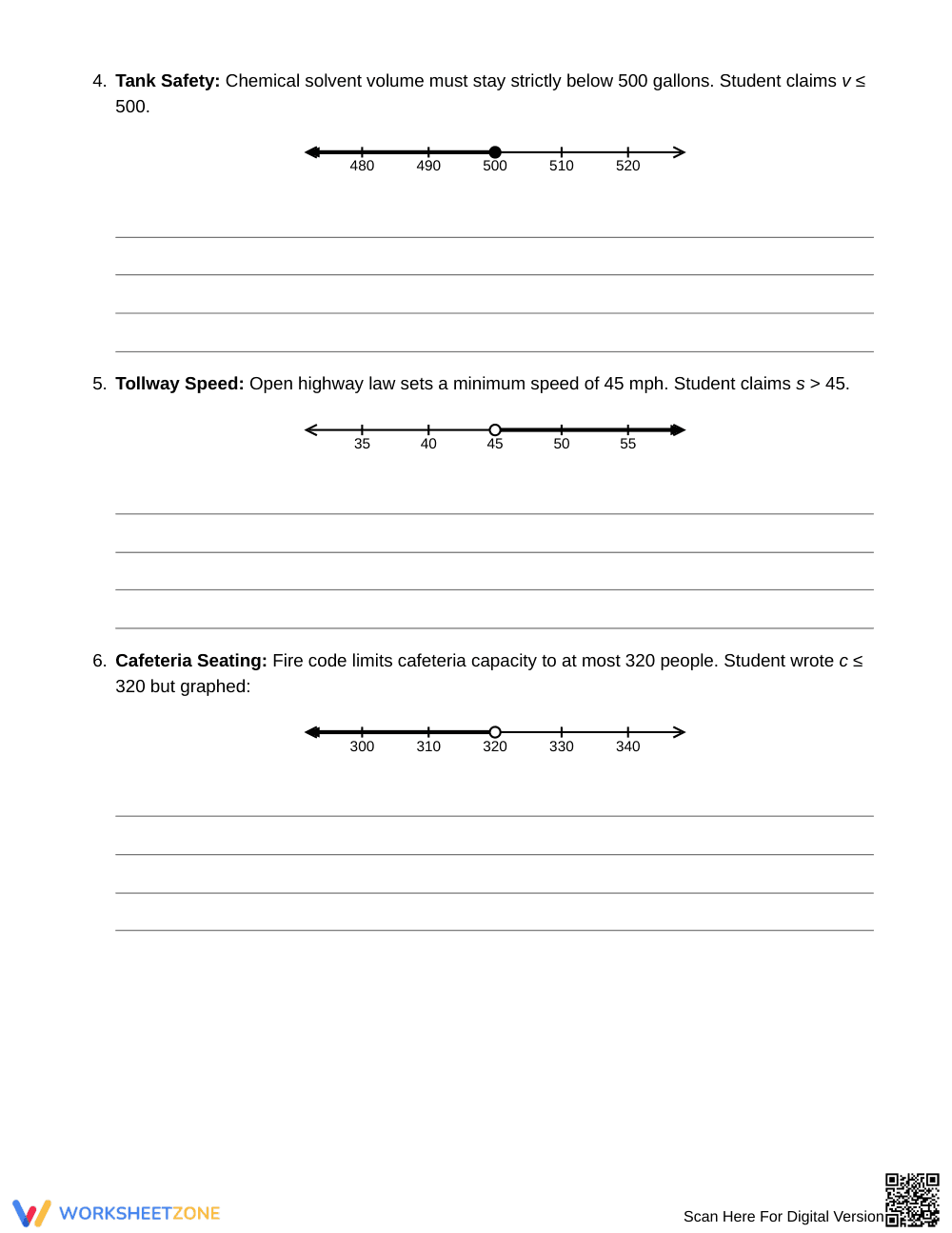
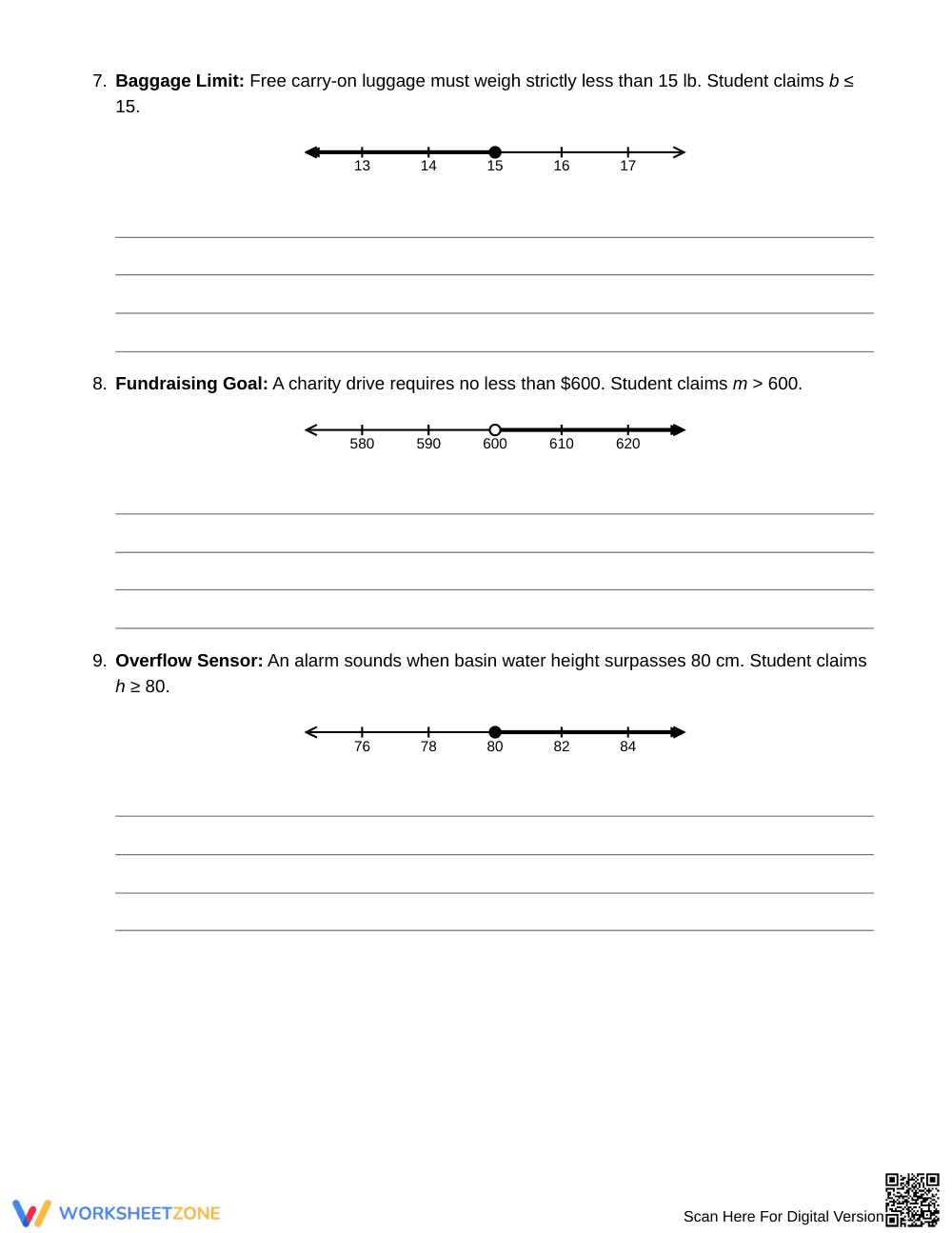
The resource begins with a reference box defining strict indicators (such as exceeds) versus inclusive indicators (such as at most). A worked model illustrates how to isolate boundary errors and redraw endpoints. Students then complete 10 error-repair tasks covering real-world constraints like elevator capacities and flood stages, supported by a 2-page answer key.
Skill Progression
- Guided Practice: Students review the reference rules and worked model, connecting verbal clues directly to open or solid circle endpoints.
- Supported Practice: Problems 1–5 present structured prompts where students diagnose faulty symbols and explain boundary inclusion using terms like maximum and strictly exceeds.
- Independent Practice: Problems 6–10 challenge learners to resolve dual representation errors by repairing mismatched algebraic expressions and graphed endpoints.
This gradual-release sequence guides students from modeled deconstruction toward confident independent mathematical reasoning.
Standards Alignment
This worksheet aligns directly with 6.EE.B.8: "Write an inequality of the form x > c or x < c to represent a constraint or condition in a real-world or mathematical problem. Recognize that inequalities of the form x > c or x < c have infinitely many solutions; represent solutions of such inequalities on number line diagrams." It also reinforces 6.EE.B.5 regarding solution sets. Both standard codes can be copied directly into lesson plans, IEP goals, or district curriculum mapping tools.
How to Use It
Assign this activity immediately following direct instruction on inequality graphing or during small-group intervention. While circulating, observe whether students check boundary wording before inspecting the flawed work to prevent confirmation bias. The 10 multi-part tasks take approximately 25 to 35 minutes to complete.
Who It's For
Designed for Grade 6 general math classrooms, this resource also provides targeted remediation for Grade 7 and 8 algebra readiness. Pair this practice with an inequality keyword anchor chart to reinforce inclusive and strict boundary conditions.
Mastering standard 6.EE.B.8 requires middle school students to accurately distinguish strict inequalities from inclusive constraints and represent solution sets on number line diagrams. According to research by Fisher & Frey (2014), engaging in explicit error analysis accelerates conceptual acquisition by prompting learners to evaluate flawed mathematical reasoning rather than merely executing repetitive procedural steps. This 5-page instructional resource operationalizes that exact principle across 10 structured real-world tasks, guiding Grade 6 students to identify whether specific boundary thresholds—such as capacity limits, cargo rules, and speed minimums—require open or closed circular endpoints. By articulating in writing why boundary numbers satisfy or violate given constraints, students build lasting algebraic intuition and notation precision. Educators can incorporate this targeted error-repair practice into core classroom instruction, small-group intervention blocks, or IEP progress monitoring routines to resolve persistent student misconceptions.


