


























Views
Downloads



Essential Inequality Constraints Worksheet | Grade 6 Math
Paste this activity's link or code into your existing LMS (Google Classroom, Canvas, Teams, Schoology, Moodle, etc.).
Students can open and work on the activity right away, with no student login required.
You'll still be able to track student progress and results from your teacher account.
This Grade 6 math worksheet guides students to write, solve, and graph one-step inequality constraints that represent real-world conditions. Learners analyze boundary points, distinguish between strict and inclusive inequalities, and recognize that constraint equations generate infinite solution sets across 14 scaffolded, contextual math problems.
At a Glance
- Grade: 6 · Subject: Math
- Standard:
6.EE.B.8— Write inequalities to represent conditions and recognize infinitely many solutions on number lines- Skill Focus: Create a Constraint with a Specified Solution Set
- Format: 5 pages · 14 problems · Answer key included · PDF
- Best For: Guided practice and formative skill checks
- Time: 35–45 minutes
What's Inside
The 5-page worksheet includes a clear Core Concept reference box defining strict and inclusive constraints, number line models, and authentic word problems involving capacities, freezer temperatures, and inventory minimums. A complete 2-page answer key provides graphed solution sets, algebraic steps, and detailed sample student responses for all 14 exercises.
Skill Progression
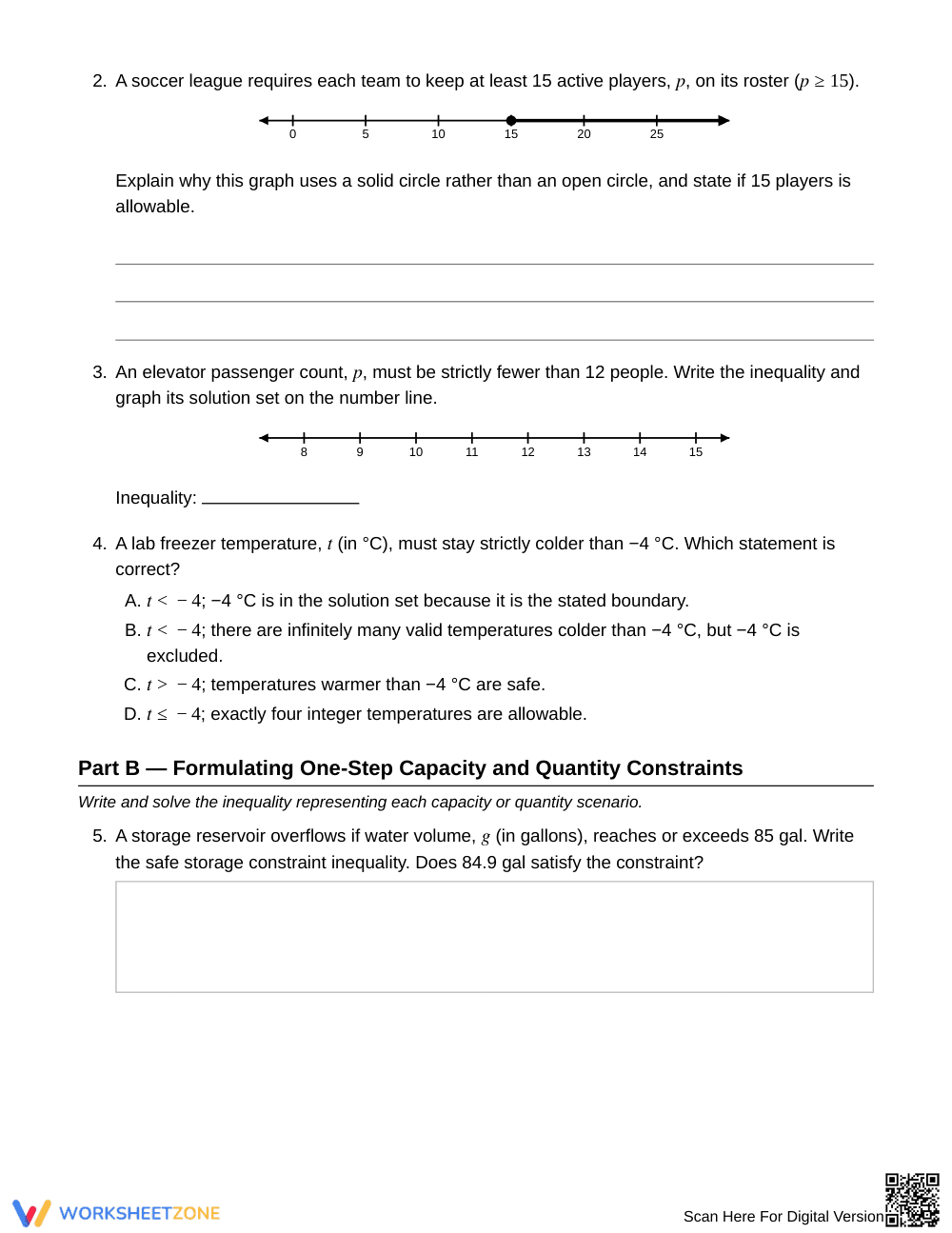
- Guided Practice (Part A, 4 problems): Students examine visual number line models and evaluate boundary values to distinguish between open and closed circles.
- Supported Practice (Part B, 4 problems): Learners formulate one-step capacity inequalities from word problems and determine whether threshold values satisfy each limit.
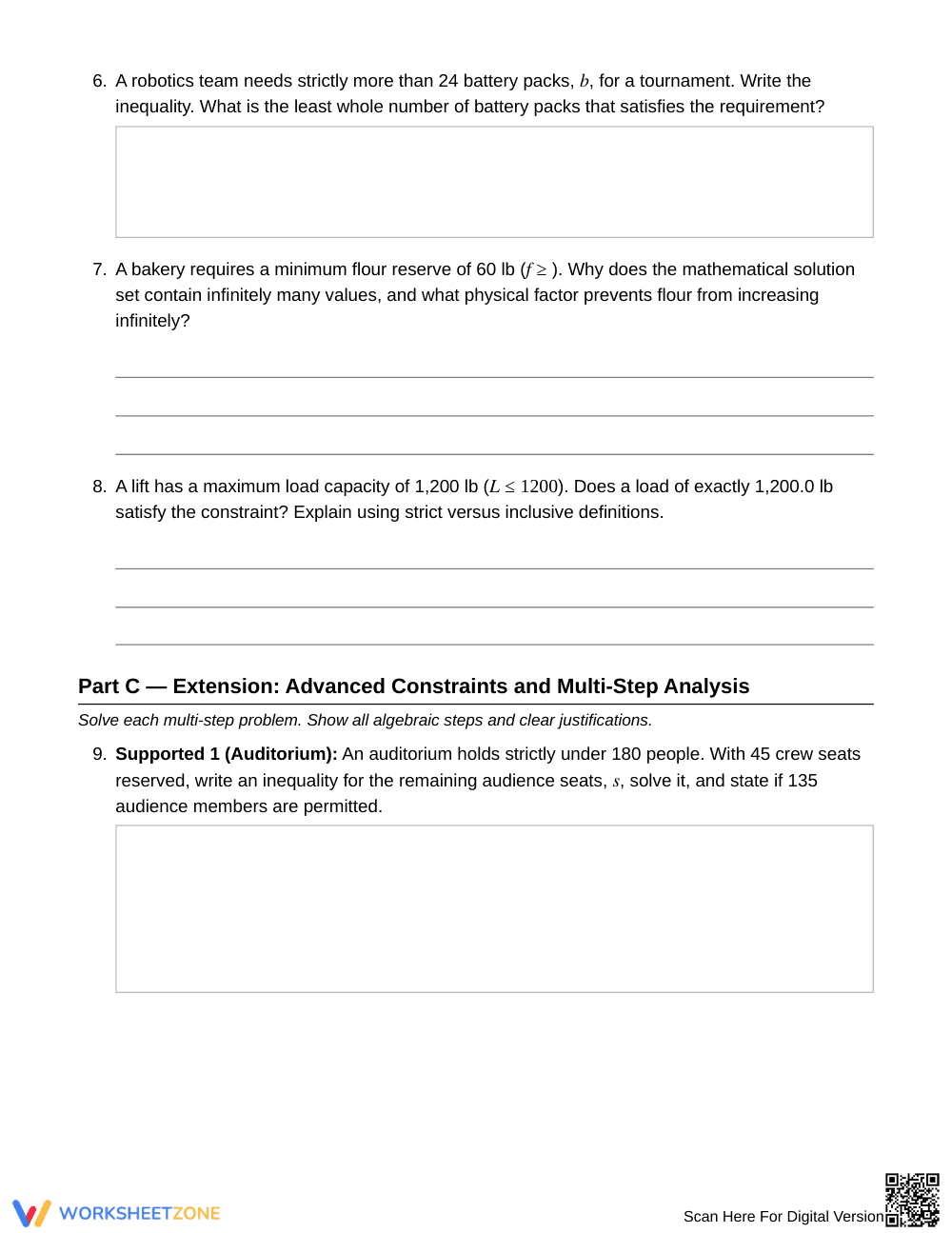
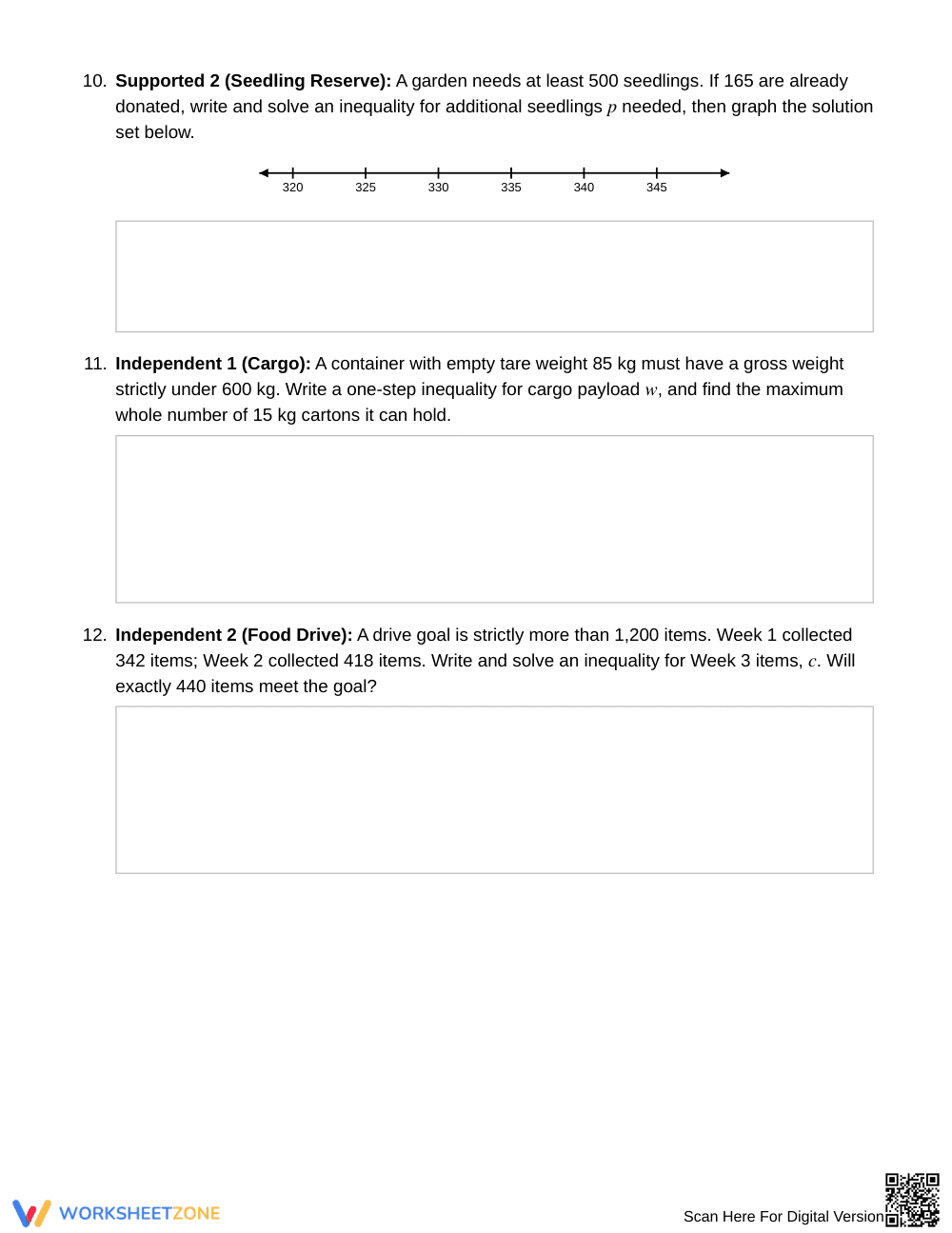
- Independent Practice (Part C, 6 problems): Students solve multi-step problems, graph remaining capacities, and construct an original scenario with written mathematical justification.
This gradual-release structure aligns with the I Do, We Do, You Do instructional framework to build independent algebraic competence.
Standards Alignment
The core activities target 6.EE.B.8: Write an inequality of the form x > c or x < c to represent a constraint or condition in a real-world problem, recognize infinitely many solutions, and represent solutions on number lines. Supporting standard 6.EE.B.5 reinforces variable substitution. Both standard codes can be copied directly into lesson plans, IEP goals, or district curriculum mapping tools.
How to Use It
Deploy this resource immediately after direct instruction on inequality symbols. During guided group work, check Part A to ensure students correctly interpret boundary inclusion before they begin writing algebraic inequalities in Part B. Use Part C as an independent exit task or partner station. The full resource typically requires 35 to 45 minutes of active instructional time.
Who It's For
This worksheet serves sixth-grade general education students, remedial math intervention groups, and special education classrooms targeting foundational algebraic expressions. Provide highlighters to help students isolate constraint boundary language, and pair this printable directly with a teacher-led mini-lesson on number line graphing.
Under CCSS standard 6.EE.B.8, Grade 6 students must learn to represent real-world constraints using one-step inequalities and interpret their infinite solution sets on number lines. According to Fisher & Frey (2014), structured gradual-release frameworks significantly improve student retention of abstract algebraic concepts by moving learners systematically from visual boundary identification to open-ended scenario construction. This worksheet operationalizes that instructional principle by providing 14 purposefully leveled tasks across 5 pages. Students evaluate strict versus inclusive boundary conditions, formulate algebraic inequalities from capacity and inventory contexts, and justify why boundary values either satisfy or fail mathematical constraints. The accompanying complete answer key offers worked numerical steps and graphing models that streamline teacher evaluation during guided or independent practice sessions. As a result, middle school educators obtain high-quality instructional materials that systematically build conceptual understanding of variable limits and real-world mathematical modeling.


