





























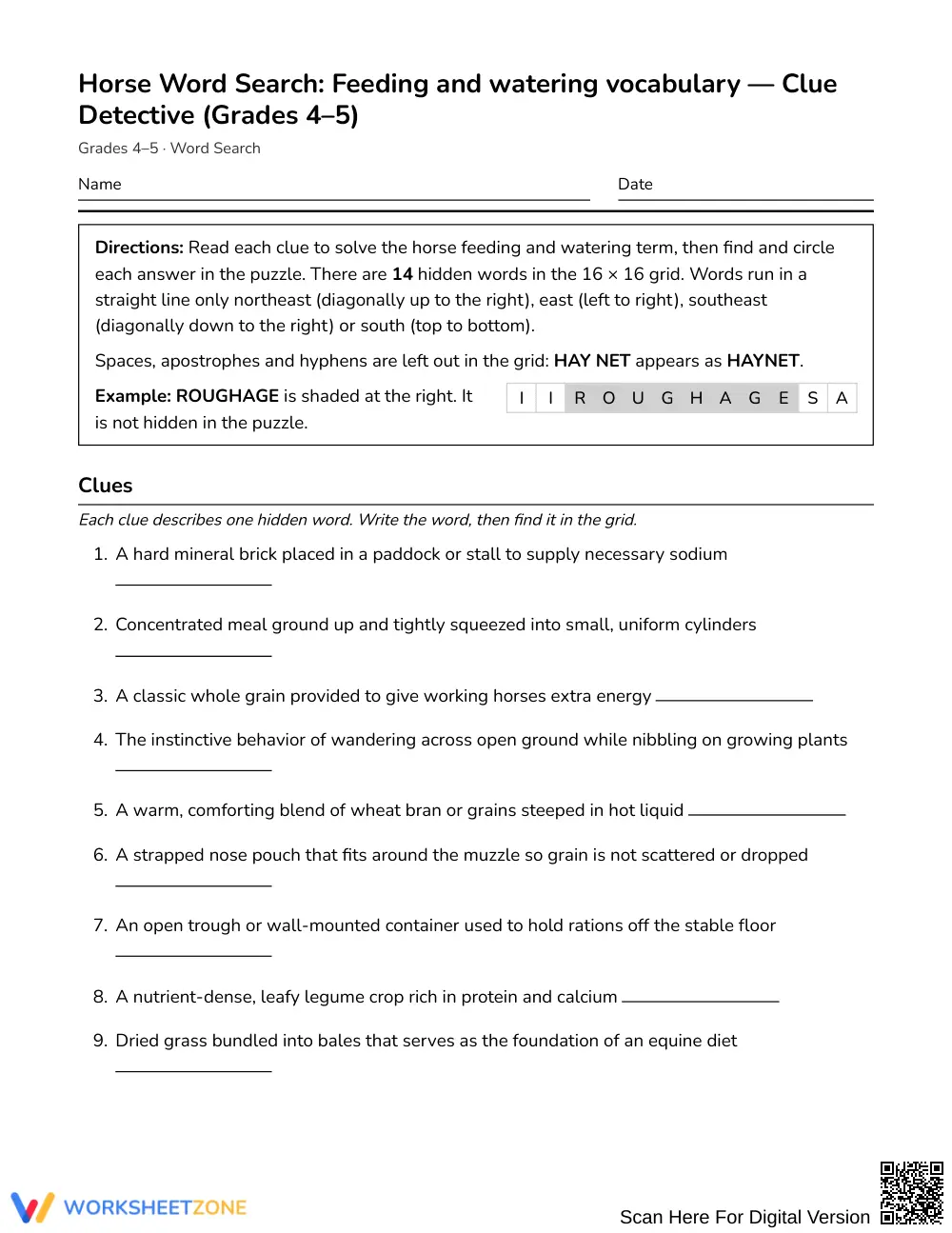


Essential Horse Feeding Word Search | Grades 4–5 ELA

Paste this activity's link or code into your existing LMS (Google Classroom, Canvas, Teams, Schoology, Moodle, etc.).
Students can open and work on the activity right away, with no student login required.
You'll still be able to track student progress and results from your teacher account.
This Grades 4–5 horse feeding and watering word search strengthens domain-specific vocabulary through active clue-based puzzle solving. Students read descriptive definitions of equine care terms, deduce the mystery vocabulary, and locate each hidden word across the grid. The activity reinforces animal science terminology during independent practice.
At a Glance
- Grade: Grades 4–5 upper elementary · Subject: English Language Arts (ELA)
- Standard: Not standards-assessed — vocabulary enrichment
- Skill Focus: Feeding and watering vocabulary
- Format: 3 printable pages · 14 words to discover · Answer key included · PDF
- Best For: Vocabulary enrichment, early finishers, and science integration
- Time: 20–30 minutes of focused work
This 3-page printable activity pack features a clue-driven word search puzzle containing 14 domain-specific vocabulary terms. Students read 14 informative definition clues describing equine feeding items to identify each word. The resource includes a shuffled word bank for scaffolding and a complete 3-page answer key showing exact letter paths for fast verification.
Puzzle Mechanics and Structure
The puzzle features a 16 x 16 letter grid containing 14 hidden vocabulary terms. Words run in four directions: northeast (NE), east (E), southeast (SE), and south (S). Students read each clue describing equine care, determine the correct term, verify it against the shuffled word bank, and locate it across the grid. This directional design challenges visual scanning without using backward spelling.
Standards Alignment
This resource is designed specifically for vocabulary enrichment and is not aligned to an assessed standard. It provides supplemental practice that develops equine science terminology and context-clue comprehension without formal standards testing constraints.
How to Use It
Use this word search after direct instruction on informational texts or during independent literacy centers. During the activity, observe whether students solve the clues before searching or rely primarily on word bank scanning. Learners typically complete the puzzle within 20 to 30 minutes.
Who It's For
This puzzle suits Grades 4–5 students developing non-fiction reading vocabulary. Support striving readers by reading the definition clues aloud, and challenge early finishers to write sentences using three target terms. It pairs naturally with an informational reading passage on horse nutrition.
Integrating clue-driven puzzle tasks into upper elementary classrooms strengthens domain-specific vocabulary retention and contextual literacy skills. Research by Fisher & Frey (2014) highlights that purposeful vocabulary acquisition requires intentional student engagement with specialized language rather than rote memorization of word lists. This Grades 4–5 equine feeding and watering vocabulary word search operationalizes that principle by requiring learners to decode descriptive definitions before locating 14 target terms across a 16 x 16 letter grid. By combining reading comprehension clues with active visual search mechanics, the activity reinforces conceptual understanding of terms such as forage, pasture, and trough. Although designed for supplemental enrichment rather than formal standards assessment, this print-ready resource offers educators a research-aligned tool that fosters independent word consciousness, promotes sustained task persistence, and reinforces agricultural science concepts across versatile literacy workstations and small-group learning environments.


