





























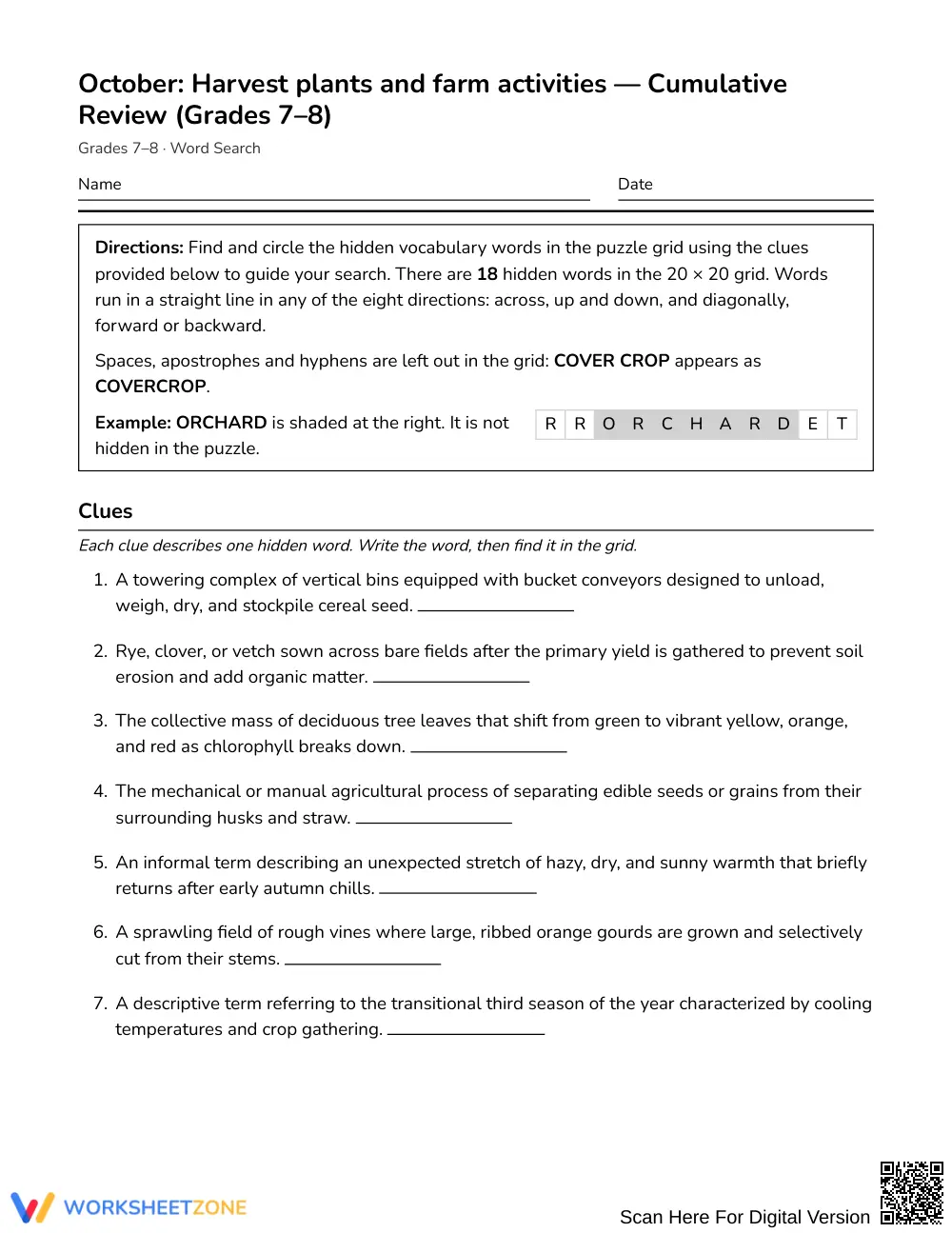

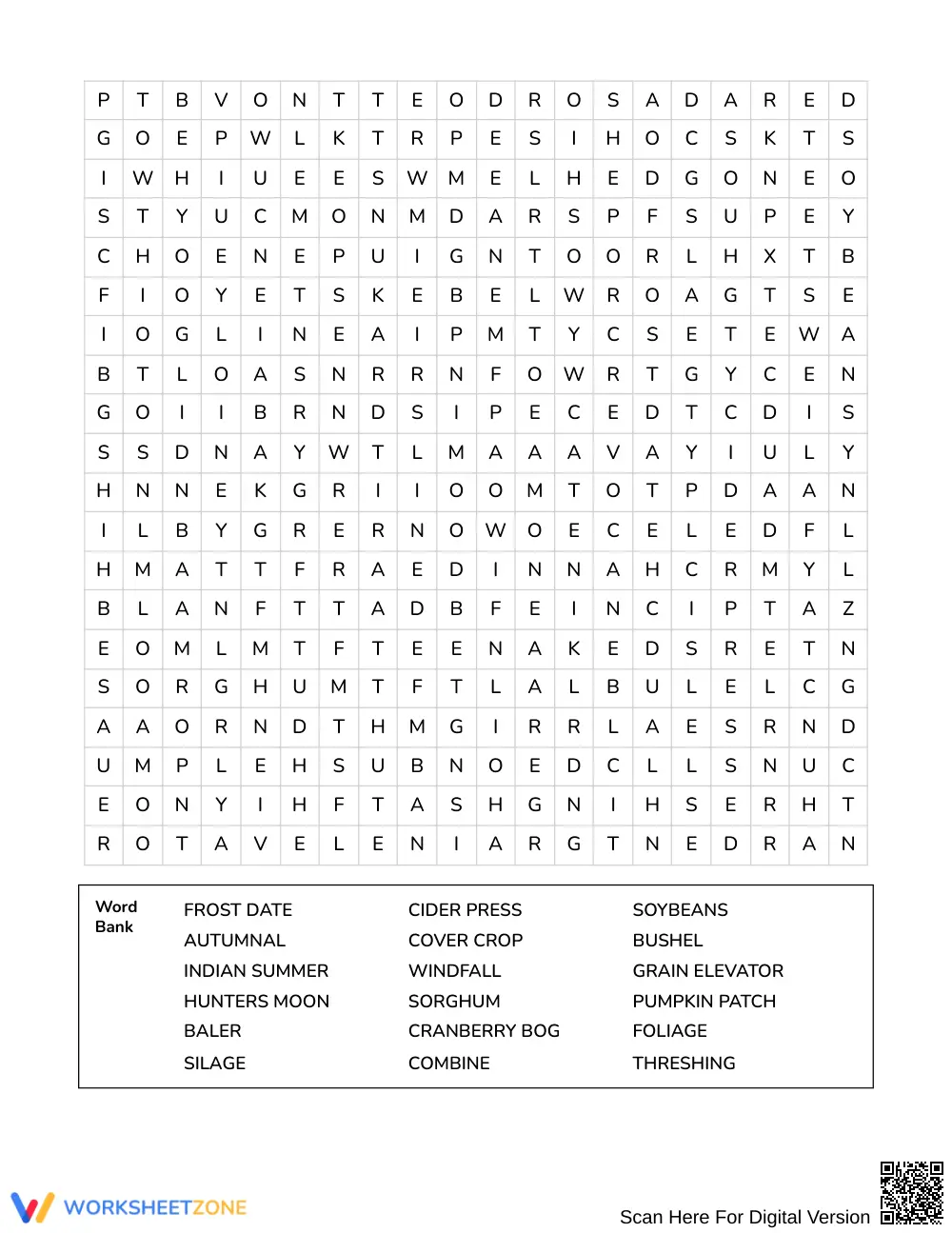


Essential Harvest Vocabulary Word Search | Grades 7–8 ELA

Paste this activity's link or code into your existing LMS (Google Classroom, Canvas, Teams, Schoology, Moodle, etc.).
Students can open and work on the activity right away, with no student login required.
You'll still be able to track student progress and results from your teacher account.
This harvest vocabulary word search builds agricultural and seasonal literacy across 18 targeted terms for Grades 7–8. Students read context clues to identify farming equipment, crops, and seasonal shifts before finding each hidden term. The activity strengthens academic vocabulary retention while delivering an engaging autumn review.
At a Glance
- Grade: Grades 7–8 · Subject: English Language Arts (ELA)
- Standard: Not standards-assessed — vocabulary enrichment
- Skill Focus: Harvest plants and farm activities
- Format: 3 pages · 18 words · Answer key included · PDF
- Best For: Seasonal vocabulary review and literacy centers
- Time: 25–35 minutes
What's Inside
This 3-page printable resource pairs an 18-word puzzle grid with comprehensive definition clues. Students explore machinery like combines and balers, agricultural terms like cover crops and silage, and seasonal markers like frost dates. A 4-page answer key provides complete letter-by-letter solutions for efficient grading.
Puzzle Architecture and Mechanics
The activity features a 20 x 20 letter grid designed for focused visual scanning. Words run in all 8 directions: north, northeast, east, southeast, south, southwest, west, and northwest. Rather than using an alphabetical list, students read clues to identify each term in a shuffled bank before locating it in the puzzle.
Standards Alignment
This activity provides targeted vocabulary enrichment and is not aligned to an assessed state academic standard. It reinforces seasonal and agricultural terminology through context-rich definitions rather than testing isolated standard mechanics.
How to Use It
Use this word search during an autumn thematic unit or following direct instruction on agricultural systems. For independent practice, assign it during literacy centers or as a bell ringer, allocating 25 to 35 minutes. Alternatively, have pairs verify clues collaboratively before searching. For formative assessment, check whether students can explain key terms like silage using clue details before confirming their grid locations.
Who It's For
Designed for Grades 7–8 English Language Arts or interdisciplinary science units, this puzzle benefits general education students and English learners requiring contextualized agricultural vocabulary. Pair it with an informational reading passage on crop harvesting or food production systems.
Direct exposure to domain-specific terminology plays a foundational role in adolescent reading comprehension and informational text mastery. As highlighted by Fisher & Frey (2014), intentional vocabulary instruction that pairs precise definitional clues with active cognitive retrieval significantly enhances long-term word memory compared to isolated rote memorization. This Grades 7–8 vocabulary enrichment activity targets harvest plants and farm activities, guiding learners through eighteen context-rich agricultural concepts including mechanical harvesters, soil preservation practices, and autumnal climate markers. By requiring students to interpret technical definitions before locating words across eight spatial vectors, the resource reinforces orthographic patterns and conceptual understanding concurrently. Structured vocabulary puzzles bridge the critical gap between incidental word exposure and active semantic retrieval, equipping middle grade students with the contextual background knowledge necessary to comprehend complex non-fiction literature across science, social studies, and agricultural disciplines.


