





























Essential Graham's Law Worksheet | Grades 9-12 Science
Paste this activity's link or code into your existing LMS (Google Classroom, Canvas, Teams, Schoology, Moodle, etc.).
Students can open and work on the activity right away, with no student login required.
You'll still be able to track student progress and results from your teacher account.
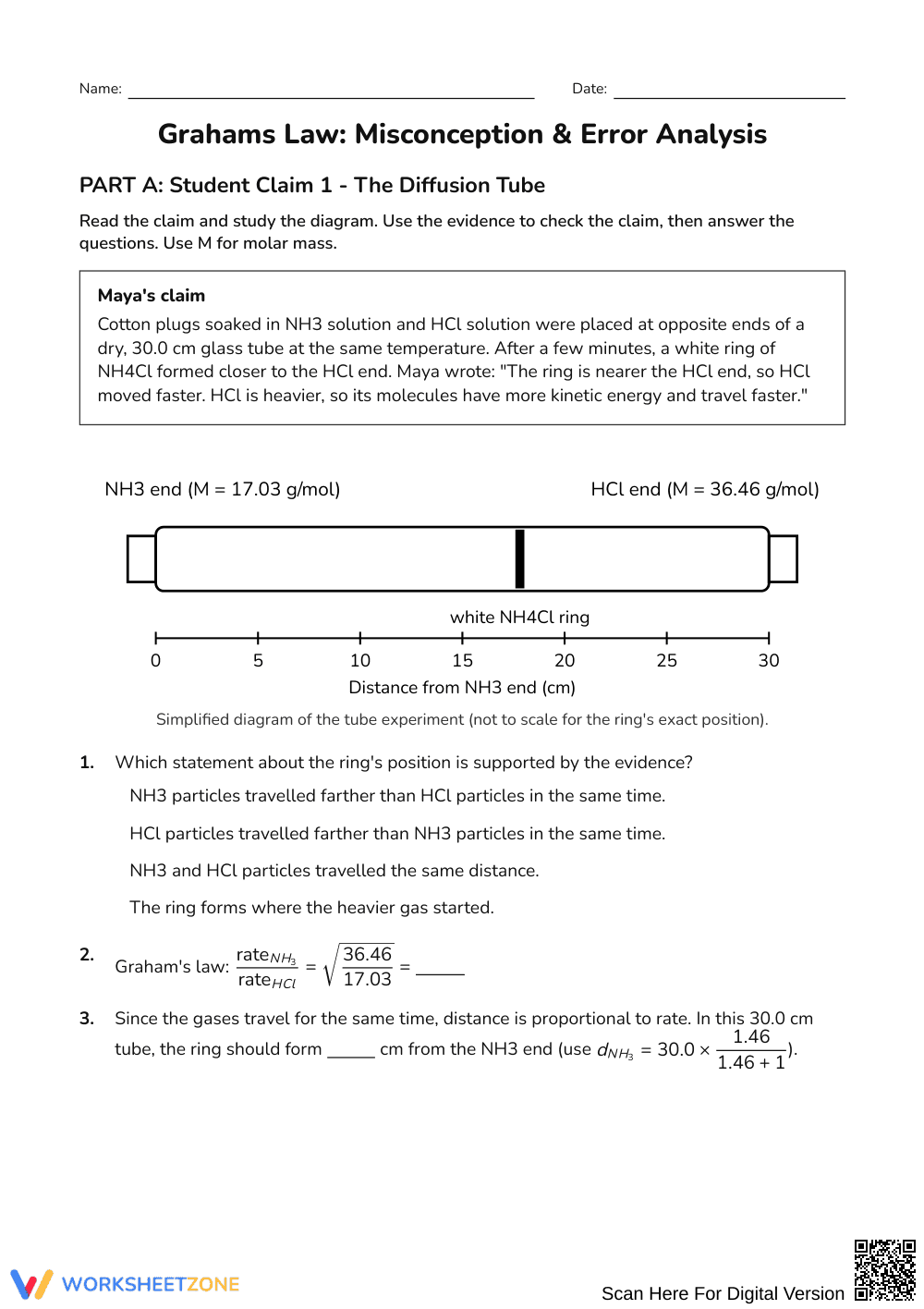
This high school chemistry worksheet trains students to critically evaluate, debunk, and recalculate flawed scientific assertions involving Graham's Law and kinetic molecular theory. Across four structured pages, learners analyze realistic peer claims, interpret laboratory apparatus models, evaluate effusion rate data, and mathematically justify inverse-square-root relationships between molecular mass and gas velocity.
At a Glance
- Grade: Grades 9–12 · Subject: Science
- Standard: Kinetic Molecular Theory — Relate molar mass, particle velocity, and effusion rates using Graham's law
- Skill Focus: Graham's Law misconception and error analysis
- Format: 4 pages · 16 problems · Answer key included · PDF
- Best For: Guided practice, misconception correction, and exam review
- Time: 45–60 minutes
What's Inside
The resource features 16 structured tasks organized around three flawed student assertions. Students examine a 30.0 cm diffusion tube diagram comparing ammonia and hydrogen chloride, evaluate a multi-gas effusion data table, and calculate quantitative rate changes using molar mass ratios. A complete 4-page answer key provides worked mathematical steps and model claim corrections.
Skill Progression
- Guided Practice (Part A, 4 tasks): Students evaluate an experimental diffusion tube diagram, identify two conceptual errors in an initial student claim, and rewrite the explanation using equal kinetic energy principles.
- Supported Practice (Part B, 6 tasks): Learners inspect a multi-gas pinhole model and effusion rate data table, contrasting experimental times with theoretical particle speeds to disprove mass-velocity misconceptions.
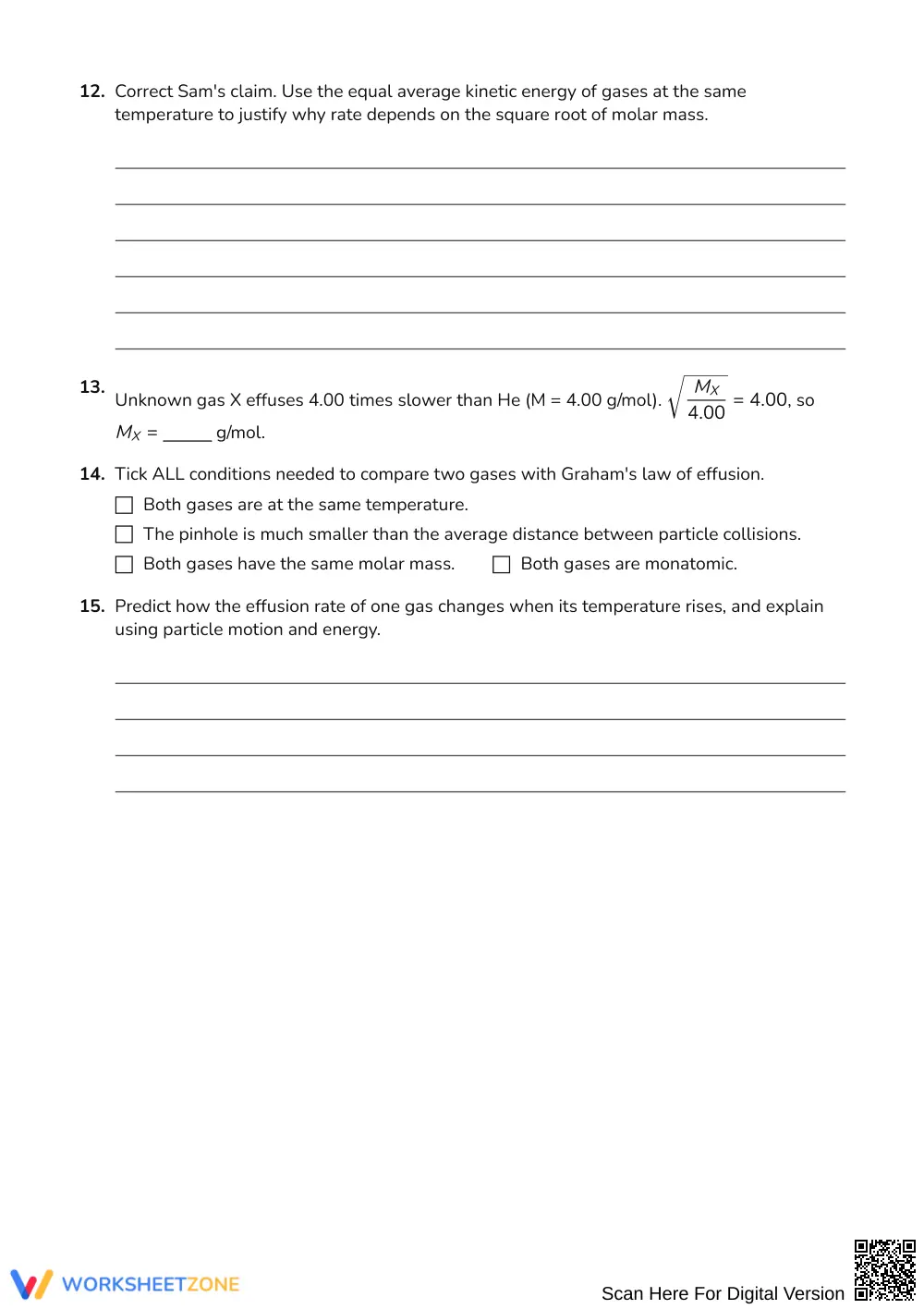
- Independent Practice (Part C, 6 tasks): Students solve quantitative inverse-square-root problems, derive molar masses of unknown gases, and specify necessary kinetic boundary conditions.
This structured progression reflects the gradual release of responsibility model, moving students systematically from qualitative diagnostic evaluation to independent mathematical proof.
Standards Alignment
This activity aligns with high school chemistry expectations for kinetic molecular theory and gas behavior. Students demonstrate that gas particles at equivalent temperatures share identical average kinetic energy, proving that effusion velocity varies inversely with the square root of molar mass. Curricular objectives can be copied directly into lesson plans, IEP goals, or district curriculum mapping tools.
How to Use It
Deploy this worksheet after direct instruction on kinetic molecular theory to target persistent misconceptions before summative testing. For formative assessment, monitor student responses to Part B, checking whether learners mistakenly equate particle mass with greater kinetic energy rather than lower velocity. The entire 4-page sequence requires 45 to 60 minutes of focused instructional time.
Who It's For
This worksheet serves general chemistry, honors chemistry, and AP Chemistry students tackling gas laws. Scaffolding notes and structured visual diagrams support emerging learners, while rigorous quantitative derivation challenges advanced students. Pair this activity with a physical diffusion tube demonstration or an interactive kinetic molecular theory computer simulation.
Targeting secondary science gas kinetics, this instructional resource builds mastery in Graham's Law error analysis by challenging learners to identify and correct conceptual fallacies. As highlighted by Fisher & Frey (2014), structured error analysis combined with guided mathematical justification prompts deeper metacognitive reflection than routine computation alone. Students reconcile kinetic molecular theory with observable effusion data by examining 16 targeted tasks spanning diffusion apparatus diagrams, comparative rate tables, and algebraic derivations. Learners explicitly evaluate why heavier gas molecules possess lower average velocities despite identical temperatures, grounding empirical observations in fundamental energy principles. Designed for high school chemistry classrooms, this ready-to-print resource establishes rigorous quantitative reasoning pathways that reinforce foundational physical science concepts and ensure durable conceptual retention.


