




























Essential Graham's Law Worksheet | Grades 9-12 Science
Paste this activity's link or code into your existing LMS (Google Classroom, Canvas, Teams, Schoology, Moodle, etc.).
Students can open and work on the activity right away, with no student login required.
You'll still be able to track student progress and results from your teacher account.
This Grades 9–12 chemistry worksheet gives students 30 structured problems analyzing Graham's law of effusion and diffusion. Students classify gas relationships, calculate relative effusion speeds, and connect molar mass to molecular velocity using kinetic molecular theory to master inverse-square proportions across laboratory scenarios.
At a Glance
- Grade: Grades 9–12 · Course: High School Science
- Standard: Relate gaseous effusion and diffusion rates inversely to molecular masses under identical conditions
- Skill Focus: Classification & Relationships in Graham's Law
- Format: 4 student pages · 30 structured problems · Full answer key included · PDF
- Best For: Core high school chemistry gas law practice
- Time: 45–60 minutes
What's Inside
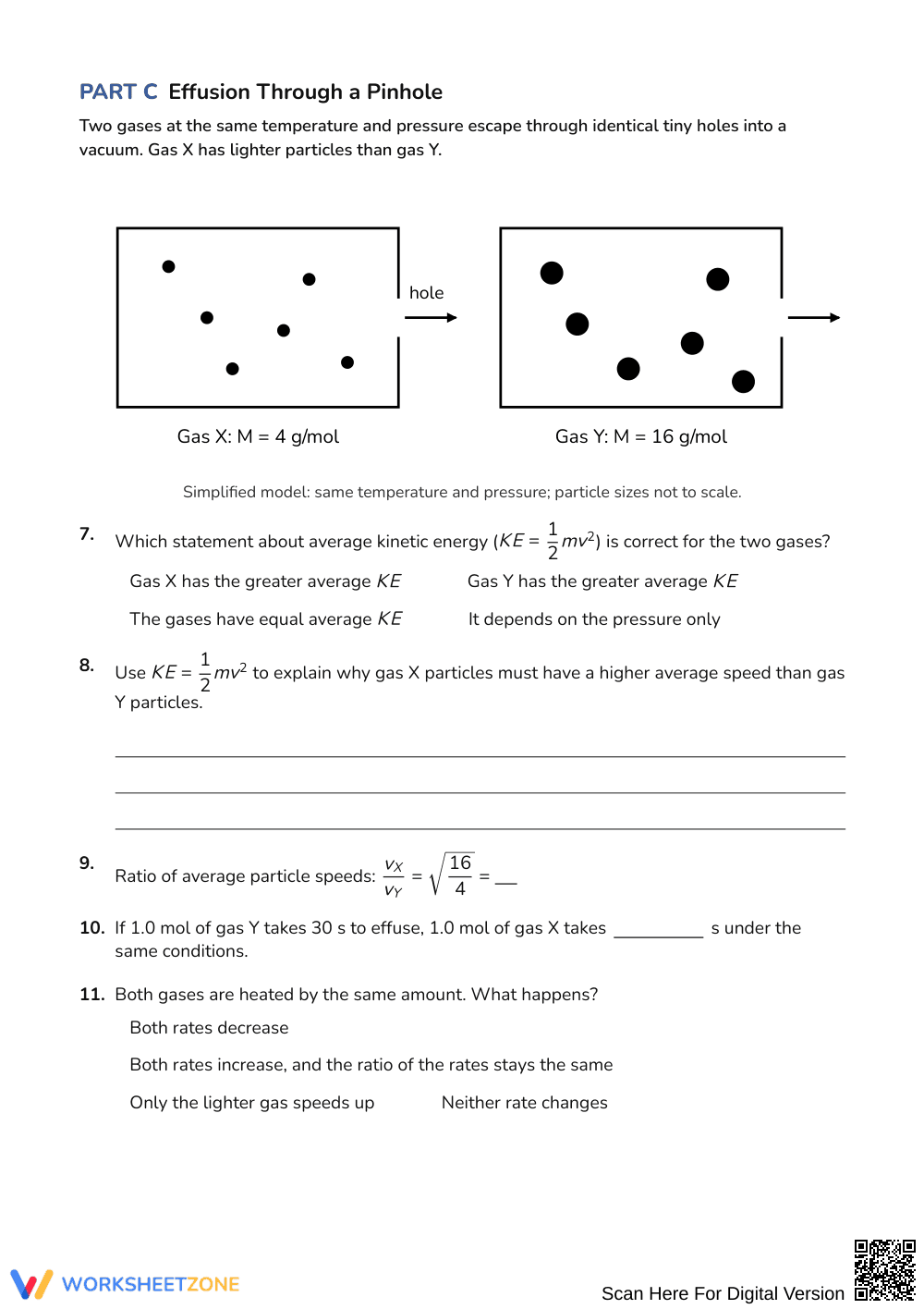
The 4-page student worksheet features 30 problems organized into four distinct sections. It includes a seven-gas reference table comparing rates against oxygen, a 100 cm diffusion tube diagram for ammonia and hydrochloric acid, pinhole vacuum effusion models, and unknown gas calculations, accompanied by a 4-page answer key.
Skill Progression
- Guided practice (Part A, 11 tasks): Students analyze a data table comparing relative rates, classify trends, and complete proportional matching statements.
- Supported practice (Parts B & C, 11 tasks): Students calculate diffusion distances in a tube model and determine particle speed ratios using kinetic energy formulas.
- Independent practice (Part D, 8 tasks): Learners solve for an unknown gas molar mass, classify gas pairs, and critique a temperature claim.
This sequence follows the gradual-release model, advancing from modeled data analysis to independent mathematical evaluation.
Standards Alignment
This worksheet aligns with high school physical science standards requiring students to use kinetic molecular theory to explain gas behaviors and calculate inverse-square relationships between particle mass and speed. These standard objectives can be copied directly into lesson plans, IEP goals, or district curriculum mapping tools.
How to Use It
Assign this worksheet directly after lecture instruction on Graham's law. Use Parts A and B for collaborative partner practice, then transition to Parts C and D for independent assessment. Formative tip: verify that students square rate ratios when calculating unknown molar masses in Part D. Completion takes 45 to 60 minutes.
Who It's For
This resource serves regular, Honors, and AP Chemistry high school students. Provide struggling learners with formula setup cards for inverse square roots, while advanced students can derive root-mean-square velocities. Pair this activity with an ammonia and hydrochloric acid diffusion tube demonstration to connect physical calculations to concrete laboratory observations.
High school physical science standards require students to analyze molecular motion and apply Graham's law to relate gas effusion and diffusion rates inversely to molar mass. This 4-page worksheet systematically operationalizes these standards across 30 scaffolded tasks, combining comparative data tables, diffusion tube models, and quantitative calculations. According to Fisher & Frey (2014), structuring chemistry problem sets through purposeful gradual release—shifting from modeled ratio tables to independent formula manipulation and conceptual critique—significantly improves student retention of abstract physical laws. By examining how particle mass governs molecular velocity at constant temperature, learners connect mathematical modeling directly to observable kinetic behavior. The structured progression ensures that high school chemistry students develop both computational fluency with square-root ratios and scientific argumentation skills when evaluating temperature and mass variables. Educators can integrate these exercises into unit assessments, guided laboratory extensions, or targeted remediation protocols.


