


























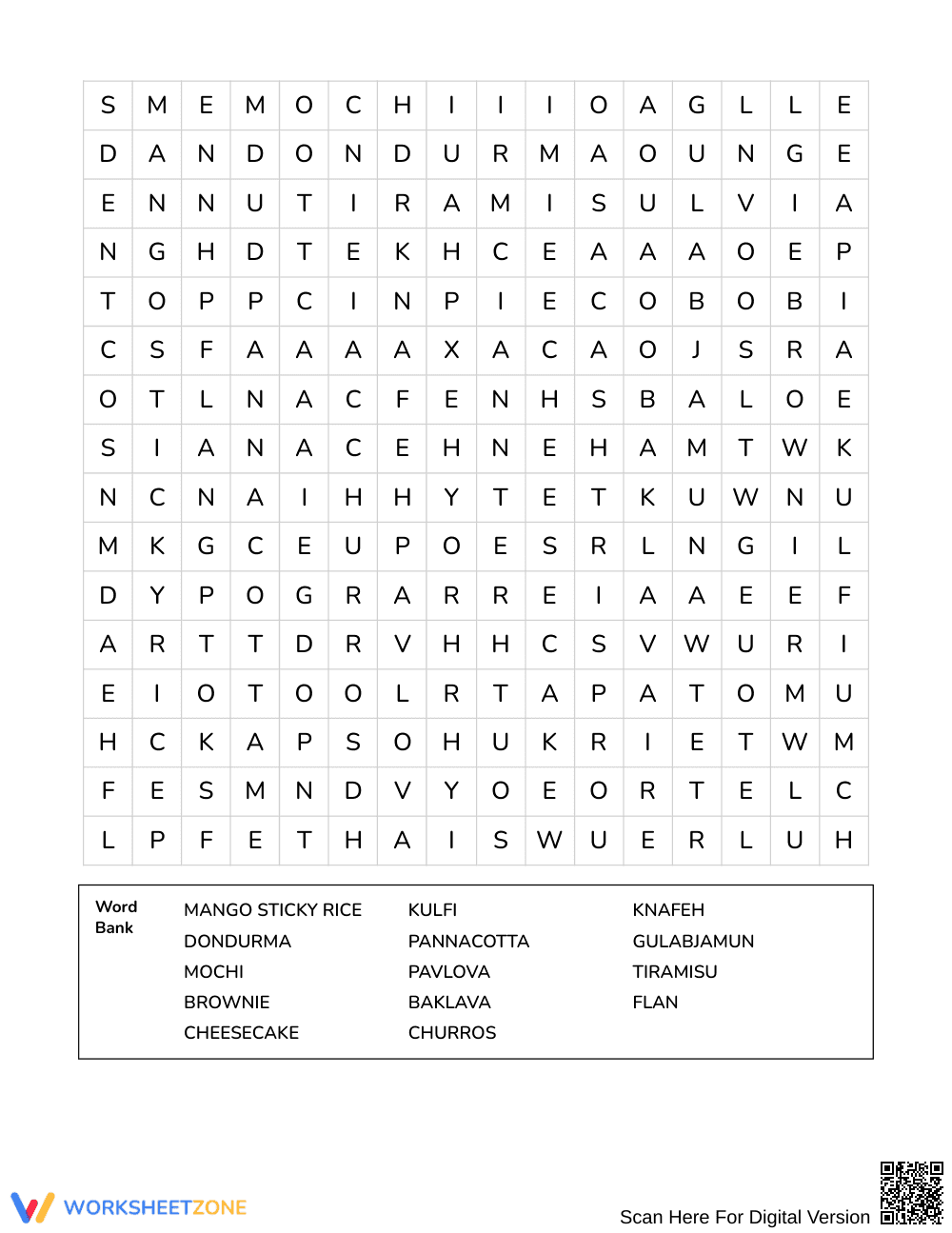

Essential Global Desserts Word Search | Grades 4–5 ELA
Paste this activity's link or code into your existing LMS (Google Classroom, Canvas, Teams, Schoology, Moodle, etc.).
Students can open and work on the activity right away, with no student login required.
You'll still be able to track student progress and results from your teacher account.
This Grades 4–5 vocabulary word search introduces learners to 14 sweet culinary traditions from around the globe. Students expand their descriptive language and world knowledge by reading contextual clues and locating targeted dessert terms. The activity builds cultural awareness and morphological recognition while reinforcing spelling in an engaging, puzzle-based format.
At a Glance
- Grade: Grades 4–5 · Subject: English Language Arts
- Standard: Not standards-assessed — vocabulary enrichment
- Skill Focus: Desserts from different culinary traditions
- Format: 3 pages · 14 words · Answer key included · PDF
- Best For: Vocabulary enrichment and cultural exploration
- Time: 20–30 minutes
Inside this 3-page printable activity, learners discover 14 international culinary terms paired with descriptive informational clues. The document features an organized puzzle grid alongside a shuffled word bank and corresponding cultural definitions. A complete 3-page answer key is provided to ensure rapid verification during independent work, partner checking, or whole-class review.
Puzzle Mechanics
The activity challenges students with a 16 x 16 letter grid where terms are placed across four distinct orientations: northeast, east, southeast, and south. Rather than relying on simple rote letter matching, learners read descriptive clues defining traditions such as Turkish dondurma, Indian gulab jamun, and Levant knafeh before locating the shuffled target words hidden across the grid.
Standards Alignment
This learning resource serves as an intentional vocabulary enrichment activity and is not aligned to a formal academic content standard. It reinforces multi-syllabic decoding, context-clue synthesis, and cross-cultural literacy through authentic informational definitions. Educators can integrate this supplemental word search during world cultures units, descriptive writing workshops, or seasonal culinary studies.
How to Use It
Deploy this activity after direct instruction on context clues or as a mid-unit transition exercise during informational reading studies. To assess formative comprehension, observe whether students read the culinary definitions before searching or locate terms solely from the list; prompting learners to explain what a specific dessert is before circling it checks active vocabulary acquisition. Completion requires approximately 20 to 30 minutes.
Who It's For
This resource is designed for upper elementary students in Grades 4–5 seeking vocabulary extension and world culture connections. For emerging multilingual learners, pair the puzzle with visual food reference cards or an illustrated world map to support conceptual association. It pairs naturally with an informational mentor text about world cuisines or a shared culinary anchor chart.
Integrating domain-specific vocabulary puzzles into upper elementary English Language Arts enhances word consciousness and orthographic mapping. According to Fisher & Frey (2014), intentional exposure to rich, contextualized terminology broadens background knowledge and strengthens schema development across diverse content areas. While traditional rote memorization often produces transient recall, puzzle-based activities requiring learners to synthesize semantic definitions with letter pattern recognition actively foster deeper cognitive engagement. This 14-word culinary activity exemplifies structured vocabulary enrichment by embedding descriptive cultural profiles alongside multi-directional grid navigation. Students in Grades 4–5 interact directly with global food traditions, reinforcing spelling conventions and expanding lexical repertoires through purposeful discovery. As documented in Fisher & Frey (2014), linking definition analysis with engaging word retrieval promotes durable language acquisition and cross-curricular concept retention, establishing a robust foundation for reading comprehension in complex informational texts across grade levels.


