





























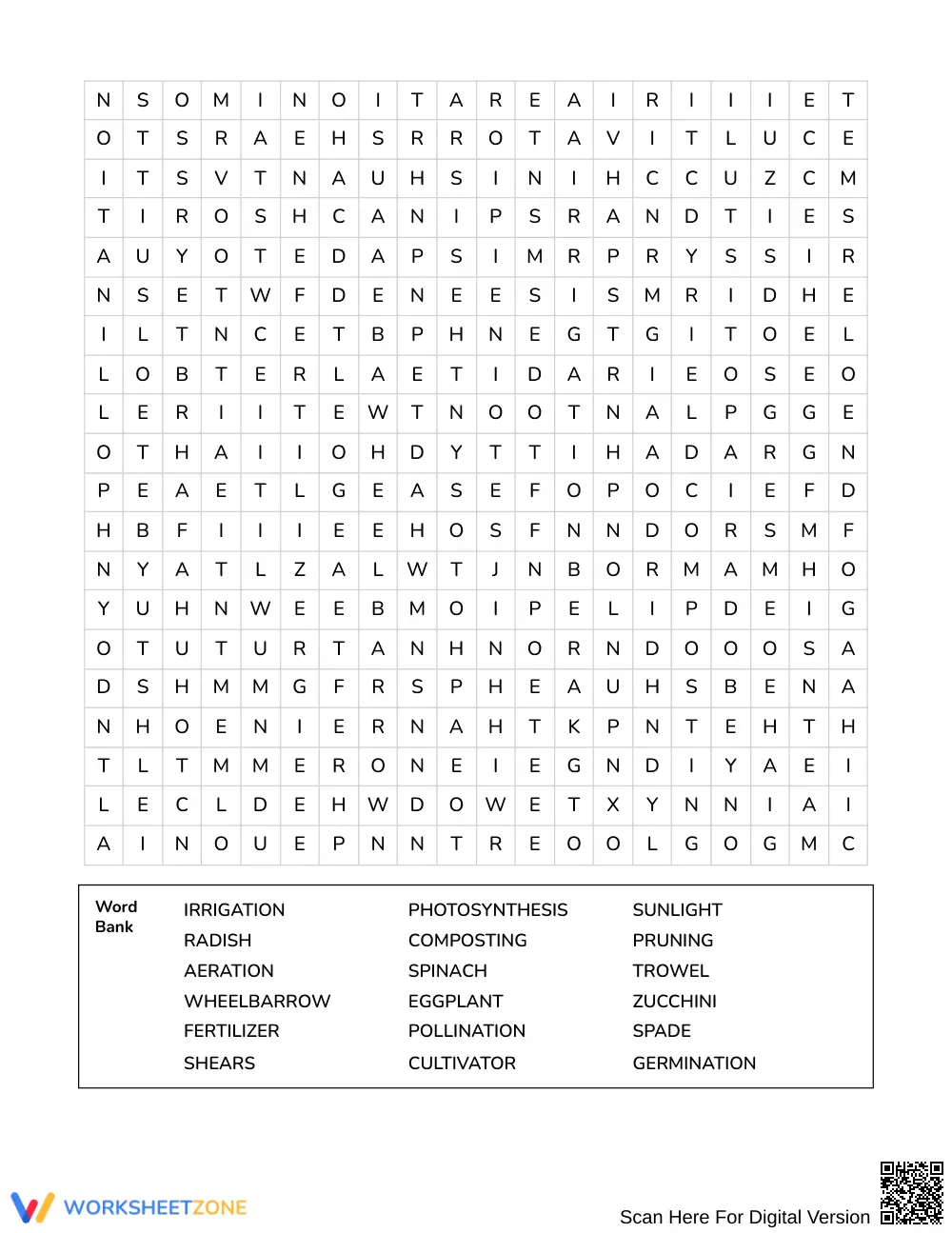


Essential Garden Vocabulary Word Search | Grades 7–8 ELA

Paste this activity's link or code into your existing LMS (Google Classroom, Canvas, Teams, Schoology, Moodle, etc.).
Students can open and work on the activity right away, with no student login required.
You'll still be able to track student progress and results from your teacher account.
This Grades 7–8 garden vocabulary word search reinforces domain-specific terminology covering agricultural tools, plant actions, and biological needs. Students read contextual definitions to determine 18 target vocabulary terms before hunting for each word in a 20 by 20 grid, strengthening spelling recognition and conceptual associations.
At a Glance
- Grade: Grades 7–8 · Subject: English Language Arts (ELA)
- Standard: Not standards-assessed — vocabulary enrichment
- Skill Focus: Tools, actions, and plant needs
- Format: 3 pages · 18 words · Answer key included · PDF
- Best For: Vocabulary enrichment and early finishers
- Time: 25–35 minutes
What's Inside
This 3-page printable PDF features an 18-word cumulative review puzzle accompanied by descriptive botanical clues. Rather than presenting a simple word list, the activity tasks students with matching technical definitions to horticultural equipment, botanical processes, and garden crops. A complete 4-page answer key provides clear grid solutions for rapid grading or student self-checking.
Puzzle Mechanics & Features
The puzzle is built upon a dense 20 by 20 letter grid designed to engage middle school learners. Hidden terms run across all 8 compass directions, including horizontal, vertical, and diagonal orientations: North, Northeast, East, Southeast, South, Southwest, West, and Northwest. The shuffled word list requires students to analyze the clue definitions first, linking concept comprehension to letter-pattern identification across reverse and overlapping paths.
Standards Alignment
This activity serves as supplemental vocabulary enrichment and is not aligned to a specific academic standard. It focuses on bolstering cross-curricular scientific and agricultural literacy, expanding students' working lexicons with domain-specific terms such as photosynthesis, aeration, and germination without formal standardized testing constraints.
How to Use It
Deploy this word search during an interdisciplinary science and ELA unit or as an independent post-lesson review after direct instruction on plant systems. For a second use case, assign it as a meaningful sub plan or productive warm-up routine. During the activity, circulate to observe whether learners solve the conceptual clues independently or rely on scanning random letter sequences. Most middle school students will complete the search within 25 to 35 minutes.
Who It's For
This activity is designed for middle school students in Grades 7–8 requiring purposeful vocabulary reinforcement in English Language Arts and life sciences. It easily accommodates diverse learning needs; educators can highlight initial letters for emerging readers or challenge advanced students to write original sentences using five discovered words. Pair this puzzle with an informational reading passage on sustainable agriculture.
Vocabulary acquisition research highlighted by Fisher & Frey (2014) emphasizes that intentional exposure to domain-specific terminology across varied modalities strengthens reading comprehension, orthographic processing, and long-term memory retention. By integrating definitional clues with visual word-search mechanics, learners must actively retrieve conceptual knowledge regarding tools, actions, and plant needs before executing spatial search patterns across the grid. This dual-processing cognitive approach deepens orthographic mapping and lexical access for complex scientific terms such as aeration, irrigation, germination, and photosynthesis. While this activity serves as non-assessed vocabulary enrichment rather than a standard-aligned metric, structured lexical puzzles provide meaningful low-stakes practice that consolidates academic language across interdisciplinary subjects. Incorporating multi-directional letter tracking in all eight compass directions fosters sustained cognitive engagement and visual discrimination, supporting middle school literacy development and agricultural science comprehension across diverse general education and supplemental learning environments.


