




























Views
Downloads


Essential Garden Tasks Word Search | Grades 6–7 ELA

Paste this activity's link or code into your existing LMS (Google Classroom, Canvas, Teams, Schoology, Moodle, etc.).
Students can open and work on the activity right away, with no student login required.
You'll still be able to track student progress and results from your teacher account.
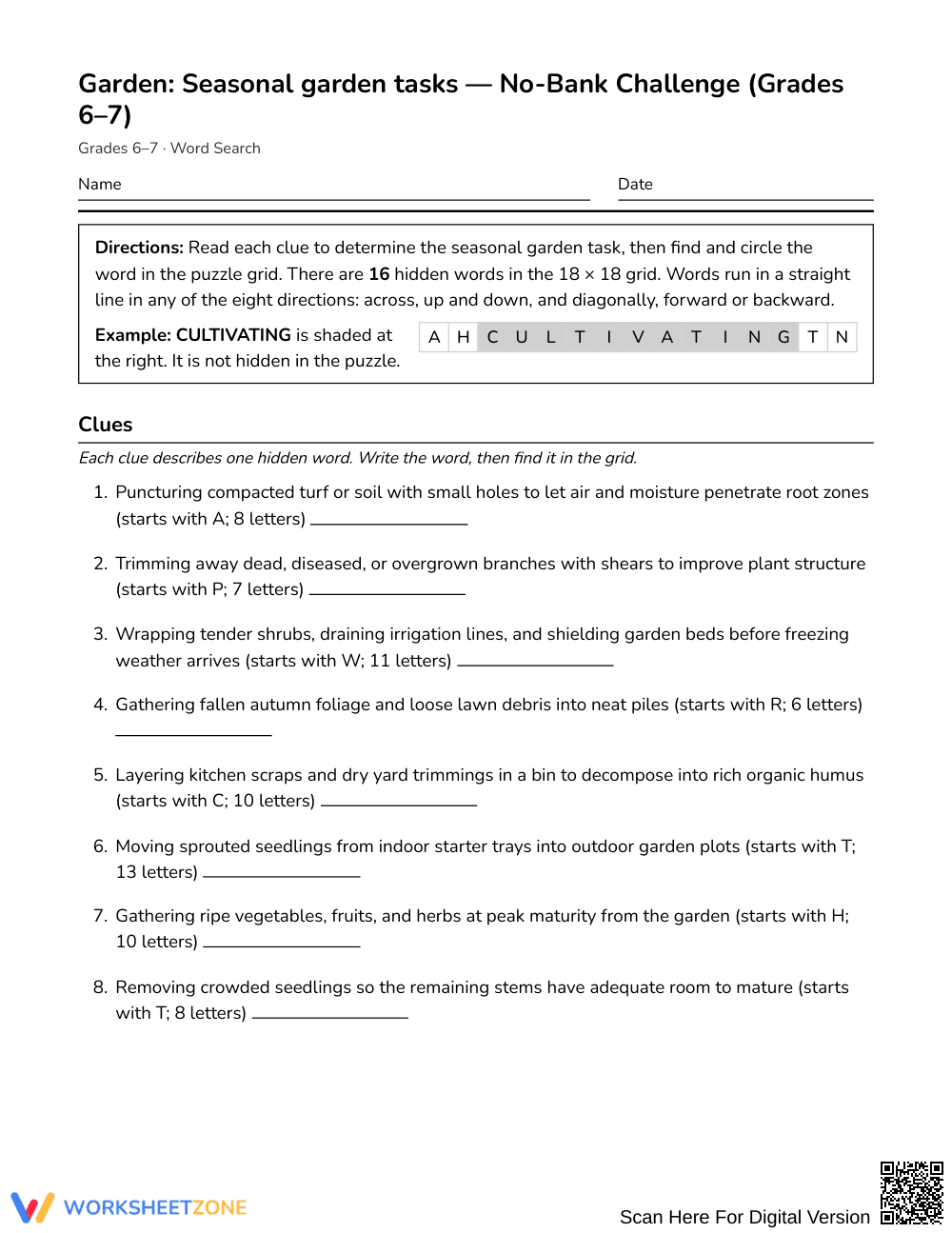
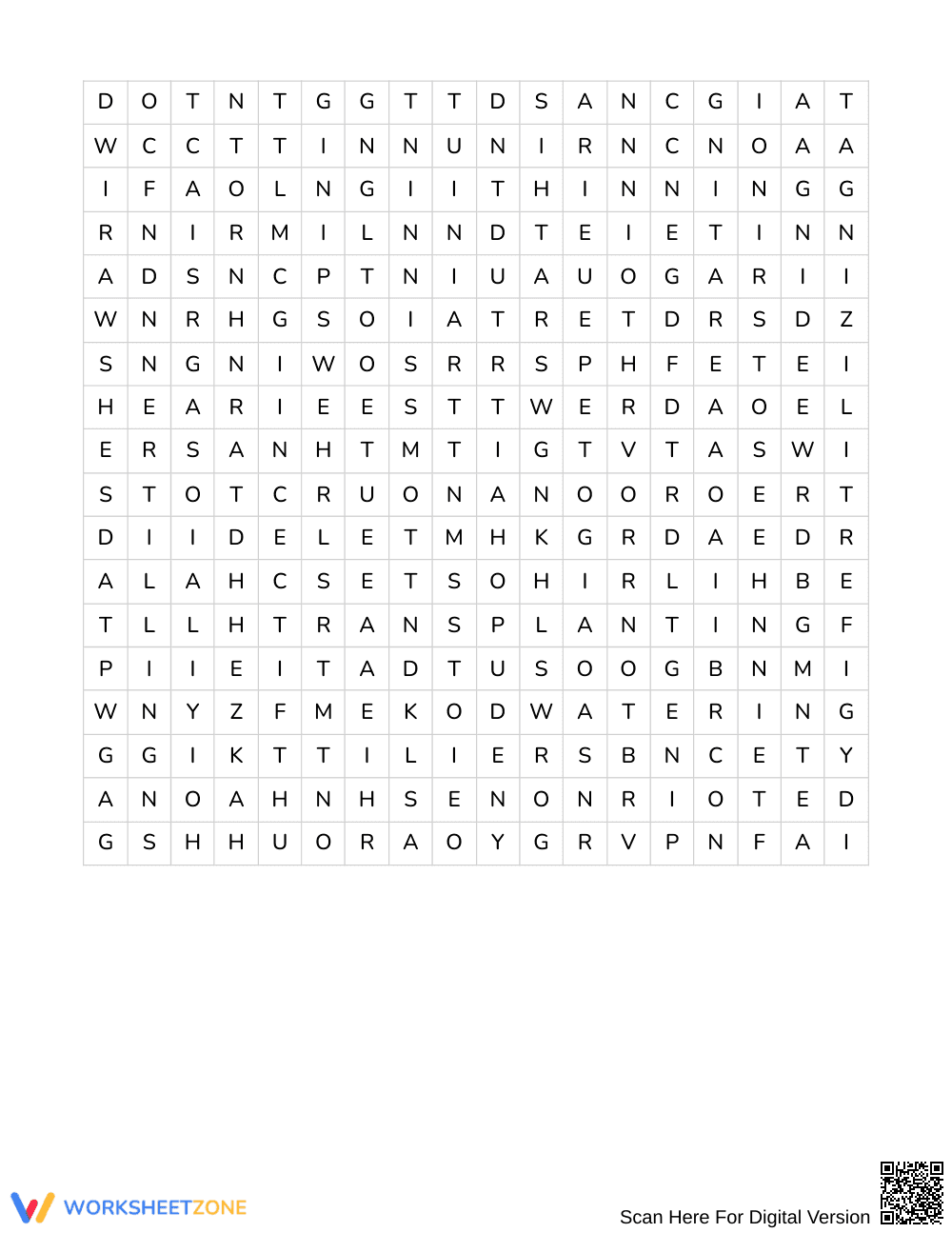
This seasonal garden tasks word search strengthens vocabulary acquisition for middle school learners through contextual problem-solving. Students read descriptive botanical and horticultural definitions, determine the corresponding action term, and locate it within the letter grid. The activity reinforces domain-specific terminology while engaging critical thinking and visual scanning skills across 16 high-utility agricultural words.
At a Glance
- Grade: Grades 6–7 · Subject: English Language Arts (ELA)
- Standard: Not standards-assessed — vocabulary enrichment
- Skill Focus: Seasonal garden tasks
- Format: 3 pages · 16 words · Answer key included · PDF
- Best For: Independent vocabulary review or extension
- Time: 20–35 minutes
What's Inside
This 3-page printable activity features a clean, student-facing puzzle layout alongside detailed definitions. Instead of relying on a passive word bank, students must actively read 16 descriptive clues detailing actions such as aerating, deadheading, mulching, and winterizing. The document package includes a complete 4-page answer key showing exact letter coordinates and highlighted word placements for quick, effortless grading.
Puzzle Mechanics and Structure
The word search utilizes an 18 x 18 grid designed specifically to challenge intermediate readers. Because no word bank is provided, learners must deduce each target term directly from its functional definition before initiating their search. Hidden words run across all eight possible directions: north, northeast, east, southeast, south, southwest, west, and northwest. This multidirectional orientation demands sustained attention and spatial analysis.
Standards Alignment
This resource serves as targeted vocabulary enrichment and is not aligned to an assessed state standard. It reinforces general academic and domain-specific language acquisition through applied context clues, supporting broader literacy development across science and informational text units.
How to Use It
Deploy this puzzle as an independent application activity after direct instruction on context clues or botanical science concepts. Alternatively, assign it as a self-directed station during literacy rotations or as an engaging sub plan. For formative assessment, observe whether students deduce the word before scanning the grid or rely on letter guessing, noting which definitions require instructional clarification. Most students complete the activity within 20 to 35 minutes.
Who It's For
Designed specifically for learners in Grades 6–7, this resource provides an age-appropriate balance of rigor and engagement. It supports general education students, gifted learners seeking an unassisted challenge, and English language learners needing contextual vocabulary practice. Pair this puzzle with an informational reading passage on sustainable agriculture or plant lifecycles for an integrated interdisciplinary unit.
According to Fisher & Frey (2014), intentional vocabulary acquisition requires students to encounter content-specific terms through multiple modalities, including definition retrieval and spatial word analysis. This 16-word seasonal garden tasks activity challenges intermediate learners in Grades 6–7 to process nuanced horticultural descriptions rather than merely matching identical letter strings from a list. By eliminating the standard word bank, the design requires pupils to generate target terms through active recall of morphological and contextual clues before locating them in an 18 x 18 letter matrix. Research demonstrates that pairing semantic clues with focused orthographic searching strengthens lexical retention and orthographic mapping. This resource operates as a rigorous supplement for agricultural science or informational text units, grounding academic vocabulary in practical, real-world procedures.


