



























Essential Functional Diversity Worksheet | Grade 12 Science
Paste this activity's link or code into your existing LMS (Google Classroom, Canvas, Teams, Schoology, Moodle, etc.).
Students can open and work on the activity right away, with no student login required.
You'll still be able to track student progress and results from your teacher account.
This Grade 12 environmental science worksheet trains students to quantify and evaluate how species richness, species evenness, and functional diversity govern ecological stability. Learners analyze synthetic riparian monitoring data and estuarine marsh disruptions, determining how functional redundancy and trait complementarity prevent catastrophic ecosystem collapse following severe pulse disturbances.
At a Glance
- Grade: 12 · Subject: Environmental & Earth/Space Science
- Standard: Evaluate how biodiversity dimensions influence ecological stability and resilience
- Skill Focus: Species Richness, Evenness, and Functional Diversity
- Format: 5 pages · 12 analytical problems · Full answer key included · PDF format
- Best For: Advanced disturbance ecology analysis and exam prep
- Time: 45–60 minutes
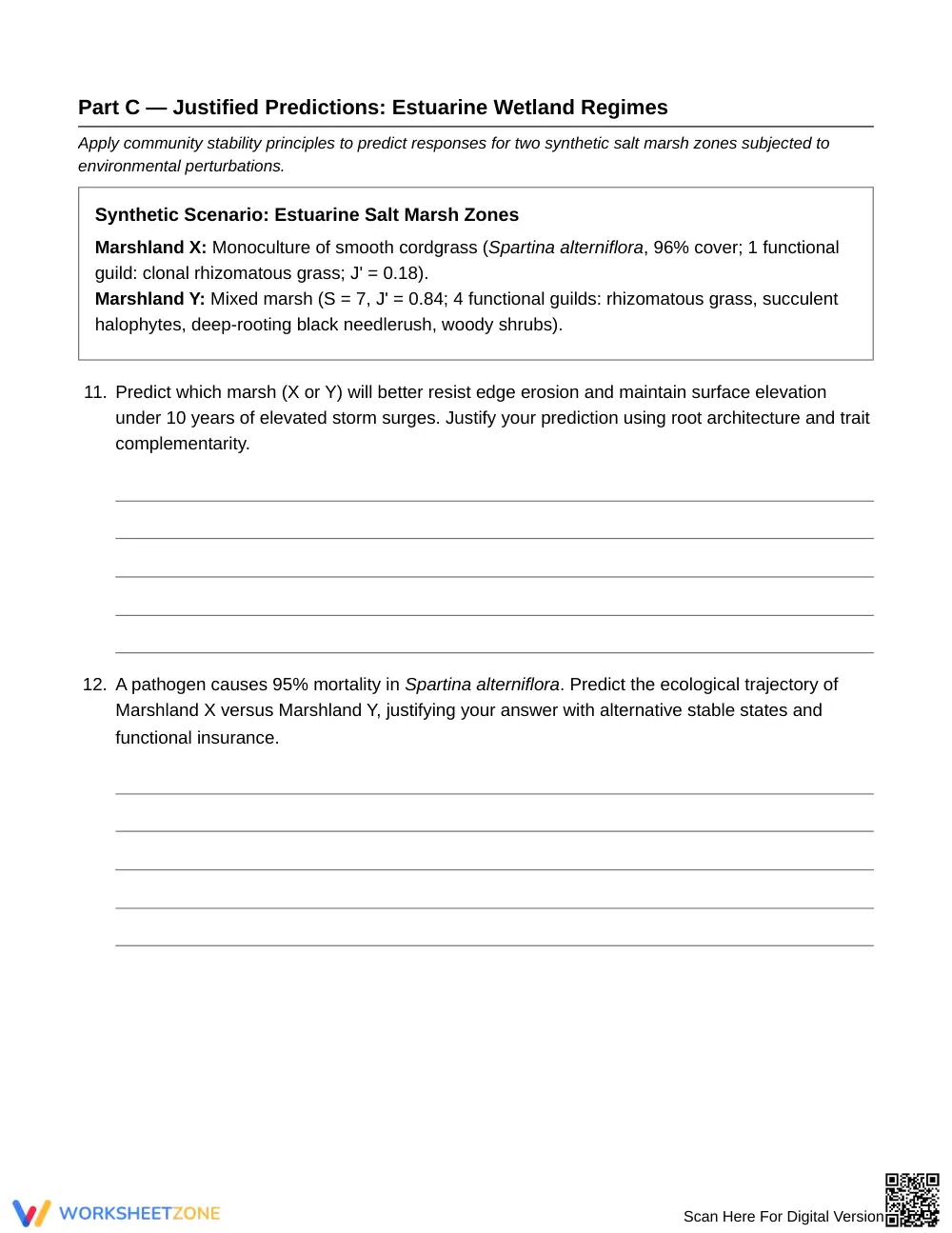
The 5-page worksheet features 12 data-driven analytical items divided across three progressive sections, supported by a 3-page explanatory answer key. Students interpret a synthetic monitoring dataset contrasting pre-fire and post-fire net primary productivity across six functional guilds. The resource incorporates comparative community scenarios, trait tables, and estuarine erosion case studies without multiple-choice items.
Skill Progression
- Guided practice (Problems 1–4): Foundational prompts guide students to contrast structural equitability with taxonomic richness and define parameters for ecological resistance and resilience.
- Supported practice (Problems 5–10): Data interpretation prompts require students to compute productivity loss, evaluate hyper-dominance risks, and link functional redundancy to nutrient cycling.
- Independent practice (Problems 11–12): High-level synthesis prompts challenge students to predict alternative stable states and erosion resistance under severe coastal disturbances.
This gradual-release structure moves learners from core principles into complex quantitative dataset analysis and unassisted predictive modeling.
Standards Alignment
This worksheet aligns with high school standards in Ecosystem Dynamics, Functioning, and Resilience by engaging students in evaluating mathematical data on biodiversity metrics and ecosystem stability. Students analyze how functional redundancy and species evenness stabilize biomes following pulse disturbances. Both standard codes can be copied directly into lesson plans, IEP goals, or district curriculum mapping tools.
How to Use It
Deploy this worksheet following direct instruction on community diversity indices or as a mid-unit analytical lab across 45 to 60 minutes. For formative assessment, examine Problem 6 to ensure students attribute resilience in Plot Gamma to functional guild breadth rather than simple richness. You can also assign Part B for collaborative group analysis and reserve Part C as an individual assessment.
Who It's For
This assignment is designed for Grade 12 Environmental Science, AP Environmental Science, and advanced ecology courses. Scaffolding is built in through structured dataset tables and clear comparative parameters, while high-achieving students engage in calculating non-linear biomass collapse. Pair this lesson naturally with a direct instruction lecture on disturbance ecology or ecological succession regimes.
Rigorous secondary science instruction requires students to evaluate multi-dimensional ecosystem stability rather than treating biodiversity as a simple species count. According to Fisher & Frey (2014), scaffolding complex ecological data through a structured gradual-release architecture significantly strengthens student capacity to evaluate scientific evidence and model ecological phenomena. This Grade 12 environmental science resource equips learners to analyze species richness, species evenness, and functional diversity across realistic disturbance contexts. By interrogating synthetic riparian wildfire datasets and estuarine monoculture regimes, students master how trait complementarity, niche redundancy, and community equitability safeguard critical ecosystem services against catastrophic collapse. The structured progression moves from theoretical metric differentiation to complex calculations of net primary productivity losses and abiotic nutrient destabilization. High school educators can utilize these twelve focused analytical tasks to build verified student mastery in quantitative disturbance ecology, ecological resilience modeling, and evidence-based environmental argumentation.


