































Essential Frozen Desserts Word Search | Grades 7–8 ELA

Paste this activity's link or code into your existing LMS (Google Classroom, Canvas, Teams, Schoology, Moodle, etc.).
Students can open and work on the activity right away, with no student login required.
You'll still be able to track student progress and results from your teacher account.
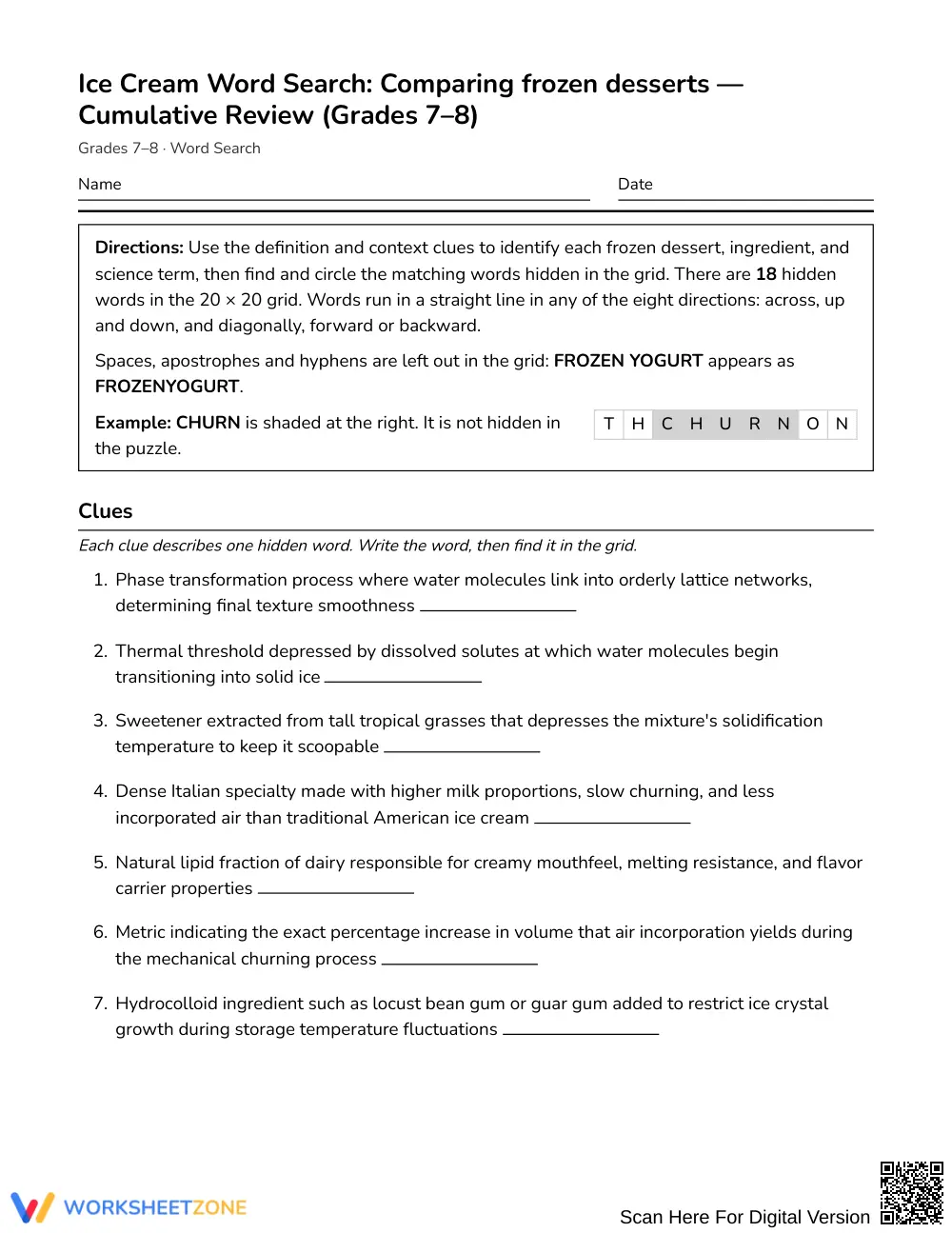
This Grades 7–8 vocabulary word search challenges students to explore the culinary and physical science behind frozen confections. Learners examine contextual definitions to identify 18 specialized terms—including gelato, granita, overrun, and crystallization—before locating them in the puzzle grid. The activity reinforces precise domain-specific language while building content-area reading comprehension.
At a Glance
- Grade: Grades 7–8 · Subject: English Language Arts
- Standard: Not standards-assessed — vocabulary enrichment
- Skill Focus: Comparing frozen desserts vocabulary
- Format: 3 pages · 18 words · Answer key included · PDF
- Best For: Vocabulary enrichment and culinary science review
- Time: 25–35 minutes
The 3-page printable includes an 18-word puzzle featuring descriptive clues that double as definitions for each frozen confection, ingredient, and food science concept. Students match each clue to its term using a shuffled word bank before locating the entry within the letter matrix. A comprehensive 4-page answer key provides clear solution paths for fast verification and student self-checking.
Puzzle Structure and Mechanics
This vocabulary search uses a dense puzzle layout designed to sustain student engagement without requiring multi-tiered scaffolding:
- 20 x 20 Letter Grid: A substantial letter grid accommodates complex multi-word entries, requiring sustained visual scanning.
- Eight Directional Paths: Words run in all directions—north, northeast, east, southeast, south, southwest, west, and northwest—offering an authentic cognitive challenge.
- Clues and Shuffled Bank: Students read thorough technical clues, check their deductions against a shuffled word bank, and locate each term.
Standards Alignment
This activity serves strictly as vocabulary enrichment and is not aligned to an assessed state standard. Teachers can integrate this resource across multidisciplinary units that bridge middle school informational text reading, technical food science, and culinary arts vocabulary without modifying standardized lesson pacing.
How to Use It
Use this word search after direct instruction on informational text structures or food science concepts as an engaging reinforcement activity. It also operates effectively as a purposeful sponge activity or independent task during stations. During the activity, circulate to monitor how students interpret clues; check whether learners infer technical definitions like viscosity or overrun from context before seeking the terms. Students typically finish the puzzle in 25 to 35 minutes.
Who It's For
This resource is designed for Grades 7–8 English Language Arts students, middle school family and consumer science classes, or cross-curricular STEM enrichment groups. For students needing visual accommodations, provide highlighters to mark found terms directly in the grid. Pair this activity with an informational reading passage on food chemistry or thermal phase changes to deepen contextual comprehension.
Vocabulary acquisition in the intermediate grades relies heavily on contextual exposure and structural reinforcement of domain-specific terminology. According to Fisher & Frey (2014), intentional word study that connects definitions to active recognition tasks enhances semantic retention and disciplinary literacy. This 18-word puzzle develops student competence in comparing frozen desserts by pairing rigorous definitions of confectionery science—such as crystallization, overrun, and butterfat—with visual pattern search strategies. Rather than passively memorizing definitions, middle school learners synthesize clue descriptions to verify word identities before scanning an authentic 20 by 20 letter matrix across eight directional orientations. The inclusion of full-page answer keys ensures timely feedback, allowing educators to gauge student mastery of content-area vocabulary efficiently. Consequently, this resource delivers targeted lexical practice that supports cross-curricular reading comprehension across both English Language Arts and introductory food science curricula.


