





























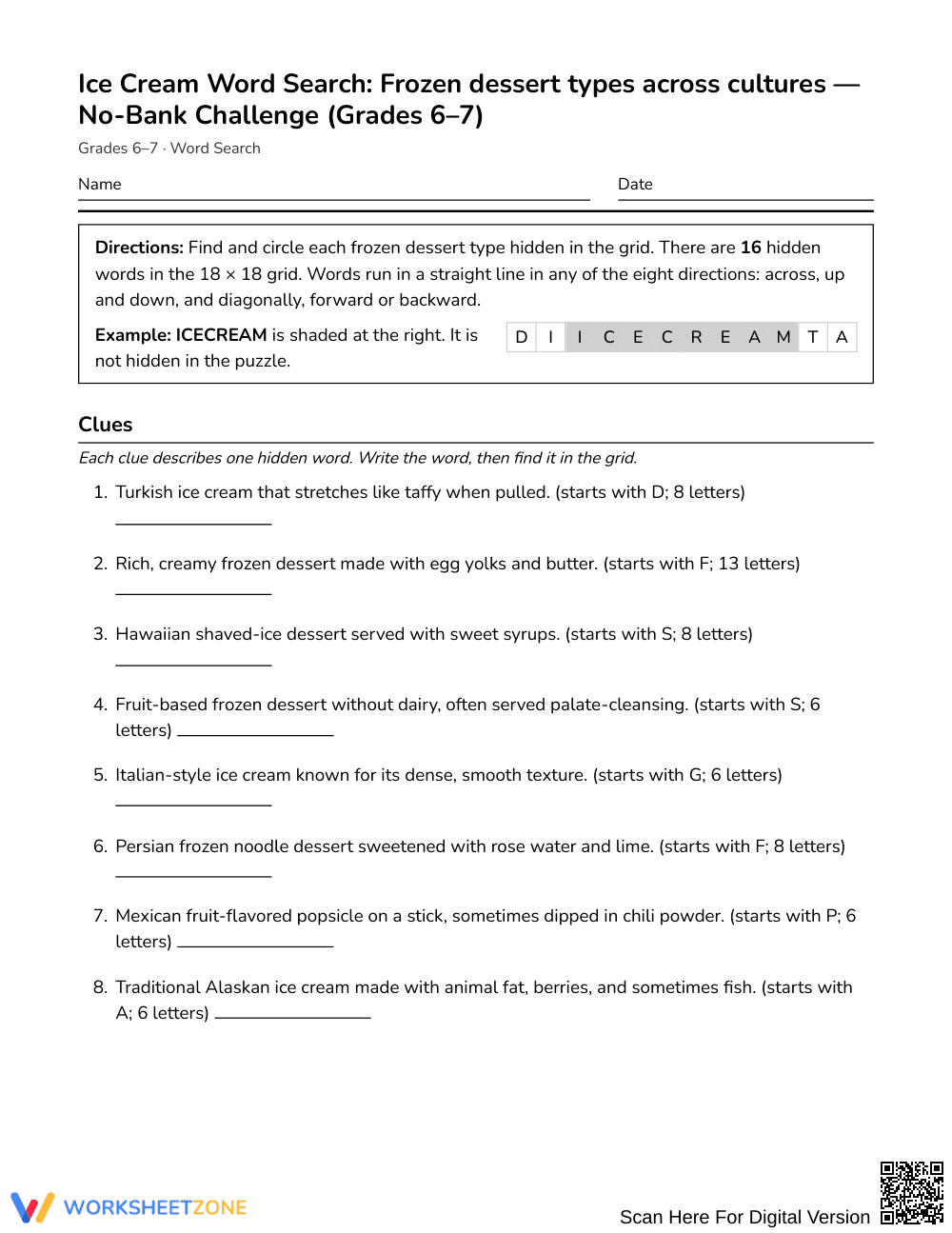


Essential Frozen Desserts Word Search | Grades 6–7 ELA

Paste this activity's link or code into your existing LMS (Google Classroom, Canvas, Teams, Schoology, Moodle, etc.).
Students can open and work on the activity right away, with no student login required.
You'll still be able to track student progress and results from your teacher account.
This Grades 6–7 English Language Arts word search builds cultural vocabulary through a challenging puzzle format. Students read descriptive clues about global culinary traditions, deduce sixteen distinct frozen treats, and locate each term within an intricate letter grid. This activity expands cultural literacy while encouraging focused spelling recognition and persistent spatial problem-solving.
At a Glance
- Grade: Grades 6–7 · Subject: English Language Arts (ELA)
- Standard: Not standards-assessed — vocabulary enrichment
- Skill Focus: Frozen dessert types across cultures
- Format: 3 pages · 16 words · Answer key included · PDF
- Best For: Vocabulary enrichment and cultural exploration
- Time: 20–30 minutes
This 3-page printable resource delivers a rigorous clue-based vocabulary puzzle alongside a complete 3-page answer key. Rather than relying on a standard word bank, students receive sixteen detailed cultural definitions that explain traditional treats ranging from Turkish dondurma to Persian faloodeh. Learners analyze each definition to identify the dessert name before scanning the grid to find each target term.
Puzzle Mechanics and Structure
The puzzle features an 18 x 18 letter grid packed with 16 hidden words. To deliver a genuine no-bank challenge, entries run across all eight possible compass directions: north, northeast, east, southeast, south, southwest, west, and northwest. Students must actively synthesize the written clues to deduce target vocabulary, then trace horizontal, vertical, and reverse diagonal orientations across the dense letter matrix.
Standards Alignment
This word search serves purely as a vocabulary enrichment activity and is not aligned to an assessed state academic standard. It focuses on expanding domain-specific culinary knowledge and cross-cultural awareness. Educators can readily integrate this activity into broader interdisciplinary thematic units examining world cultures, geography, or descriptive informational texts without standard tracking requirements.
How to Use It
Deploy this activity as an independent enrichment task following direct instruction on world cultures, or assign it as an engaging sponge activity for early finishers. During work time, circulate to observe whether students solve the cultural clues before searching or rely purely on random visual letter hunting. Most middle school learners finish the puzzle within 20 to 30 minutes.
Who It's For
This activity is designed for middle school students in Grades 6–7 who are ready for advanced vocabulary tasks without word bank support. To support emerging readers, educators can highlight initial letters or pre-read clues aloud. Pair this puzzle with an informational reading passage on world food traditions or a geography lesson on culinary heritage.
Building vocabulary through clue-based word puzzles enables students in Grades 6–7 to connect domain-specific definitions with precise orthographic patterns. While unassessed by formal state codes, cultural vocabulary enrichment provides meaningful background knowledge that aids reading comprehension across diverse informational texts. Research synthesized by Fisher & Frey (2014) emphasizes that intentional word study and schema-building activities significantly enhance student engagement and long-term lexical retention. By eliminating the traditional word bank and requiring learners to decode sixteen cultural descriptions—such as Italian granita, Mexican raspado, and Alaskan akutaq—this puzzle encourages students to actively retrieve conceptual knowledge prior to visual scanning. The multi-directional search mechanics reinforce orthographic mapping, letter sequence memory, and spatial concentration. Consequently, this printable resource offers educators an effective tool for cultural literacy development, combining rigorous independent problem-solving with purposeful lexical discovery across modern classroom environments.


