



























Essential Fractions As Division: Multiple Representations
Paste this activity's link or code into your existing LMS (Google Classroom, Canvas, Teams, Schoology, Moodle, etc.).
Students can open and work on the activity right away, with no student login required.
You'll still be able to track student progress and results from your teacher account.
This Grade 5 math worksheet guides students to interpret fractions as division by connecting visual models, number lines, and word problems. Learners solve 13 targeted problems to show how sharing whole units equally produces fractional quotients, solidifying conceptual understanding across multiple mathematical representations.
At a Glance
- Grade: 5 · Subject: Math
- Standard:
5.NF.B.3— Interpret fractions as division of the numerator by the denominator.- Skill Focus: Fractions as division across multiple representations
- Format: 2 pages · 13 problems · Answer key included · PDF
- Best For: Guided math stations and independent practice
- Time: 25–35 minutes
What's Inside
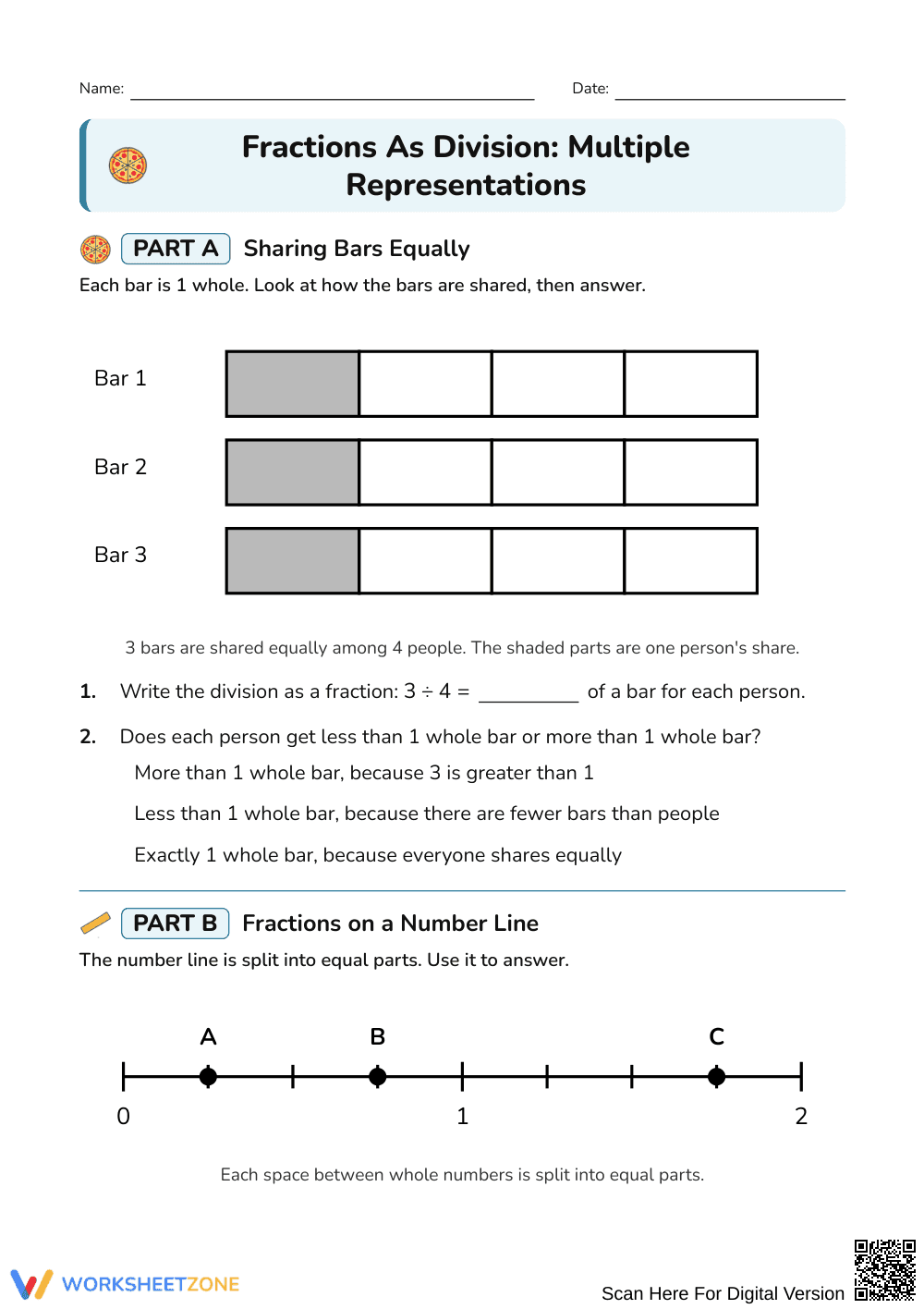
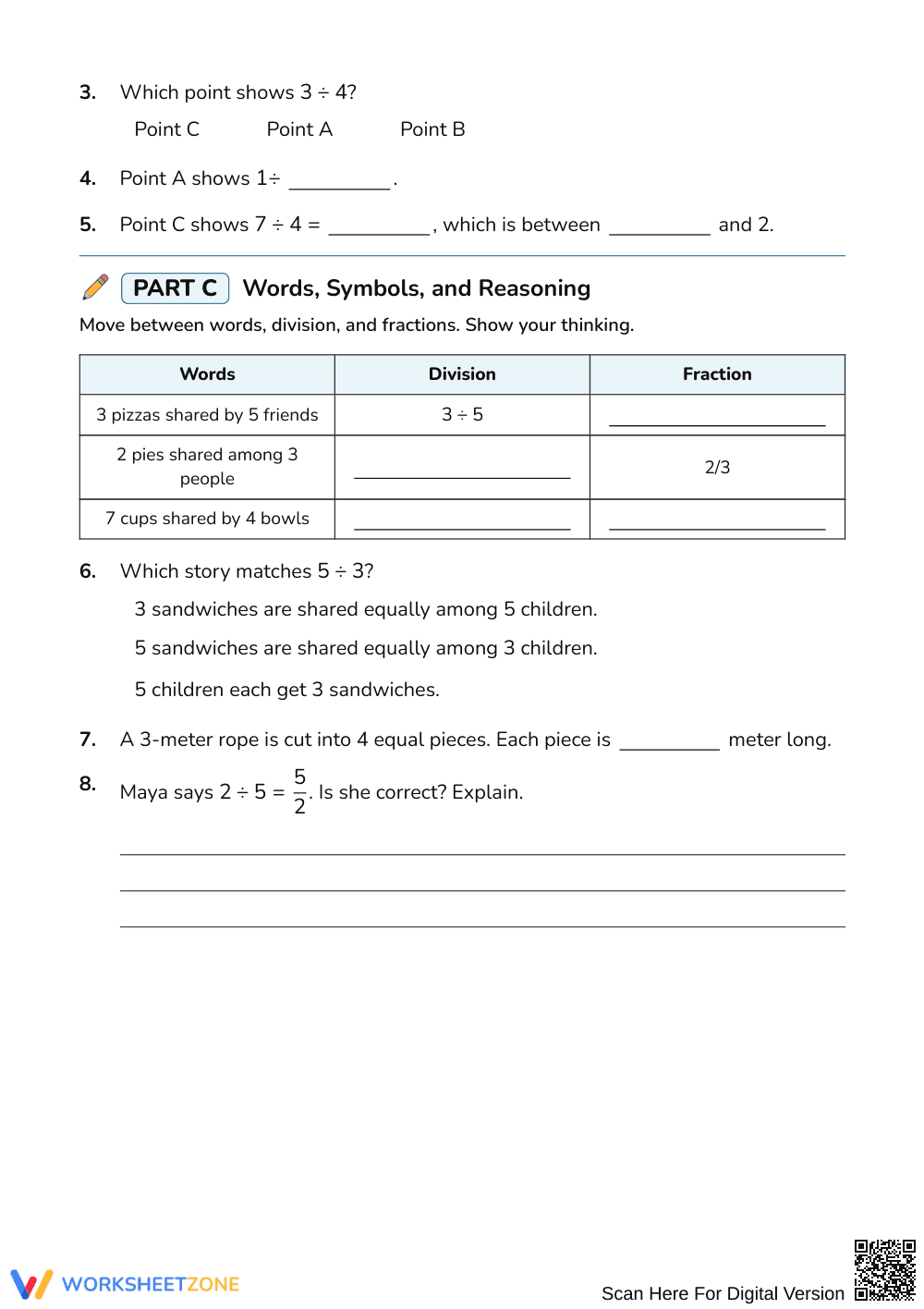
This two-page resource contains 13 problems across three distinct sections. Students examine partitioned bar models, plot quotients on number lines, complete a sharing-story conversion table, and resolve an error analysis prompt. A two-page answer key provides complete solutions.
Skill Progression
- Guided practice (Part A – 4 items): Students use visual sharing bars to write division equations and evaluate fractional shares.
- Supported practice (Part B – 4 items): Students identify fraction quotients on partitioned number lines using unit-fraction intervals.
- Independent practice (Part C – 5 items): Learners complete representation tables, match story contexts, and explain common division misconceptions.
This sequence follows a gradual-release framework, advancing students from concrete models to symbolic reasoning.
Standards Alignment
This resource aligns with `5.NF.B.3`: interpret a fraction as division of the numerator by the denominator ($a/b = a \div b$). It also supports `5.NF.B.4` by building fraction reasoning for multiplication and division. Both standard codes can be copied directly into lesson plans, IEP goals, or district curriculum mapping tools.
How to Use It
Use this worksheet after direct instruction on fraction division as independent seatwork taking 25 to 35 minutes. Alternatively, facilitate Part A in small groups before assigning Parts B and C. As a formative check, inspect Part C item 13 to detect students confusing dividends and divisors.
Who It's For
This activity suits Grade 5 general math classrooms, Tier 2 intervention, and special education settings requiring visual scaffolding. Pair it with an equal-sharing anchor chart to reinforce division concepts.
According to EdReports 2024 instructional alignment criteria, developing foundational fluency in fraction operations requires bridging concrete visual models to symbolic notation before introducing abstract algorithms. Standard 5.NF.B.3 tasks students with recognizing fractions as division quotients, an essential gateway skill for middle school proportional reasoning and algebraic expressions. This 13-item worksheet systematically grounds learners in equal-sharing models, number line placement, and verbal context translation across 2 rigorous pages. Research emphasizes that multi-representational practice directly counteracts common whole-number misconceptions, such as reversing dividend and divisor when dividing smaller numbers by larger ones. By integrating visual bars, interval benchmarks, and error analysis, this printable equips Grade 5 students with the conceptual depth prioritized in modern state standards. Educators can reliably utilize this resource for formative evaluation, targeted small-group intervention, and standard-aligned mastery verification across elementary mathematics curricula.


