































Essential Food Webs & Pyramids Worksheet | Grade 6 Science

Paste this activity's link or code into your existing LMS (Google Classroom, Canvas, Teams, Schoology, Moodle, etc.).
Students can open and work on the activity right away, with no student login required.
You'll still be able to track student progress and results from your teacher account.
This Grade 6 science worksheet builds student mastery of food chains, webs, and energy pyramids in a meadow ecosystem. Students analyze the distinct roles of producers, consumers, and decomposers, track one-way energy flow versus nutrient cycling, and apply trophic transfer efficiencies to predict environmental outcomes.
At a Glance
- Grade: 6 · Subject: Science
- Standard: Model trophic energy flow and matter cycling in ecosystems
- Skill Focus: Food Chains, Webs & Energy Pyramids
- Format: 5 pages · 12 problems · Answer key included · PDF
- Best For: Ecology unit instruction and review
- Time: 40–50 minutes
What's Inside
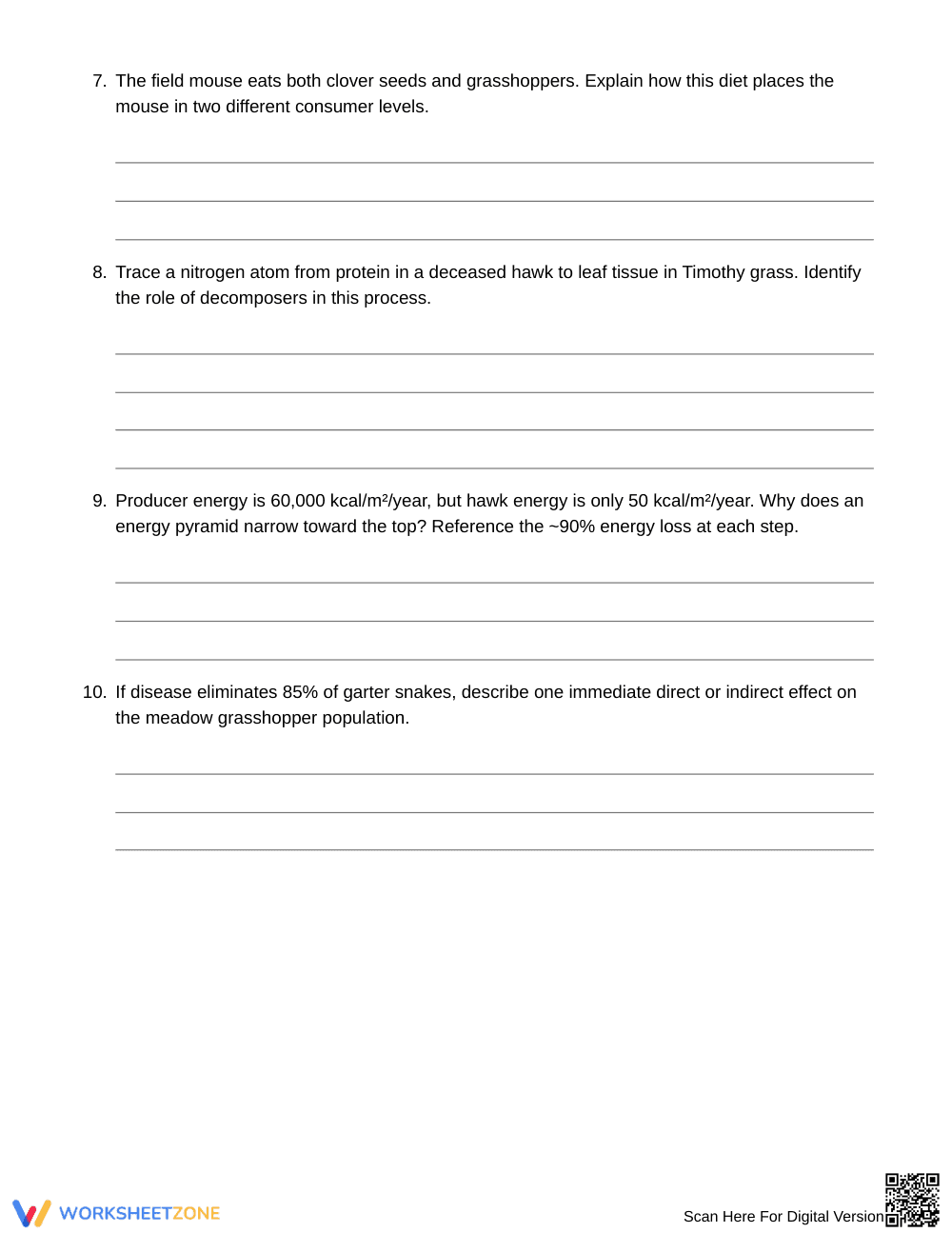
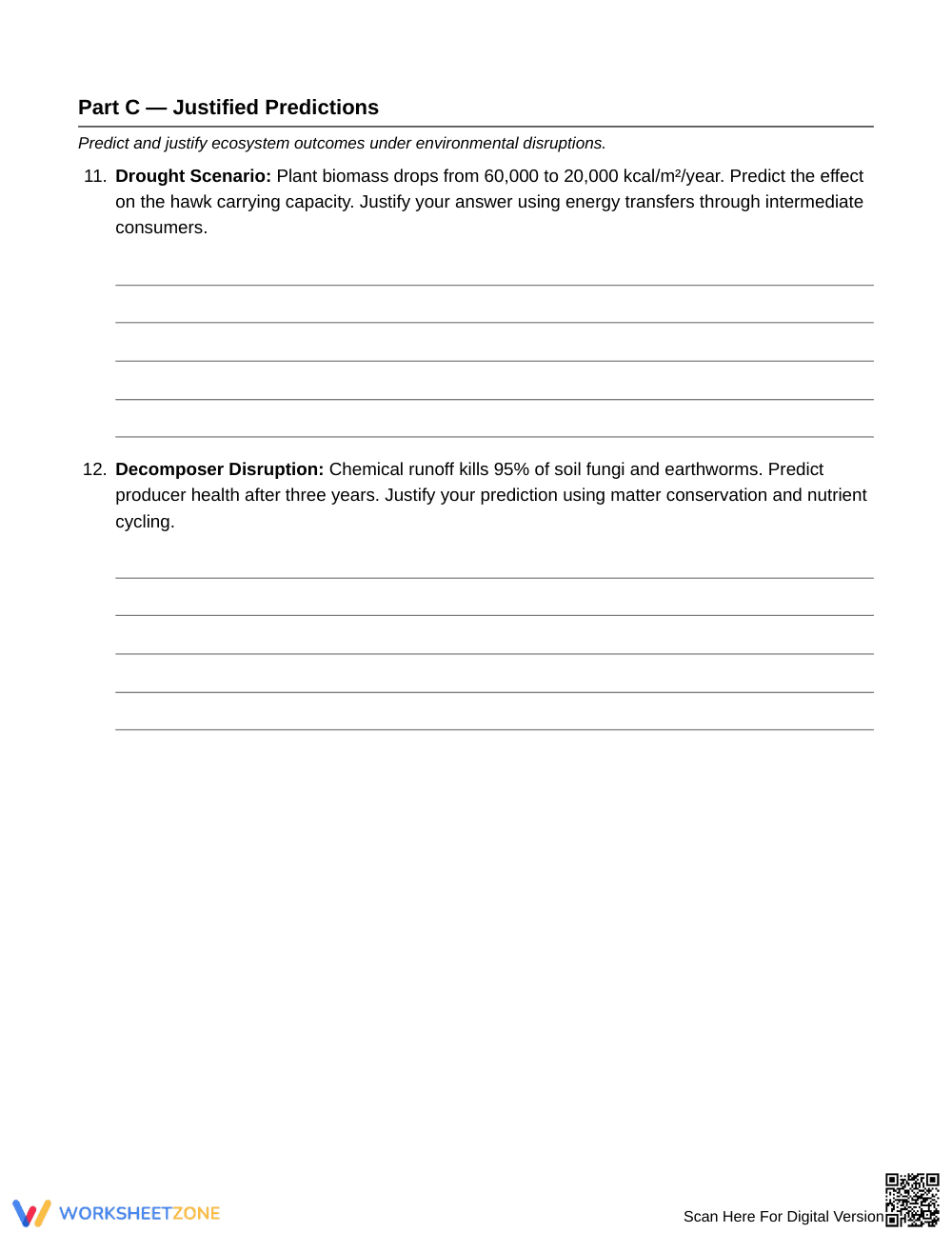
The 5-page packet begins with a reference chart containing synthetic meadow data and annual energy values across trophic levels. The 12 tasks include conceptual checks, arrow-direction analysis, ten-percent rule calculations, nitrogen matter tracing, and disruption predictions. A complete 2-page answer key provides step-by-step solutions and biological justifications.
Skill Progression
- Guided practice (Part A, 4 problems): Reinforces trophic role definitions, arrow conventions, and the distinction between energy flow and matter cycling.
- Supported practice (Part B, 6 problems): Guides data analysis, ten-percent rule calculations, omnivore classifications, and decomposer nutrient pathways.
- Independent practice (Part C, 2 problems): Prompts students to predict and justify carrying capacity shifts following drought and decomposer disruptions.
This structure follows the gradual release of responsibility model, moving students from foundational recall to complex ecological analysis.
Standards Alignment
This resource aligns with middle school life science standards requiring students to model the movement of matter and flow of energy in ecosystems. Both standard codes can be copied directly into lesson plans, IEP goals, or district curriculum mapping tools.
How to Use It
Use this worksheet after direct instruction on trophic levels. Have students complete Part A in pairs before independently calculating values in Part B. As a formative checkpoint, check Part A Task 2 to ensure students draw arrows toward the consumer showing energy transfer. Expected completion time is 40 to 50 minutes.
Who It's For
This resource supports Grade 6 science students, introductory ecology units, and targeted intervention groups. The reference data table supports visual learners and English language learners. Pair this printable packet with a hands-on food web simulation or a nutrient cycling anchor chart.
According to research by Fisher & Frey (2014) on effective instructional scaffolding, structured task sequences bridging foundational concept discrimination with quantitative application produce significant gains in middle school science comprehension. This Grade 6 ecology resource applies those principles across 12 targeted tasks, guiding learners to systematically examine producers, consumers, and decomposers within an authentic meadow dataset. By distinguishing the unidirectional dissipation of solar energy via the ten-percent rule from the cyclical conservation of matter mediated by soil decomposers, students construct accurate mental models of ecosystem dynamics. The integration of numerical data alongside qualitative disruption scenarios ensures learners develop both computational reasoning and scientific argumentation skills. As a comprehensive classroom tool, this 5-page worksheet provides rigorous practice that clarifies trophic interactions and prepares middle school science students for advanced environmental coursework.


