


























Views
Downloads
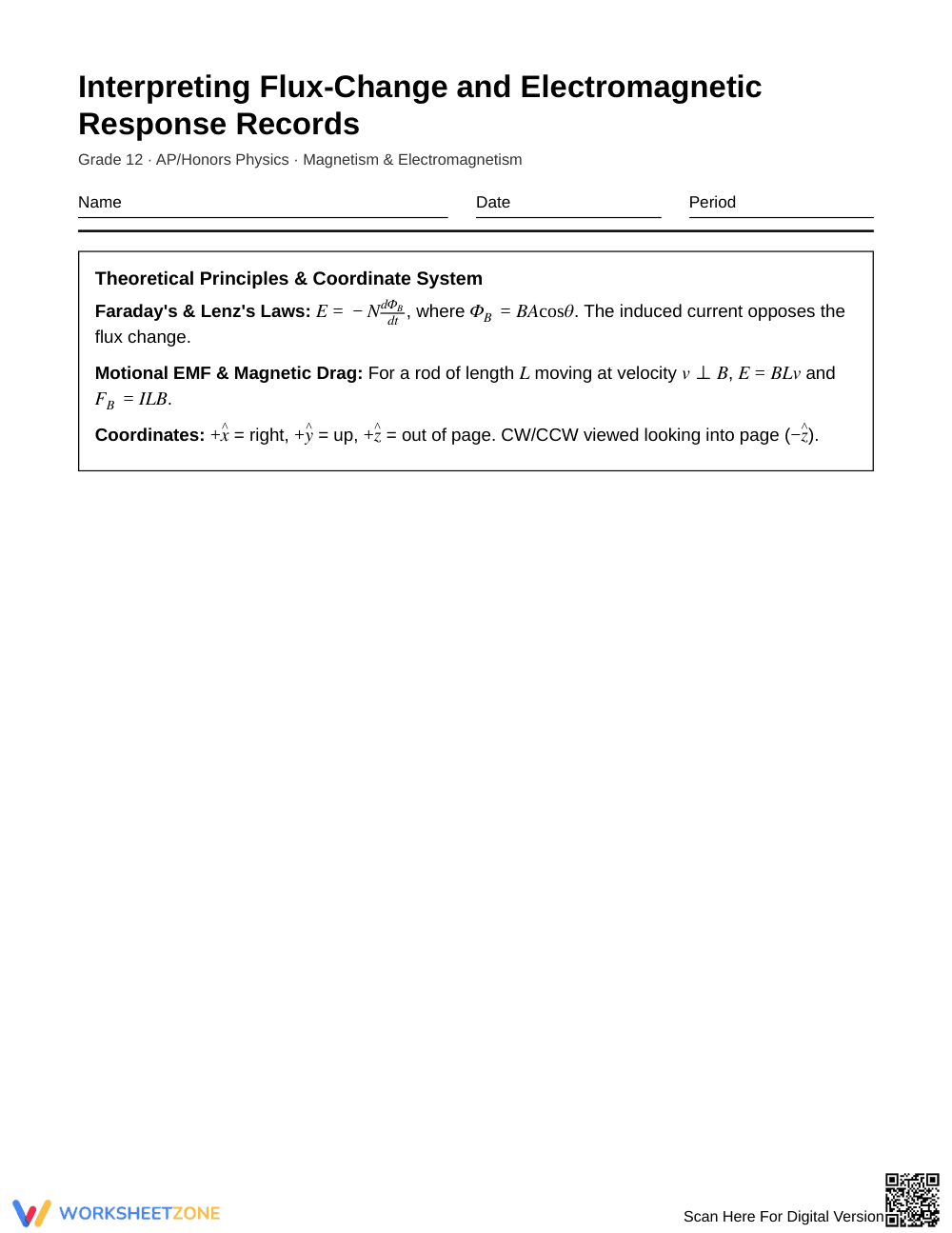
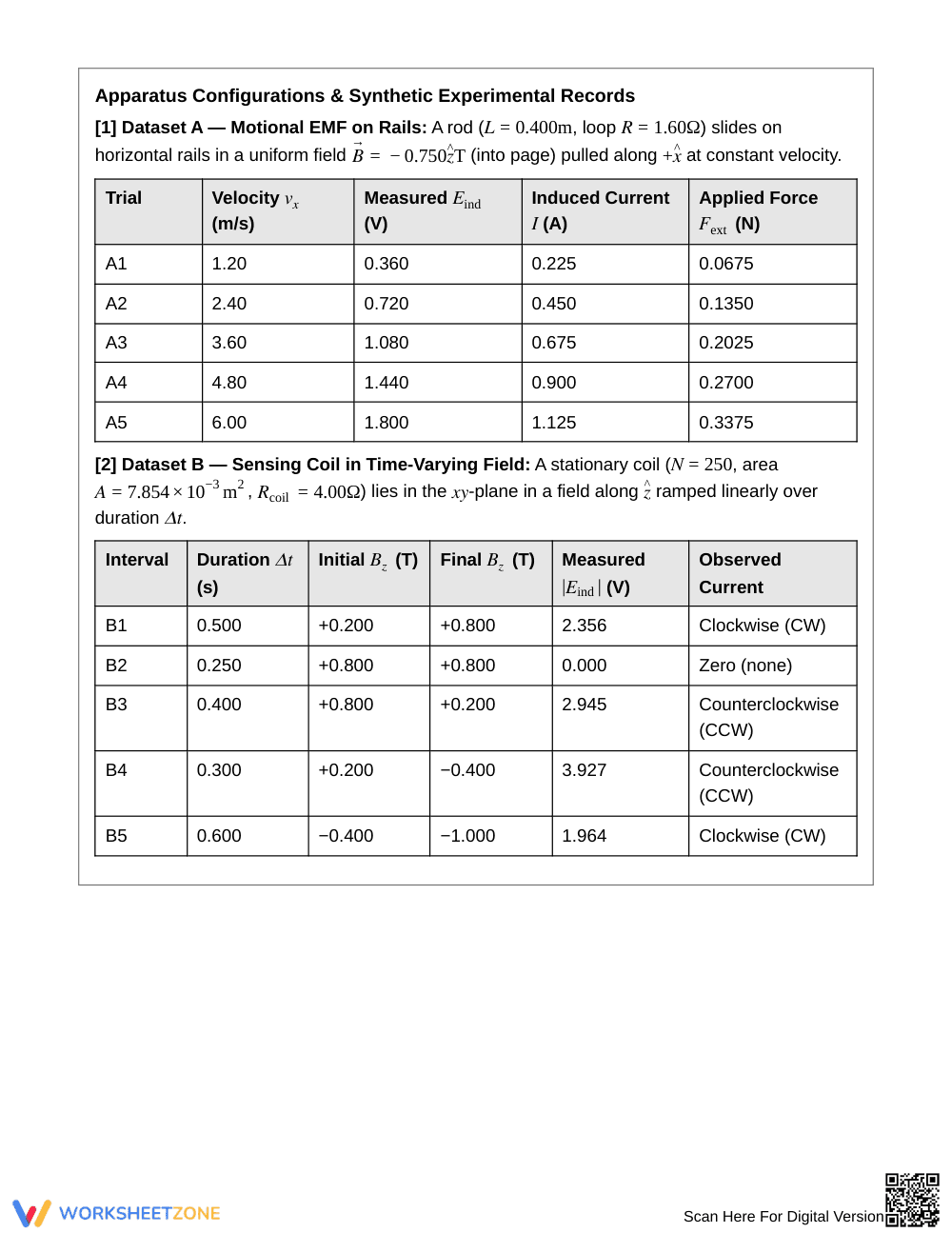
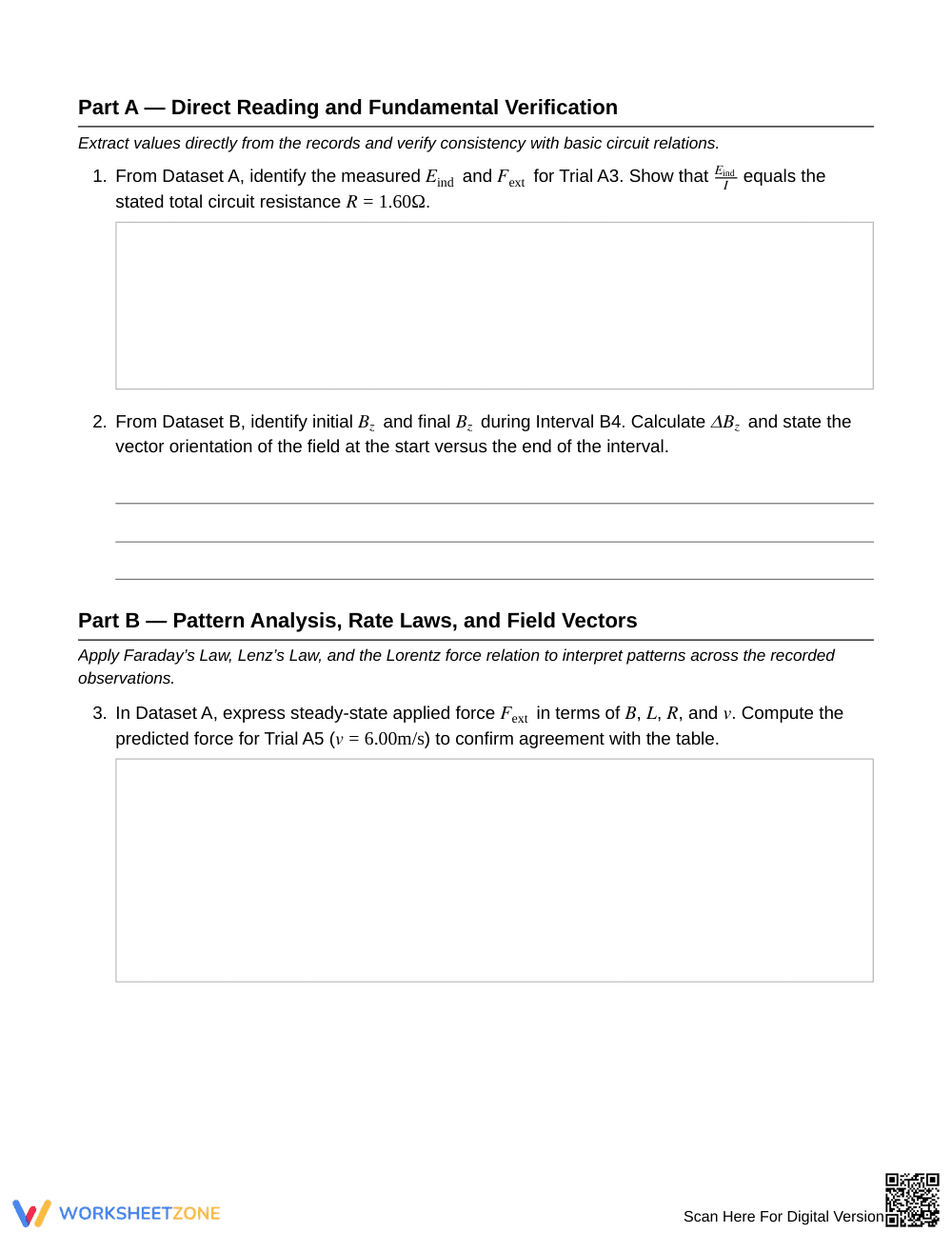
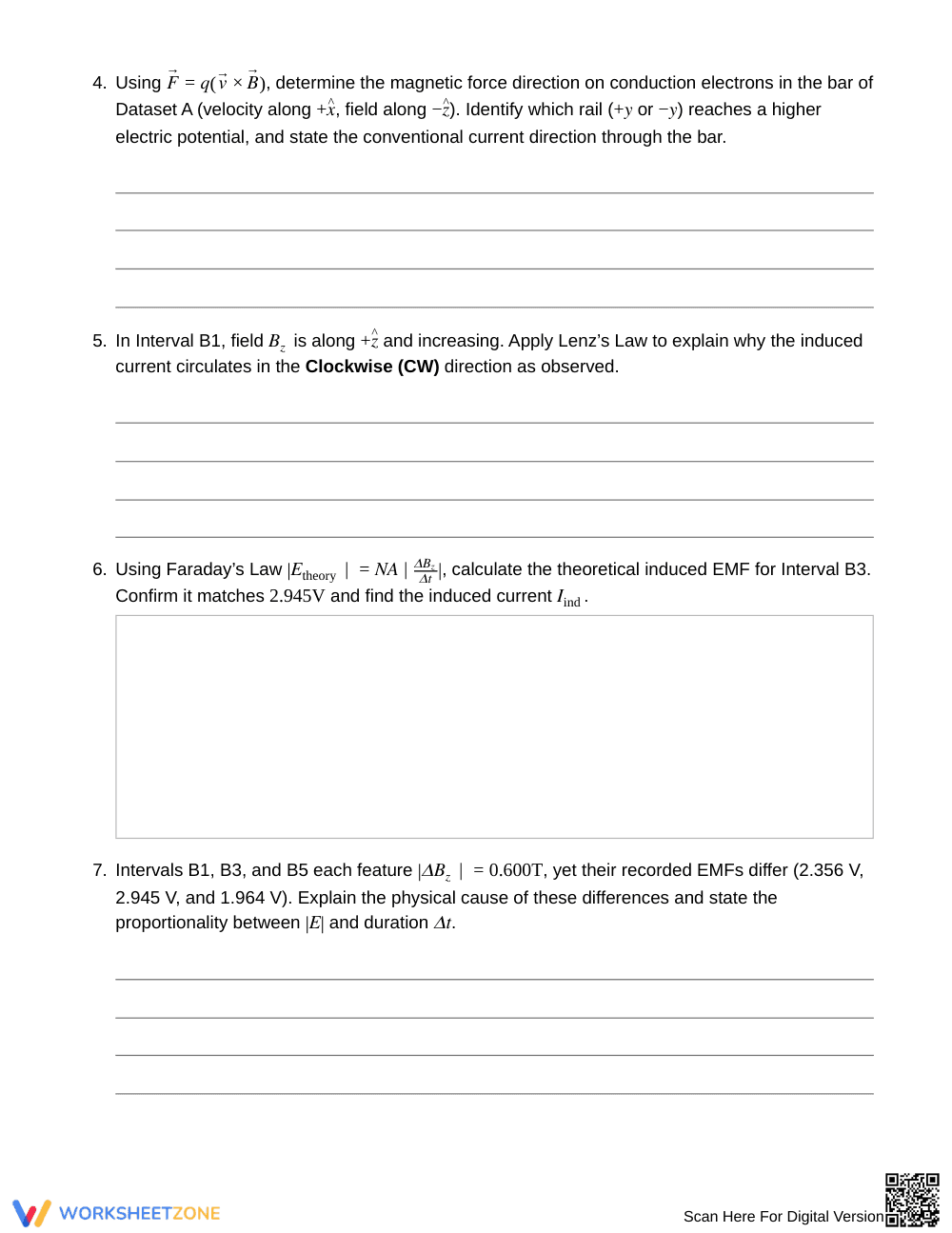

Essential Flux-Change Records Worksheet | Grade 12 Physics
Paste this activity's link or code into your existing LMS (Google Classroom, Canvas, Teams, Schoology, Moodle, etc.).
Students can open and work on the activity right away, with no student login required.
You'll still be able to track student progress and results from your teacher account.
This physics worksheet builds mastery in interpreting magnetic flux changes and electromagnetic response records. Grade 12 students analyze experimental datasets involving motional EMF on rails and sensing coils in time-varying fields. Through quantitative deduction, learners master Faraday's law, Lenz's law, and non-ideal circuit behaviors across ten structured analytical tasks.
At a Glance
- Grade: 12 · Subject: Physics
- Standard: Analyze induction records using Faraday's and Lenz's laws
- Skill Focus: Interpret Flux-Change and Response Records
- Format: 5 pages · 10 problems · Answer key included · PDF
- Best For: AP physics review and lab follow-up
- Time: 45–60 minutes
What's Inside
The 5-page student activity features two experimental datasets with coordinate schematics: motional EMF on rails and a multi-interval coil in a ramping field. Across 10 multi-part analytical problems, students verify circuit resistance, calculate rate laws, and evaluate system constraints. A 2-page answer key provides complete algebraic solutions and physical reasoning.
Skill Progression
- Guided practice (Part A, 2 tasks): Students extract tabulated data to verify Ohm's law and calculate field changes across baseline intervals.
- Supported practice (Part B, 6 tasks): Learners apply Faraday's and Lenz's laws to derive theoretical EMF values, calculate magnetic forces, determine current vectors, and explain rate-dependent differences.
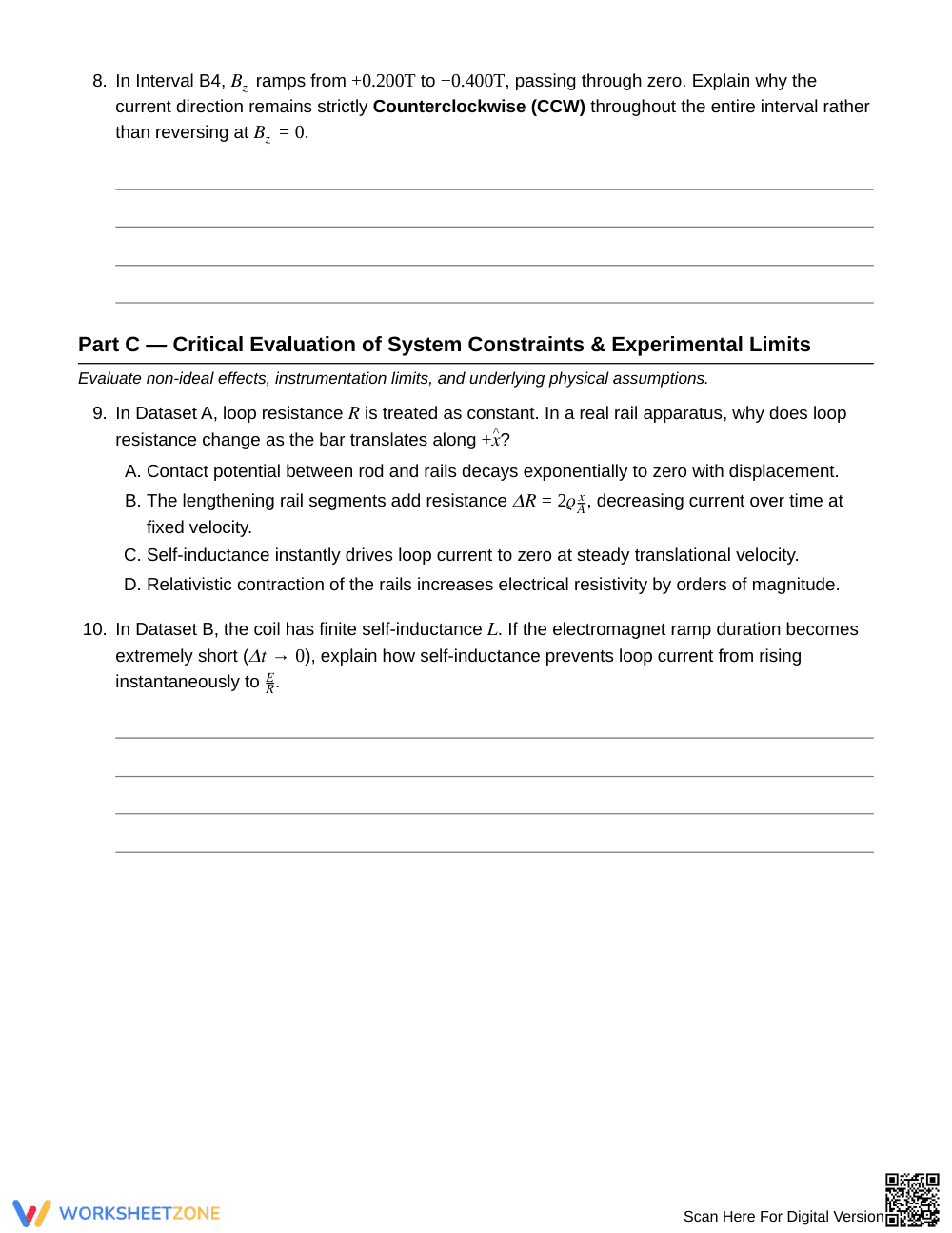
- Independent practice (Part C, 2 tasks): Students evaluate real-world constraints, analyzing lengthening rail resistance and self-inductance limits as ramp durations approach zero.
This progression embodies the gradual release of responsibility model, shifting students from empirical reading to advanced constraint modeling.
Standards Alignment
This resource aligns with high school advanced physics and AP Physics electromagnetism objectives. Students calculate induced electromotive forces using Faraday's law and determine induced current directions via Lenz's law across changing flux environments. Both standard codes can be copied directly into lesson plans, IEP goals, or district curriculum mapping tools.
How to Use It
Assign this worksheet after direct instruction on electromagnetic induction as guided classwork or targeted AP review. As students work, check their Part B vector diagrams to ensure they distinguish between external field changes and opposing induced fields. Students typically complete the 10 problems within 45 to 60 minutes.
Who It's For
This resource is designed for Grade 12 students in AP or honors physics who require quantitative data analysis practice. Provide an annotated right-hand rule reference sheet for students needing support, and challenge advanced learners to prove energy conservation during magnetic drag. Pair this worksheet directly with a live induction coil demonstration.
According to research highlighted in Fisher & Frey (2014), guided cognitive apprenticeships that transition students systematically from direct data extraction to complex physical modeling produce substantial gains in conceptual retention and quantitative transfer. This 5-page Grade 12 physics worksheet operationalizes that instructional architecture by guiding learners through 10 targeted problems centered on electromagnetic induction. Working with synthetic experimental records, students verify fundamental circuit laws, apply Faraday's and Lenz's rate relationships, and diagnose non-ideal boundary constraints like rail lengthening and self-inductance. Rather than engaging in rote formula substitution, students actively interpret empirical trends, reconcile opposing field vectors, and validate dynamic electromagnetic behaviors under varying time constraints. This rigorous, scaffolded design ensures that high school physics students develop deep conceptual fluency and transferable analytical habits necessary for success in advanced STEM coursework and standardized college-level assessments.


