




























Views
Downloads

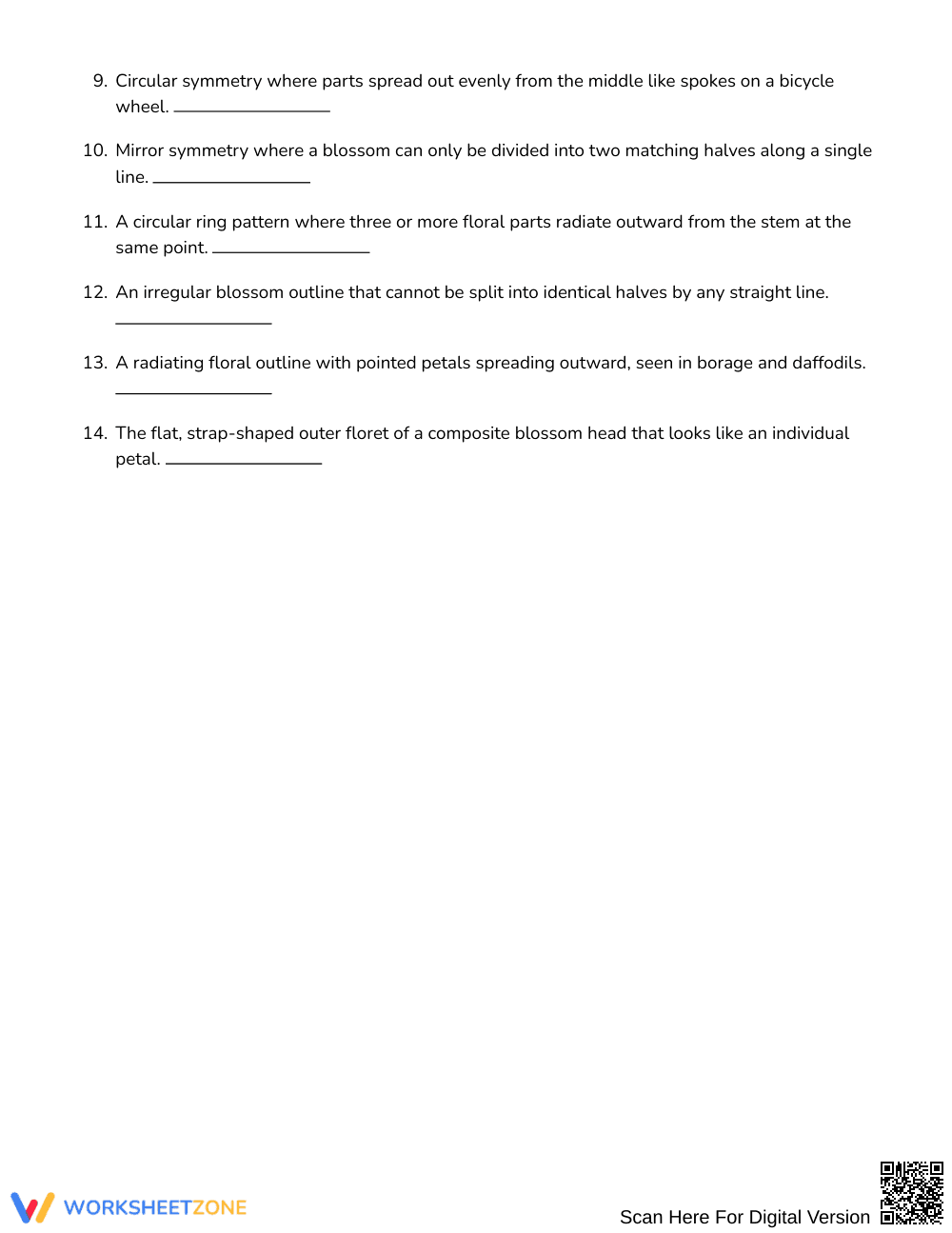


Essential Flower Shapes Word Search | Grades 4–5 Science

Paste this activity's link or code into your existing LMS (Google Classroom, Canvas, Teams, Schoology, Moodle, etc.).
Students can open and work on the activity right away, with no student login required.
You'll still be able to track student progress and results from your teacher account.
This flower shapes and symmetry word search gives intermediate elementary students 14 structured botanical vocabulary terms to identify, define, and locate. Learners read descriptive anatomical clues to determine each target word before searching the puzzle grid, reinforcing key plant morphology concepts and scientific observation skills through engaging vocabulary enrichment.
At a Glance
- Grade: Grades 4–5 · Subject: Science
- Standard: Not standards-assessed — vocabulary enrichment
- Skill Focus: flower shapes and symmetry
- Format: 3 pages · 14 words · Answer key included · PDF
- Best For: Science centers and early finishers
- Time: 20–30 minutes
What's Inside: This 3-page printable science activity features a 16 × 16 letter grid packed with 14 hidden botanical terms, paired with a complete clue detective section. Rather than simply copying words from a list, students read context-rich definitions for terms like bilateral, radial, tubular, and whorl. A complete 3-page answer key provides clear solution paths for quick verification.
How the Puzzle Works: Students navigate a challenging 16 × 16 grid where vocabulary terms run in four distinct orientations: northeast, east, southeast, and south. A shuffled word bank provides reference support, while the detective clues challenge learners to connect precise botanical descriptions to the corresponding structural terms before locating each hidden word.
Standards Alignment: This activity serves as targeted vocabulary enrichment and is not aligned to a specific grade-level standard. It provides supplementary domain-specific language practice to support broader life science units covering plant life cycles, plant structures, and floral adaptations.
How to Use It: Introduce this puzzle during an introductory botany unit or as a review station after hands-on flower dissection labs. Formatively assess comprehension by checking whether students can explain the difference between bilateral and radial symmetry using their clue sheet. Typical completion time ranges between 20 and 30 minutes.
Who It's For: Designed for students in Grades 4–5, this activity offers rigorous content reinforcement for visual learners and independent workers. Pair this puzzle with real floral specimens, hand lenses, or a botanical diagram anchor chart to bridge vocabulary acquisition with real-world scientific inquiry.
According to Fisher & Frey (2014), intentional exposure to domain-specific vocabulary within meaningful contexts significantly improves long-term content retention across elementary science curricula. This botanical word search builds foundational literacy around flower shapes and symmetry, challenging students to analyze 14 distinct morphological definitions before tracking words across a multi-directional grid. By coupling descriptive clues with puzzle mechanics, the resource strengthens recall of essential plant anatomy concepts such as petals, spurs, and asymmetrical structures without unnecessary instructional overhead. The self-contained format and thorough three-page answer key make it an effective tool for independent practice, science stations, or fast-finisher enrichment, giving young learners targeted practice in biological terminology while supporting observational science frameworks across upper elementary classrooms.


