




























Views
Downloads


Essential Fish Camouflage Word Search | Grades 6–7 Science

Paste this activity's link or code into your existing LMS (Google Classroom, Canvas, Teams, Schoology, Moodle, etc.).
Students can open and work on the activity right away, with no student login required.
You'll still be able to track student progress and results from your teacher account.
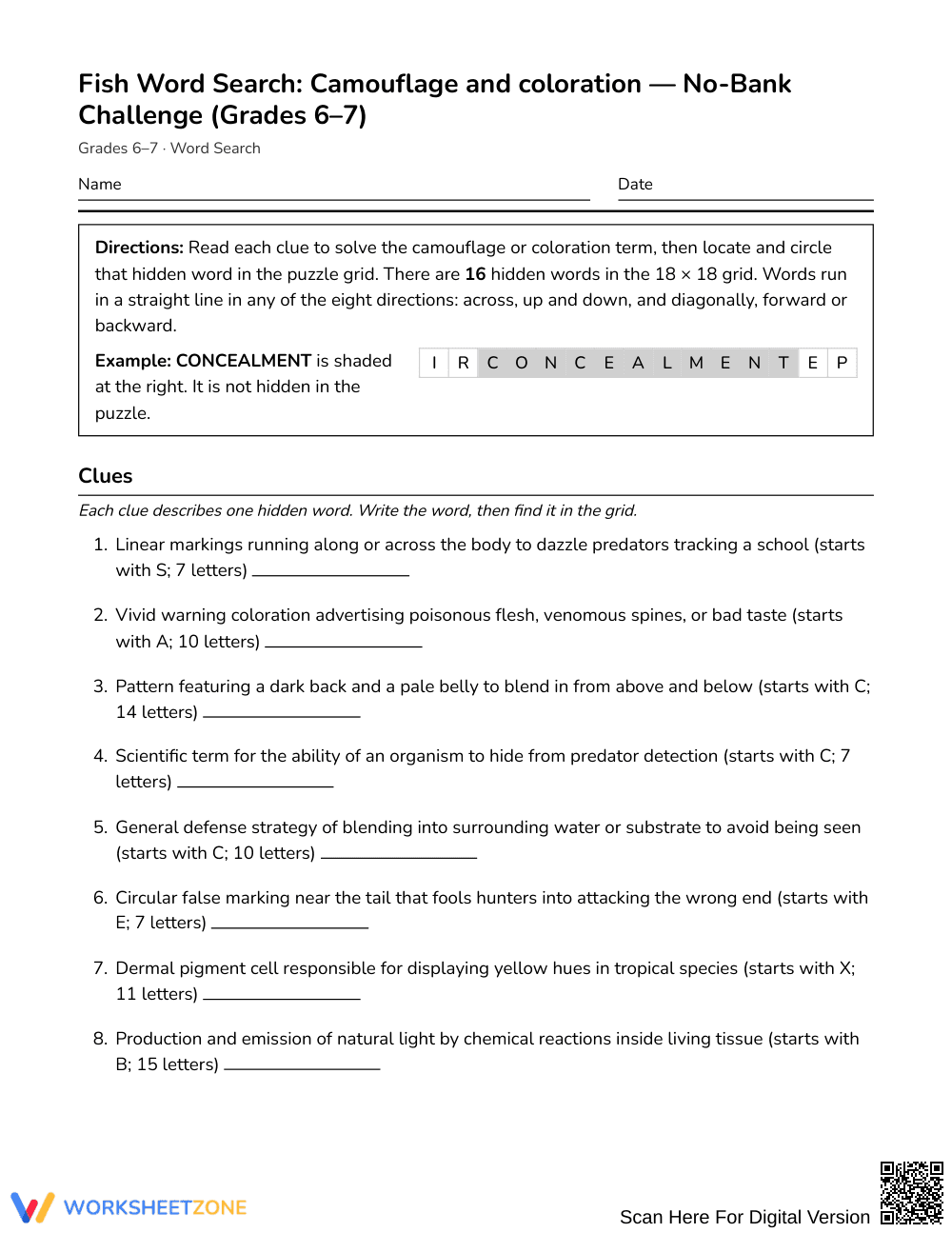
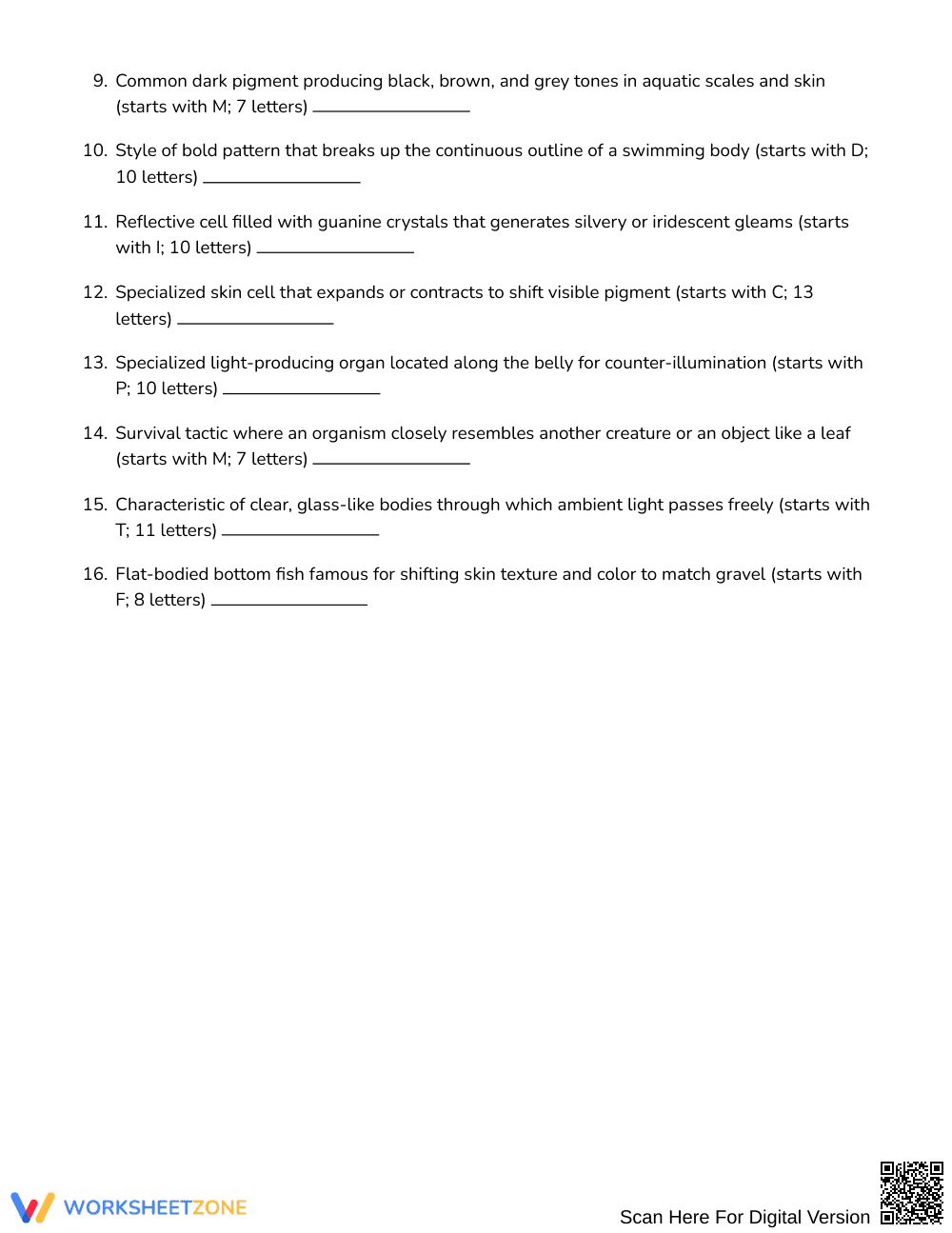
This science word search reinforces middle school knowledge of aquatic animal adaptations by challenging students to connect physiological mechanisms to specific terminology. Learners analyze descriptive scientific clues to identify 16 words related to fish camouflage and coloration, locating each hidden term within the puzzle grid to demonstrate conceptual understanding.
At a Glance
- Grade: Grades 6–7 · Subject: Middle School Life Science
- Standard: Not standards-assessed — scientific vocabulary enrichment
- Skill Focus: Marine animal adaptations, fish camouflage, and coloration mechanisms
- Format: 3 student pages · 16 words · Complete 4-page answer key included · Printable PDF
- Best For: Independent science vocabulary practice, sub plans, early finishers, and unit review
- Time: 25–35 minutes of focused engagement
This 3-page printable science resource provides an active challenge featuring 16 hidden marine biology terms. Unlike traditional puzzles with simple word banks, this activity includes clue-based prompts that require students to recall or deduce vocabulary words before finding them. A thorough 4-page answer key provides visible solution paths for rapid evaluation.
Puzzle Mechanics and Structure
This vocabulary challenge uses targeted structural parameters to encourage rigorous visual scanning and recall:
- No Word Bank Design: Students must decode 16 clue definitions—covering specialized topics like chromatophores, countershading, and photophores—to determine the hidden vocabulary terms independently.
- Large 18 x 18 Grid: The substantial letter grid requires sustained attention and systematic searching strategies across an expansive playing field.
- Eight-Direction Search: Hidden terms run in all eight possible orientations: North, Northeast, East, Southeast, South, Southwest, West, and Northwest, challenging spatial orientation and letter recognition.
Standards Alignment
This learning resource serves as focused scientific vocabulary enrichment and is not aligned to a formal state standard. It enhances life science units on animal adaptations, marine ecosystems, and evolutionary biology by reinforcing domain-specific terminology without requiring standardized assessment scoring.
How to Use It
Deploy this word search during an animal adaptations unit to consolidate learning after direct instruction on camouflage tactics. Alternatively, use it as a low-stress review activity before a summative assessment on marine life. As a formative check, observe whether students identify physiological structures like iridophores and xanthophores quickly or need to consult reference notes. Most students complete the full 16-word challenge in 25 to 35 minutes.
Who It's For
This activity is designed for middle school life science students in Grades 6–7 who are studying ecological adaptations. For students needing support, allow peer collaboration or provide an open textbook reference during the clue-solving phase. Pair this resource with a visual anchor chart displaying living fish species displaying countershading, disruptive coloration, and mimicry.
Targeted vocabulary acquisition plays a decisive role in middle school science comprehension, particularly when learning complex biological mechanisms such as fish camouflage, countershading, and adaptive coloration. According to Fisher & Frey (2014), intentional exposure to domain-specific terminology through interactive, clue-based tasks substantially improves conceptual retention and helps students bridge everyday language with formal academic registers. This 3-page word search supports 16 words within an 18 x 18 grid running across eight compass directions, demanding active retrieval rather than passive letter hunting. By eliminating a standard word bank and supplying rigorous biological definitions, the resource requires students to process functional adaptations before searching the grid. A complete 4-page answer key allows teachers to verify student accuracy immediately. Grounded in evidence-based vocabulary instruction, this supplementary activity strengthens scientific literacy and equips Grade 6 and Grade 7 learners with the specialized lexicon necessary for advanced life science study.


