




























Essential Fetal Pig Anatomy Worksheet | Grades 7-12 Science
Paste this activity's link or code into your existing LMS (Google Classroom, Canvas, Teams, Schoology, Moodle, etc.).
Students can open and work on the activity right away, with no student login required.
You'll still be able to track student progress and results from your teacher account.
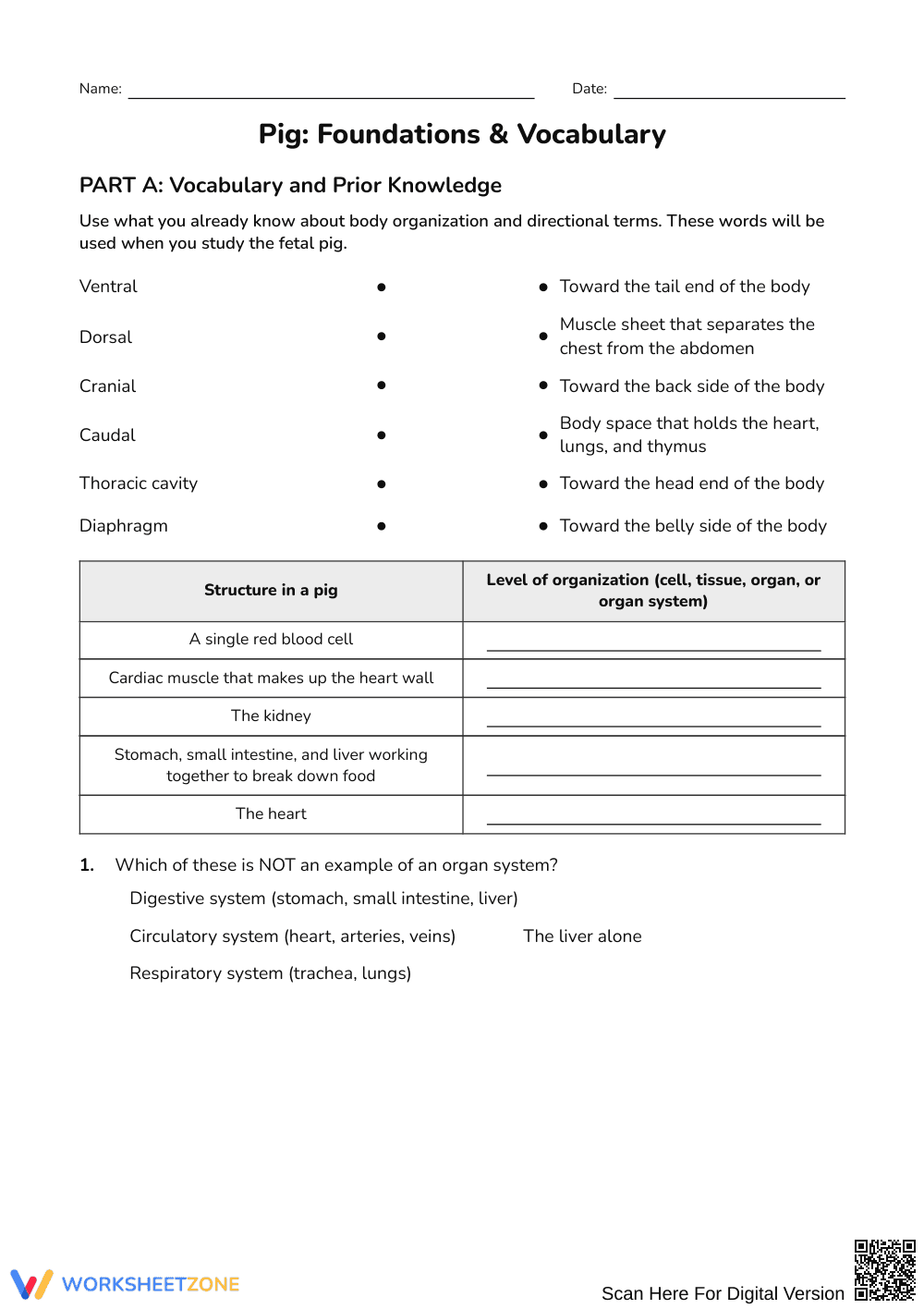
This fetal pig anatomy worksheet prepares secondary biology students for dissection by reinforcing essential anatomical vocabulary, body organization, and internal structures. Across 32 targeted tasks, learners examine directional terms, organ systems, and fetal circulation to establish a firm conceptual foundation before entering the laboratory.
At a Glance
- Grade: Grades 7–12 · Subject: Science
- Standard: Life Science — Relate anatomical structures, body cavities, and specialized circulatory adaptations to physiological function
- Skill Focus: Essential vocabulary and prior knowledge
- Format: 4 pages · 32 problems · Answer key included · PDF
- Best For: Pre-lab dissection preparation and anatomy review
- Time: 45–60 minutes
What's Inside
This 4-page activity provides 32 structured questions across three parts. Part A reviews directional terms—including ventral, dorsal, cranial, and caudal—paired with classification of biological organization levels. Part B features a ventral dissection diagram where students identify thoracic and abdominal organs and analyze system interdependence. Part C features a circulatory flow chart, cardiac shunt analysis, and misconception prompts. A 4-page answer key provides complete model solutions.
Skill Progression
- Guided practice: Students review defined directional terms and classify red blood cells, cardiac tissue, and organs into hierarchical levels (Part A, 8 tasks).
- Supported practice: Learners label internal organs on a ventral diagram and explain digestive and circulatory interdependence (Part B, 12 tasks).
- Independent practice: Students trace placental blood flow through fetal shunts and resolve conceptual misconceptions (Part C, 12 tasks).
This sequence follows an intentional gradual-release model, advancing students from terminology recall to independent physiological analysis.
Standards Alignment
This worksheet aligns with secondary life science standards covering hierarchical structural organization and organ system interactions. Students demonstrate how specialized body systems work together to deliver nutrients and oxygen. The alignment details can be copied directly into lesson plans, IEP goals, or district curriculum mapping tools.
How to Use It
Assign this worksheet immediately before physical dissection. Have students complete Parts A and B individually to verify anatomical landmark fluency before handling specimen tools. During Part C, circulate to check student understanding of placental oxygenation versus pulmonary function. Expect 45 to 60 minutes for completion.
Who It's For
This resource serves middle and high school students in introductory life science, general biology, or anatomy courses. Provided definitions scaffold struggling readers, while advanced learners can compare fetal shunts to adult pulmonary circulation. Pair this worksheet with an introductory organ system demonstration or dissection briefing.
According to Fisher & Frey (2014), structured instructional scaffolds and intentional vocabulary acquisition are essential prerequisites for students to succeed in complex inquiry tasks. This science worksheet directly targets anatomical vocabulary and structural organization, guiding secondary biology students through the foundational concepts required for laboratory dissection. Learners define directional terms, classify hierarchical biological structures, and analyze fetal circulatory pathways to understand organ system interdependence. By anchoring abstract physiological mechanisms in concrete visual models and targeted misconception checks, the resource ensures students master foundational terminology before engaging in physical dissection. The structured design enables teachers to evaluate student comprehension of how mammalian body systems interact to maintain homeostasis. By moving systematically from guided terminology identification to independent functional analysis, this resource reinforces core life science concepts while equipping learners with the precise academic language necessary for meaningful scientific investigation and long-term retention.


