

































Essential Faulty Reasoning Worksheet | Grade 10 English II

Paste this activity's link or code into your existing LMS (Google Classroom, Canvas, Teams, Schoology, Moodle, etc.).
Students can open and work on the activity right away, with no student login required.
You'll still be able to track student progress and results from your teacher account.
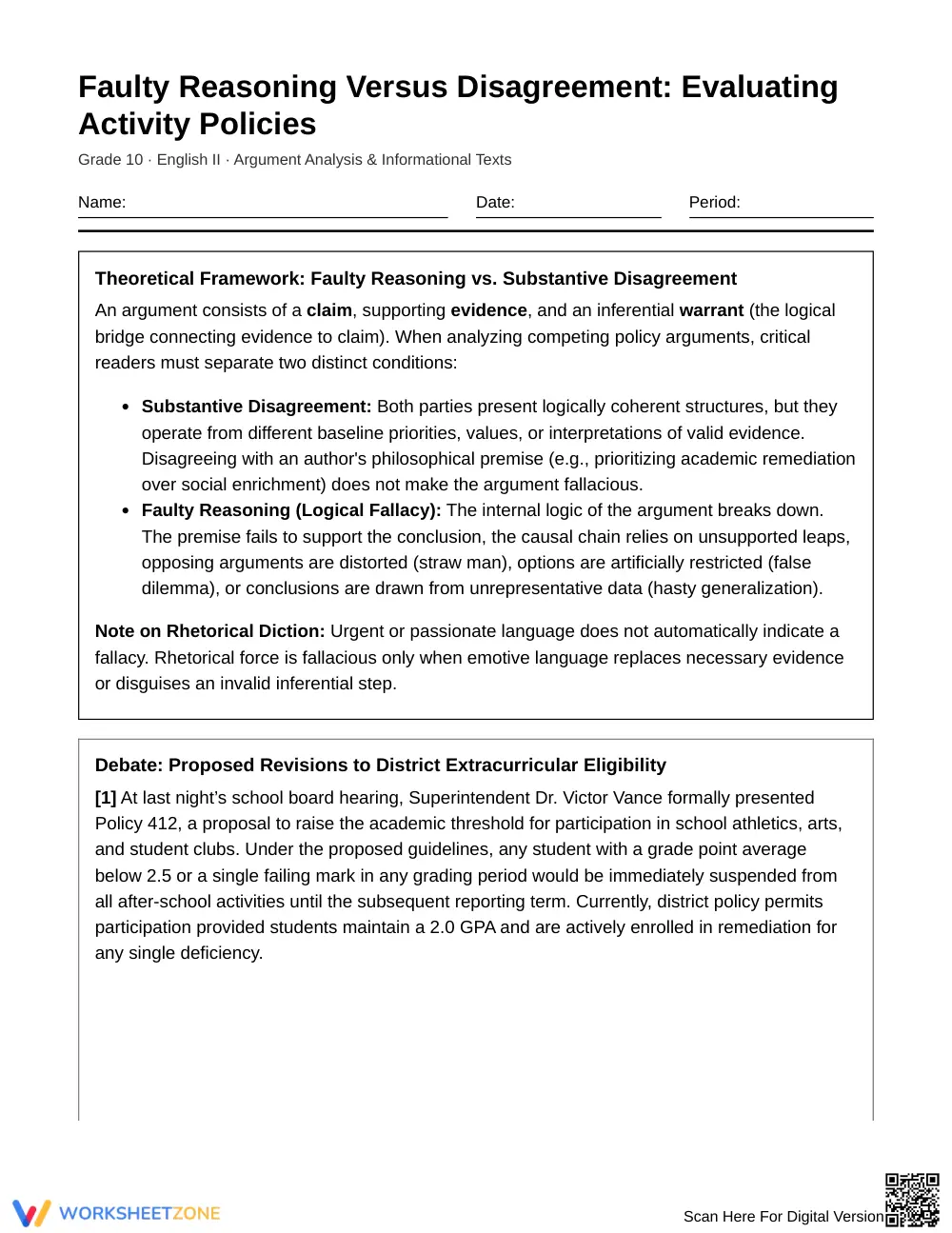
This high school argument analysis worksheet trains students to distinguish between legitimate philosophical disagreements and invalid logical fallacies. Learners read a realistic school board debate passage on extracurricular eligibility policies, evaluate specific inferential claims, identify structural flaws like false dilemmas and hasty generalizations, and construct evidence-based justifications of rhetorical validity.
At a Glance
- Grade: 10 · Subject: English II
- Standard:
RI.9-10.8— Evaluate argument validity and identify fallacious reasoning in texts- Skill Focus: Faulty Reasoning Versus Disagreement
- Format: 6 pages · 10 problems · Answer key included · PDF
- Best For: Argument analysis and fallacy identification practice
- Time: 45–60 minutes
What's Inside
This 6-page printable resource includes a comprehensive theoretical framework defining inferential warrants, a multi-perspective policy debate passage, 10 structured analysis tasks across three progressive sections, and a detailed 4-page answer key with model written justifications.
Skill Progression
- Guided Practice (Part A, Items 1–3): Students differentiate conceptual definitions, contrast substantive disagreements with structural fallacies, and explain how to evaluate emotionally charged rhetoric.
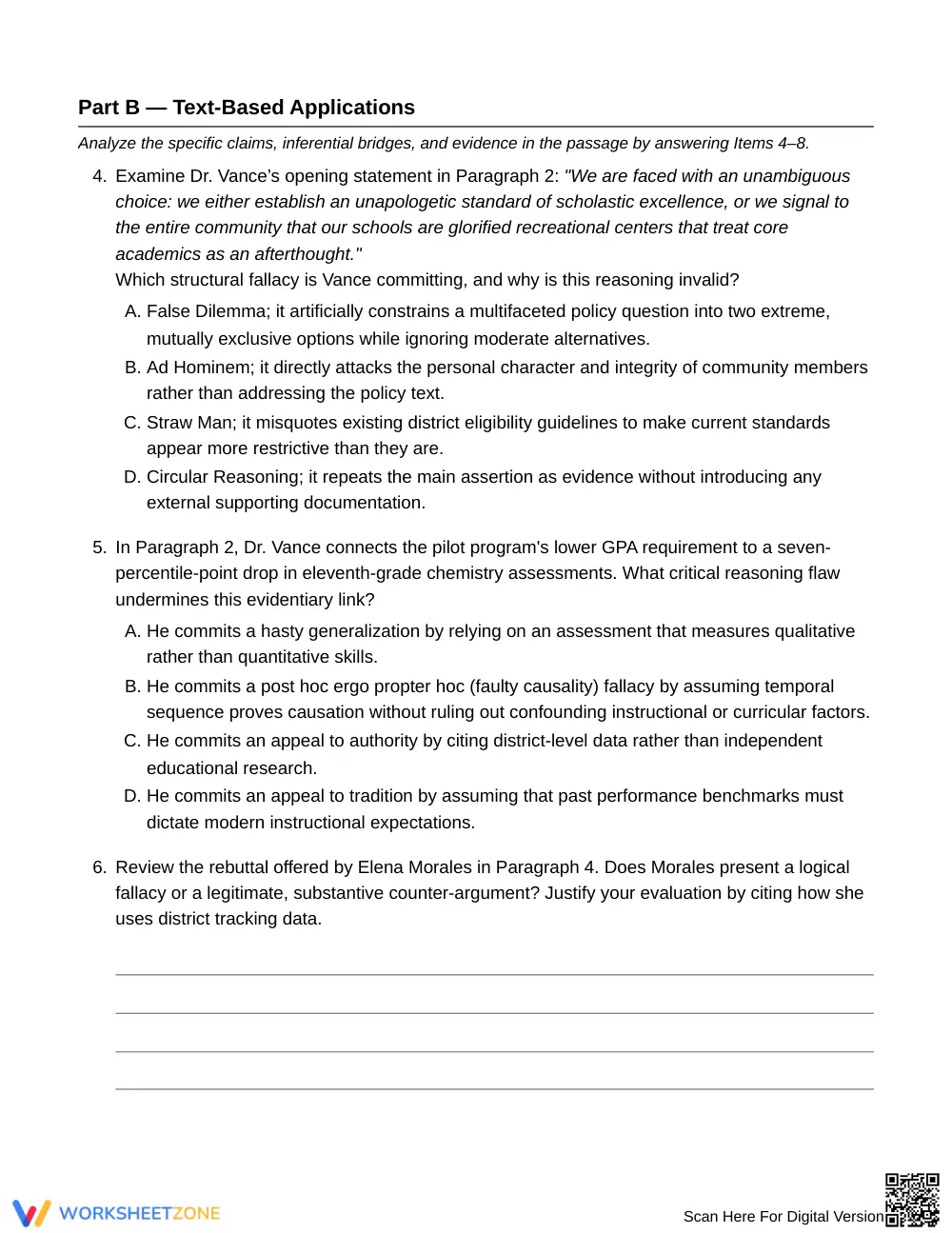
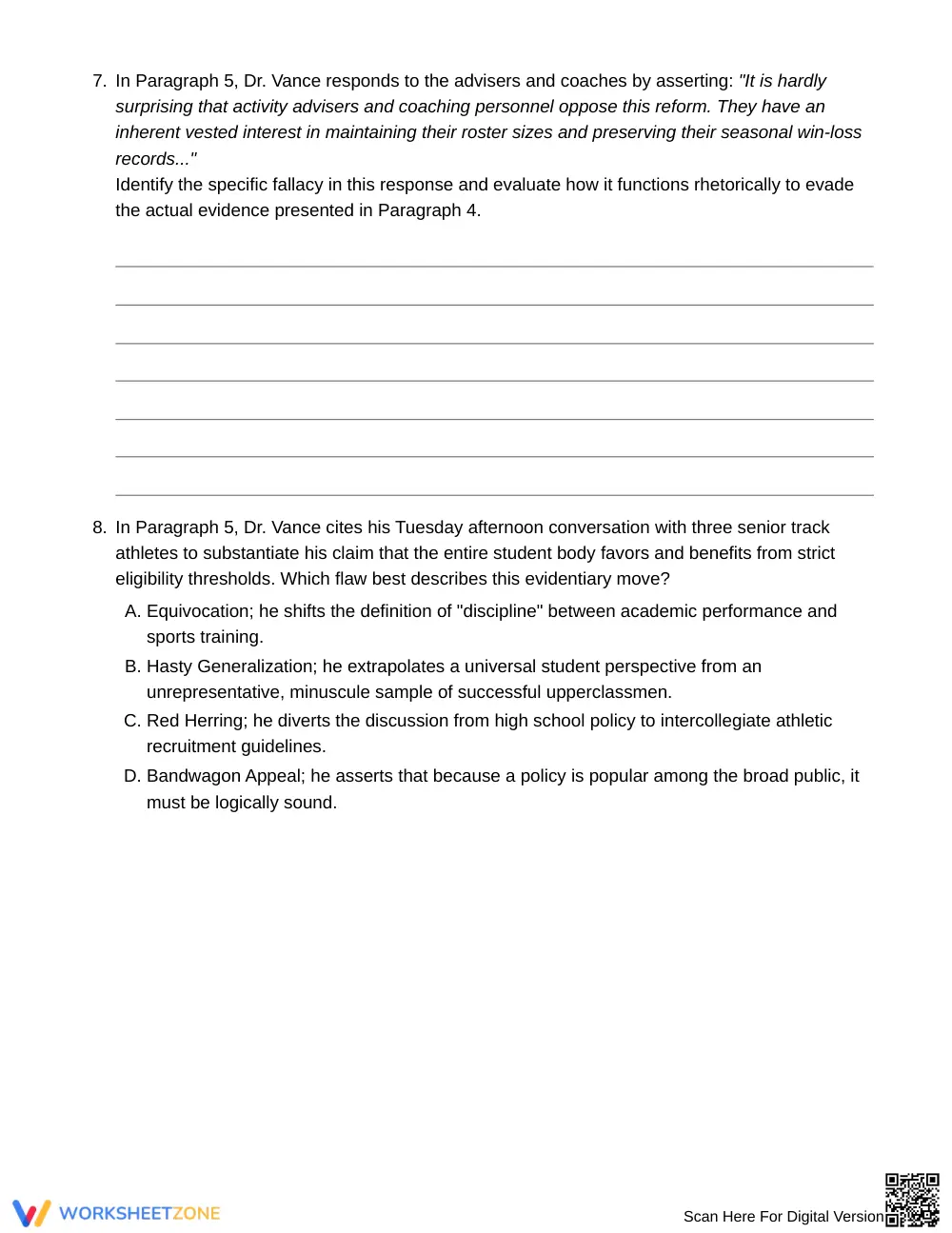
- Supported Practice (Part B, Items 4–8): Learners analyze targeted excerpts from the debate text, identifying specific informal fallacies including false dilemma, faulty causality (post hoc), ad hominem, and hasty generalization.
- Independent Practice (Part C, Items 9–10): Students write extended, multi-sentence analyses that deconstruct complex inferential chains, isolate underlying value systems, and explain slippery slope escalation.
This sequence follows a gradual-release model that moves students from conceptual categorization to rigorous, independent text-based critique.
Standards Alignment
This worksheet directly aligns with primary standard `RI.9-10.8`: Delineate and evaluate the argument and specific claims in a text, assessing whether the reasoning is valid and the evidence is relevant and sufficient; identify false statements and fallacious reasoning. Both standard codes can be copied directly into lesson plans, IEP goals, or district curriculum mapping tools.
How to Use It
Implement this worksheet after direct instruction on informal fallacies to deepen rhetorical analysis during an argumentative reading unit. During classwork, observe whether students confuse passionate diction with fallacious logic in Part B, using Item 2 as a formative checkpoint. The activity requires approximately 45 to 60 minutes of focused instructional time.
Who It's For
Designed for tenth-grade English II and Pre-AP English students, this resource includes a foundational reference framework that supports striving readers while challenging advanced analysts. Pair this activity with an argumentative anchor chart or a comparative non-fiction essay lesson.
Evaluating rhetorical validity requires high school readers to isolate inferential mechanisms from underlying value disputes. Under standard RI.9-10.8, students must delineate and evaluate informational arguments, determining whether claims rest on sound evidence or logical fallacies such as false dilemmas and hasty generalizations. According to research by Fisher & Frey (2014), explicit instruction in argumentative architecture directly strengthens secondary reading comprehension and analytical writing. When learners distinguish substantive disagreement—wherein opposing speakers operate from divergent yet logically valid premises—from genuine fallacies of reasoning, they move beyond surface-level reaction to rigorous critique. This 6-page resource provides high school educators with 10 scaffolded analytical tasks centered on a simulated school board debate. By systematically examining causal leaps, unrepresentative sampling, and emotional escalation, tenth-grade students build essential critical reading routines that support academic discourse, standardized assessment performance, and active civic participation across complex informational texts.


