
































Essential Energy Pyramids Worksheet | Grade 6 Science

Paste this activity's link or code into your existing LMS (Google Classroom, Canvas, Teams, Schoology, Moodle, etc.).
Students can open and work on the activity right away, with no student login required.
You'll still be able to track student progress and results from your teacher account.
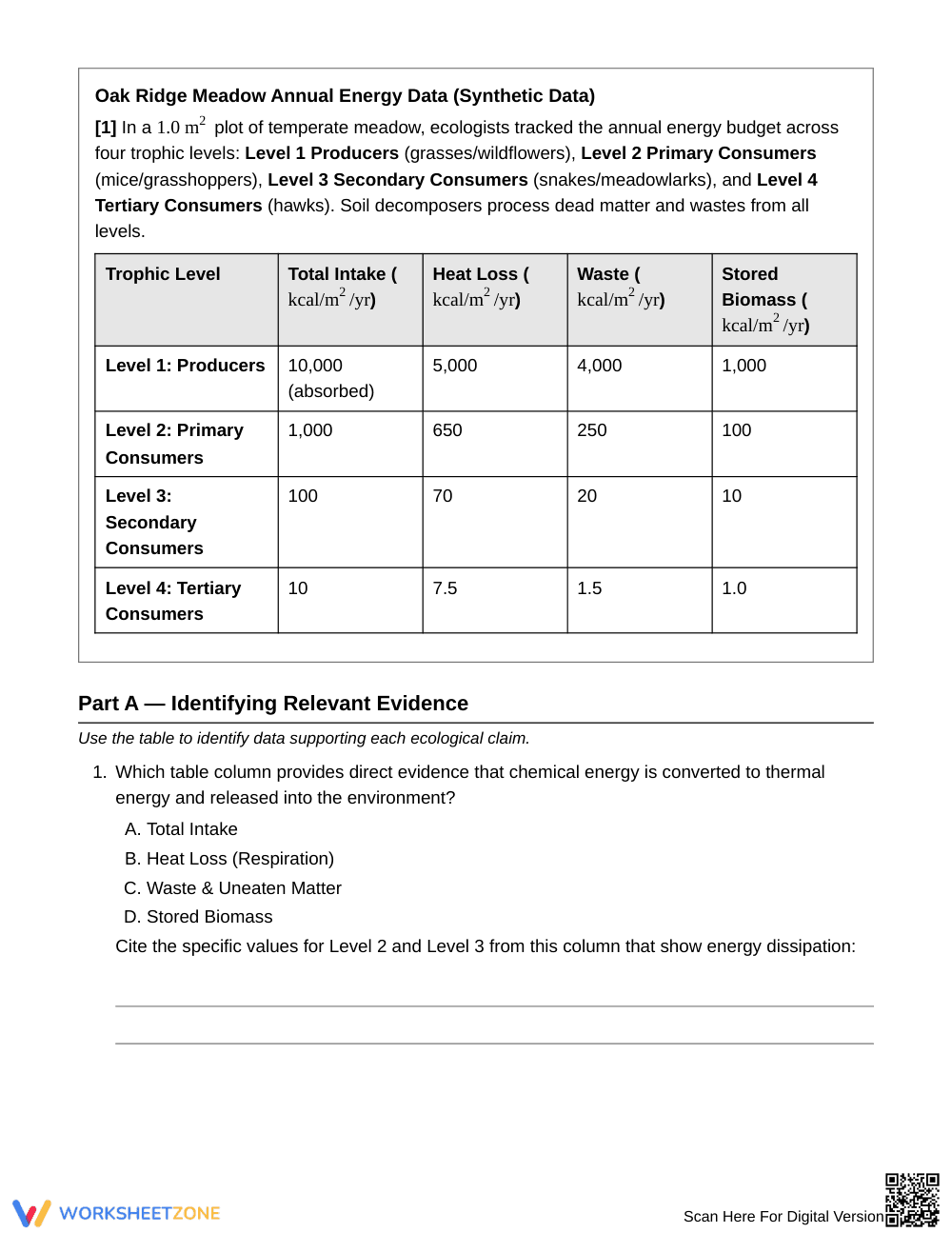
This Grade 6 life science worksheet develops student mastery of ecosystem energy dynamics, guiding learners to analyze quantitative meadow data and explain why energy availability decreases from producers to apex predators. Students evaluate energy budgets, trace heat dissipation from cellular respiration, and differentiate energy transfer from matter cycling across 8 rigorous questions.
At a Glance
- Grade: 6 · Subject: Science
- Standard: Middle School Ecology — Model energy flow and matter conservation through ecosystem trophic levels
- Skill Focus: Explaining decreased energy availability across trophic pyramids
- Format: 5 pages · 8 problems · Answer key included · PDF
- Best For: Quantitative ecology inquiry and assessment
- Time: 40–50 minutes
What's Inside: The 5-page printable document features core ecological definitions, an authentic synthetic dataset detailing annual energy budgets across four trophic tiers, and 8 structured free-response prompts. It includes a complete 2-page teacher answer key detailing quantitative calculations and sample mechanistic explanations.
Skill Progression
- Guided Practice (Part A, Problems 1–2): Students interpret the ecological energy data table, identifying data columns that show heat dissipation and citing specific values for Level 2 and Level 3 consumers.
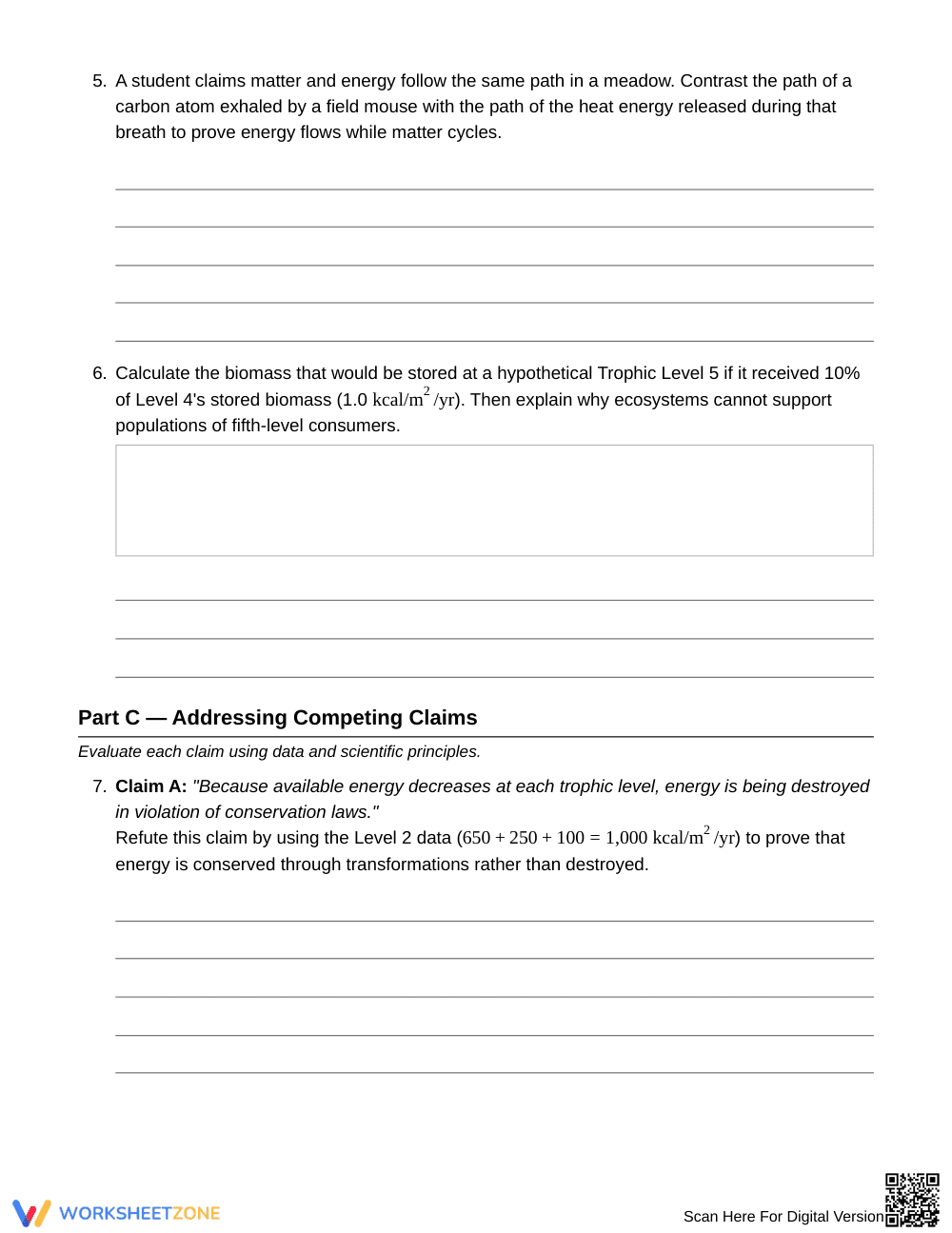
- Supported Practice (Part B, Problems 3–6): Learners construct mechanism-based explanations connecting thermal energy release to cellular respiration, determine biomass retention at higher trophic levels, and distinguish carbon cycling from one-way energy flow.
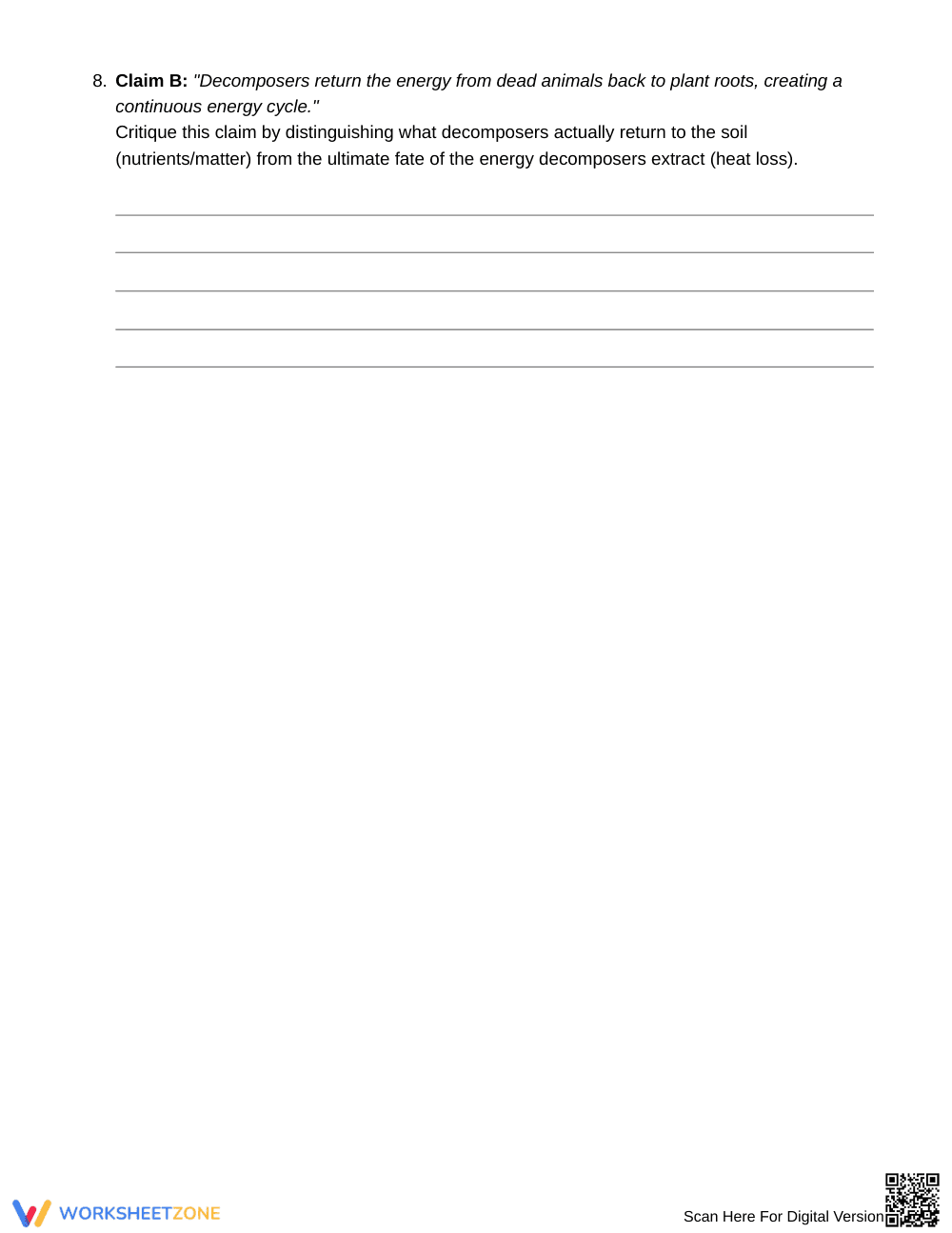
- Independent Practice (Part C, Problems 7–8): Students evaluate and refute two common misconceptions, proving conservation of energy via mathematical summation and clarifying decomposer nutrient recycling versus energy dissipation.
This sequence mirrors the gradual release of responsibility model, shifting students from data extraction to independent argument critique.
Standards Alignment
This worksheet aligns directly to middle school life science standards addressing ecological interactions, food web dynamics, and the flow of energy in ecosystems. Students develop models showing that while matter cycles endlessly among living and nonliving components, chemical energy transfers inefficiently as metabolic thermal energy dissipates into the environment. Both conceptual and mathematical expectations outlined in this resource can be copied directly into lesson plans, IEP goals, or district curriculum mapping tools.
How to Use It
Deploy this resource during the elaboration phase of an ecology unit following direct instruction on trophic levels and cellular respiration. Alternatively, assign it as a targeted formative assessment before an ecology summative exam to identify lingering misconceptions regarding energy destruction. During independent work, monitor whether students attribute biomass decreases to physical matter destruction or correct metabolic heat loss. The activity requires 40 to 50 minutes of instructional time.
Who It's For
This worksheet serves general sixth-grade science classrooms, middle school life science honors courses, and intervention small groups requiring scaffolded quantitative reasoning. Provide graphic organizers or sentence stems to support English language learners, and pair this resource directly with interactive food chain diagrams or hands-on trophic pyramid models.
Middle school life science standards expect Grade 6 students to explain trophic energy loss and trace one-way energy dissipation through multi-tier food webs. According to research from Fisher & Frey (2014) on close reading and evidence-based writing in the content disciplines, pairing quantitative data tables with structured argumentative prompts dramatically accelerates middle school conceptual mastery. This 5-page worksheet targets student misconceptions regarding energy destruction by requiring explicit mathematical justification of conservation laws across 8 scaffolded tasks. Students examine cellular respiration, biomass limitations, and nutrient recycling across four distinct trophic levels in an accessible meadow ecosystem model. By bridging ecological data literacy with written scientific argumentation, the resource equips students to distinguish indefinite matter cycling from continuous heat loss, building robust foundational knowledge for high school biology and environmental science coursework.


