


























Views
Downloads



Essential Energy Chain Models Worksheet | Grade 6 Science
Paste this activity's link or code into your existing LMS (Google Classroom, Canvas, Teams, Schoology, Moodle, etc.).
Students can open and work on the activity right away, with no student login required.
You'll still be able to track student progress and results from your teacher account.
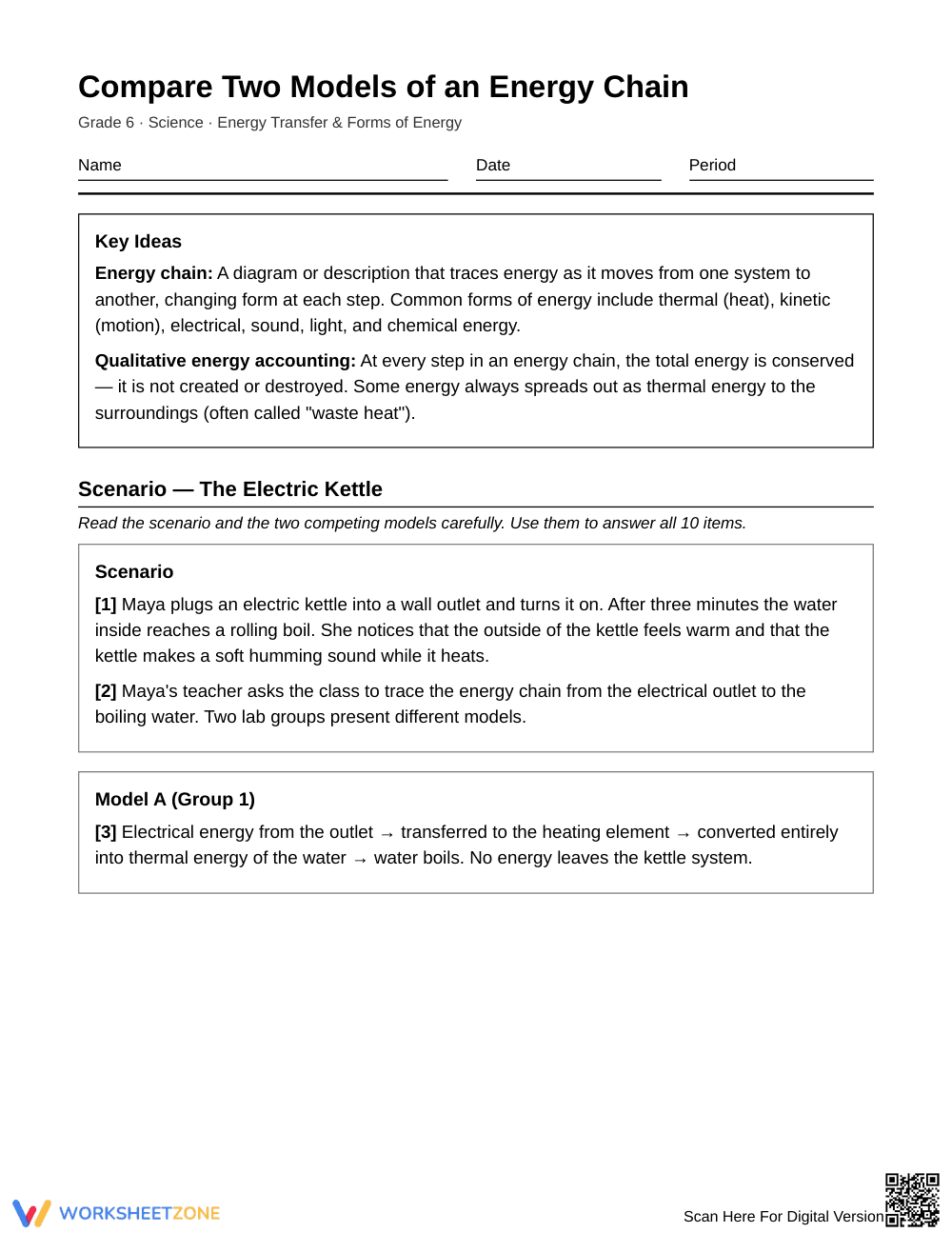
This Grade 6 science worksheet helps students analyze and compare competing models of an energy chain. Using an electric kettle scenario and observational data, learners evaluate thermal loss, energy conservation, and experimental variables across 10 analytical tasks to reach evidence-based scientific conclusions.
At a Glance
- Grade: 6 · Subject: Science
- Standard:
Energy Transfer— Evaluate competing models of energy chains using qualitative evidence- Skill Focus: Compare Two Models of an Energy Chain
- Format: 5 pages · 10 problems · Answer key included · PDF
- Best For: Energy unit formative assessment
- Time: 35–45 minutes
What's Inside
This 5-page physical science resource provides a contextual investigation. Students examine an electric kettle scenario, review two contrasting energy chain models, and analyze a five-point observation table. The 10 items require students to make predictions, identify experimental variables, evaluate insulation effects, and determine discriminating evidence that confirms or refutes each scientific model.
Skill Progression
- Guided practice (Items 1–2): Students make model-based predictions about thermal and sound energy outputs using provided scenario prompts and initial definitions.
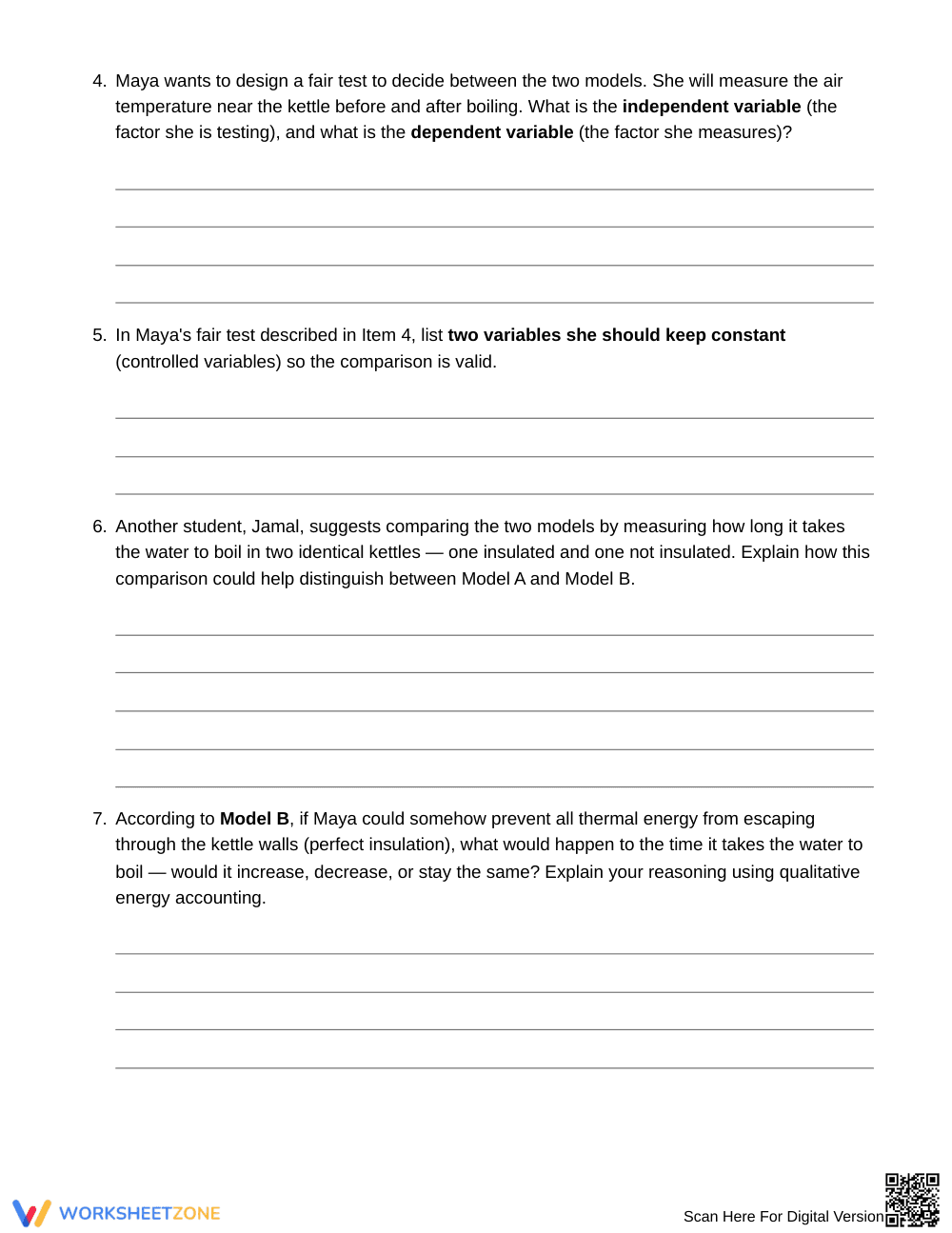
- Supported practice (Items 3–8): Learners compare specific energy accounting mechanisms, identify independent and controlled variables for a fair test, and evaluate system boundaries under changing insulation conditions.
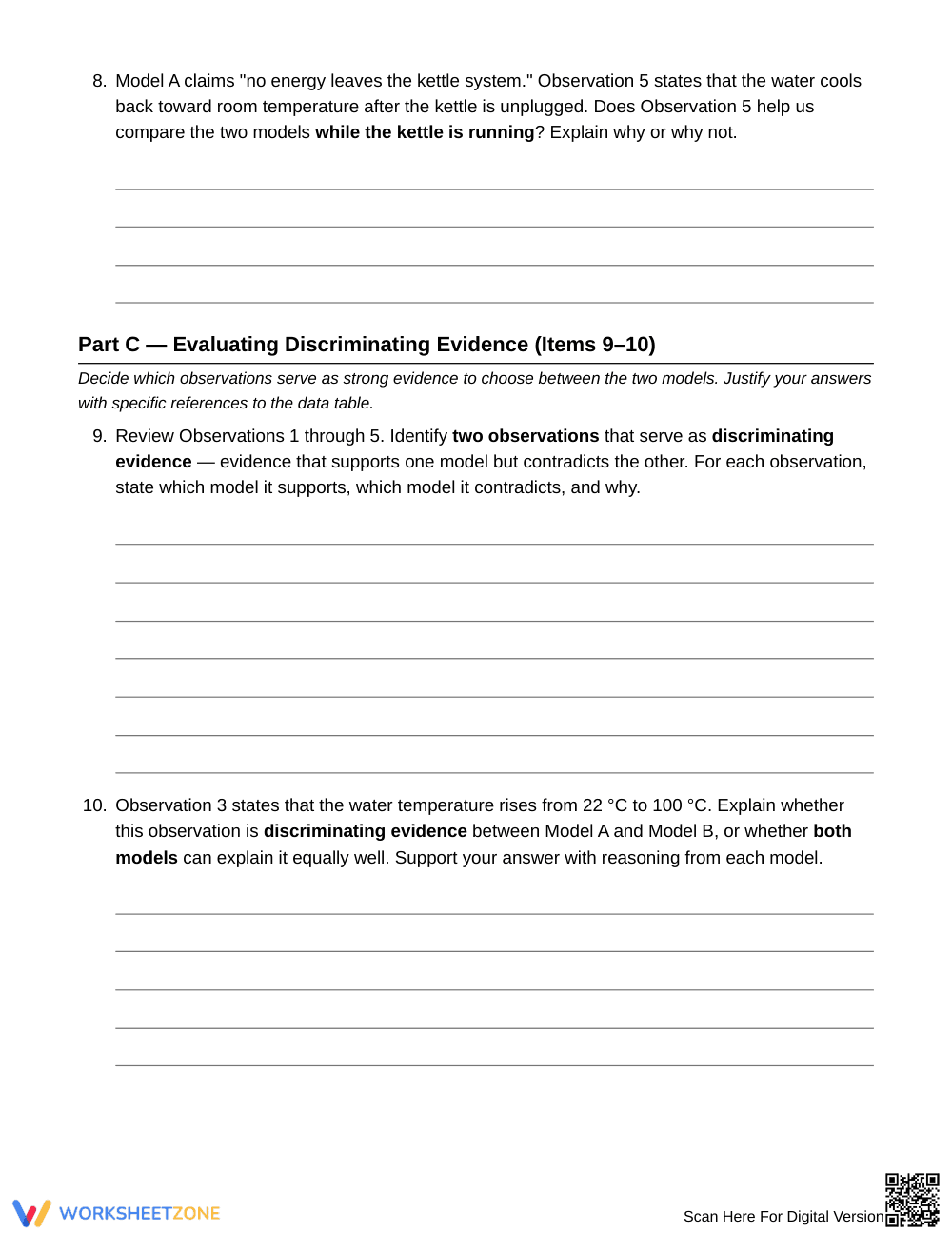
- Independent practice (Items 9–10): Students independently analyze the observation data table to distinguish between discriminating evidence and non-discriminating data, justifying their model selections with written claims.
This structured progression follows the gradual-release framework, moving students from basic conceptual predictions to rigorous evidence evaluation.
Standards Alignment
This activity aligns with middle school physical science objectives for Energy Transfer & Forms of Energy, focusing on evaluating models describing energy conservation. Students show how energy dissipates into surroundings as thermal energy. Both standard codes can be copied directly into lesson plans, IEP goals, or district curriculum mapping tools.
How to Use It
Deploy this worksheet after direct instruction on the law of conservation of energy and thermal dissipation. It functions effectively as a collaborative mid-unit checkpoint or a post-instruction summative review. During completion, monitor how students differentiate between total system energy and localized thermal loss in Item 7 to catch common misconceptions early. Most Grade 6 students will complete all 10 problems within 35 to 45 minutes.
Who It's For
This resource is designed for Grade 6 general science and introductory physical science classrooms. It offers accessible qualitative scaffolding for emerging learners while challenging advanced thinkers with variable design and data discrimination. Pair this worksheet with a direct instruction slide deck or an interactive thermal energy transfer lab investigation.
Evaluating competing scientific models enables Grade 6 students to build deep conceptual understanding of energy transfer and conservation principles. According to research highlighted by Fisher & Frey (2014), structured comparative analysis tasks prompt students to synthesize multiple data points and defend claims using empirical observations rather than rote memorization. This 10-item worksheet embeds qualitative energy accounting into everyday laboratory scenarios, challenging learners to trace energy forms, account for surrounding thermal dissipation, and isolate experimental variables across 5 comprehensive pages. By distinguishing between discriminating observations and shared model predictions, students develop sophisticated scientific argumentation skills that translate across middle school physical science units and standardized science assessments.


