




























Essential Diversity Metrics Worksheet | Grade 12 Science
Paste this activity's link or code into your existing LMS (Google Classroom, Canvas, Teams, Schoology, Moodle, etc.).
Students can open and work on the activity right away, with no student login required.
You'll still be able to track student progress and results from your teacher account.
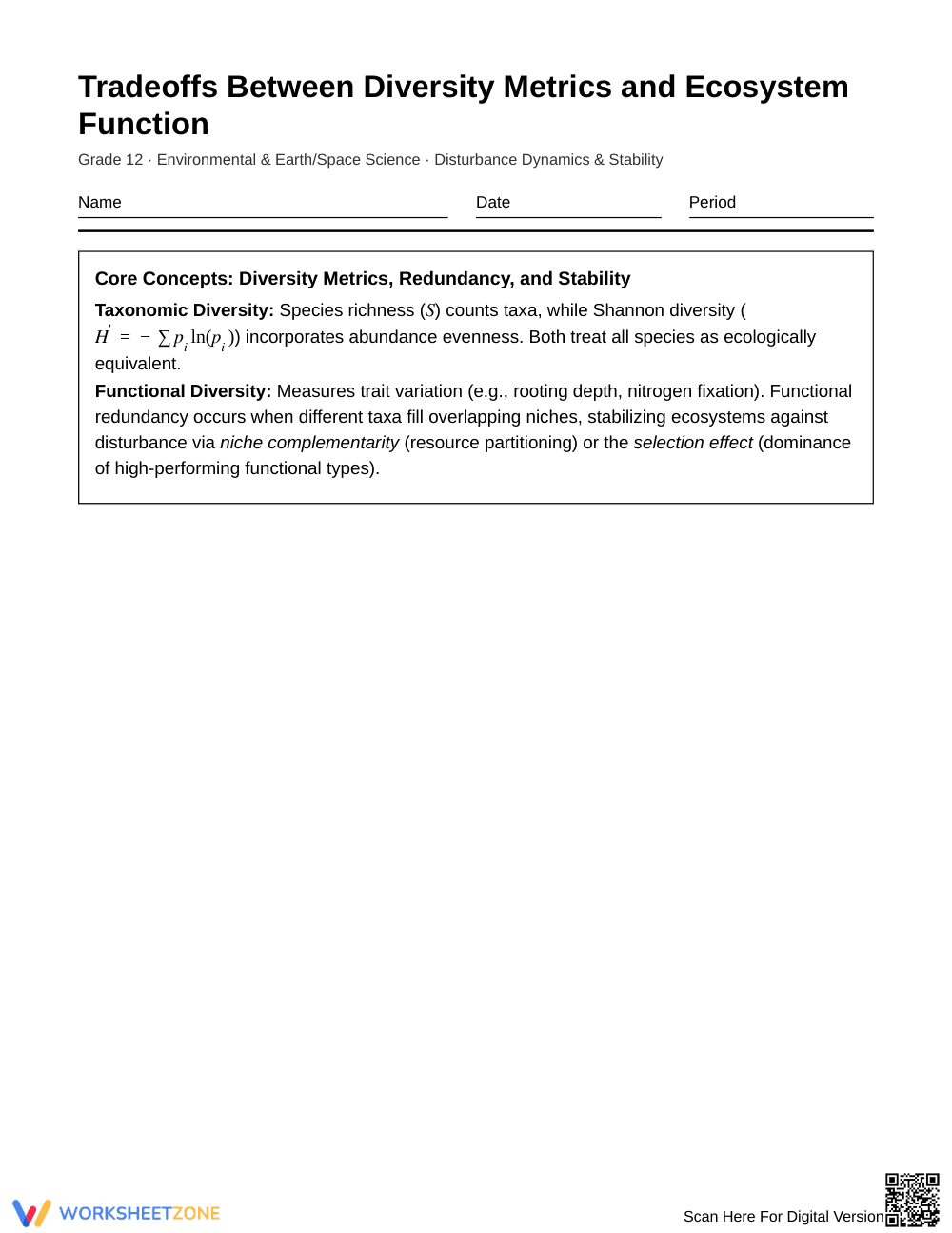
This Grade 12 environmental science worksheet guides students through quantitative and theoretical tradeoffs between diversity metrics and ecosystem function. High school learners evaluate synthetic ecological datasets, differentiate species richness from functional redundancy, and formulate defended resource management prescriptions for post-disturbance watershed stability.
At a Glance
- Grade: 12 · Subject: Environmental Science
- Standard: Ecological Analysis — Evaluate tradeoffs between species diversity metrics and ecosystem stability
- Skill Focus: Diversity metrics vs. ecosystem function
- Format: 5 pages · 6 problems · Answer key included · PDF
- Best For: Advanced high school ecology practice
- Time: 45–60 minutes
What's Inside
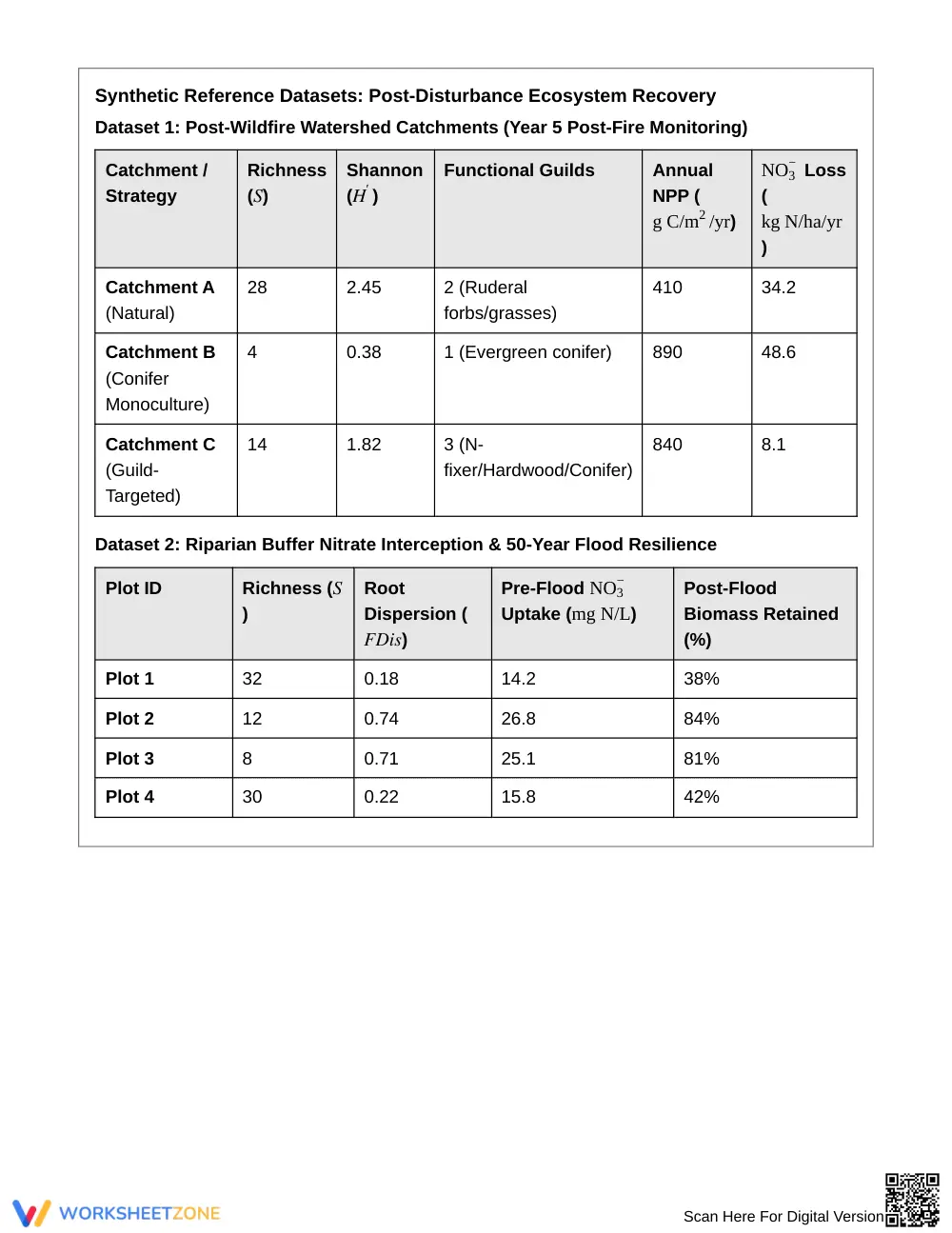
This 5-page worksheet includes core concept summaries, 2 synthetic reference datasets on post-wildfire catchments and riparian buffers, and 6 rigorous analytical tasks. Students interpret Shannon diversity and functional root dispersion, supported by a 3-page answer key with complete mathematical breakdowns and model justifications.
Skill Progression
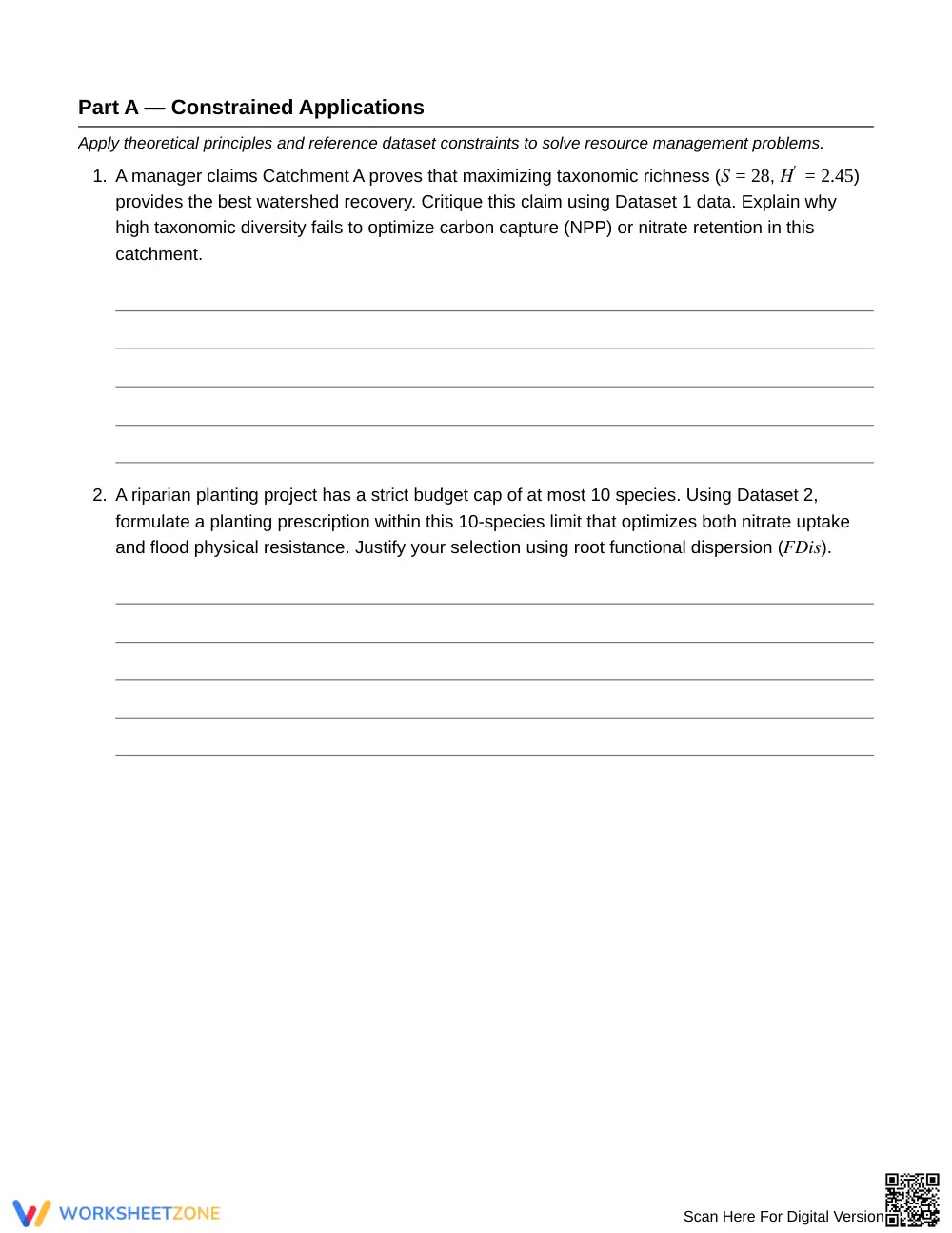
- Guided Practice (Part A, 2 problems): Students analyze datasets to critique flawed richness claims and design a 10-species riparian buffer using root functional dispersion data.
- Supported Practice (Part B, 3 problems): Learners evaluate competing productivity models, explain drought anomalies using physiological redundancy, and decompose net biodiversity effects.
- Independent Practice (Part C, 1 problem): Students synthesize data into a defended multi-guild restoration plan for a 50,000-hectare burned watershed.
This sequence follows the gradual-release framework from structured data analysis to open-ended ecological problem-solving.
Standards Alignment
This resource aligns with high school Earth and environmental science standards governing biological diversity, biogeochemical cycling, and disturbance resilience. Both curriculum standards and performance expectations can be copied directly into lesson plans, IEP goals, or district curriculum mapping tools.
How to Use It
Use this resource following direct instruction on community ecology. Assign Parts A and B during collaborative group work, reserving Part C for individual summative assessment. Formative tip: verify that students distinguish species richness from functional trait diversity in Part B. Expected completion time is 45 to 60 minutes.
Who It's For
Ideal for Grade 12 Environmental Science, AP Environmental Science, and advanced ecology courses. Scaffolding supports honors students with structured data, while Part C extends advanced learners. Pair this printable worksheet with a niche complementarity lab or community dynamics simulation.
Mastering ecological evaluation requires students to explain tradeoffs between diversity metrics and ecosystem function through rigorous data interpretation. According to Fisher & Frey (2014), gradual-release instructional designs that guide learners from structured problem sets to independent synthesis significantly deepen conceptual retention and scientific reasoning in secondary classrooms. This Grade 12 environmental science resource equips students with 6 multi-part analytical tasks grounded in synthetic post-wildfire and riparian buffer datasets. Students examine species richness, Shannon diversity, and functional redundancy to critique ecological models and calculate niche complementarity effects. By progressing systematically through constrained application scenarios, competing-model evaluations, and a defended 50,000-hectare watershed restoration proposal, learners connect abstract biodiversity indices directly to real-world nutrient retention and disturbance resilience. The included 3-page explanatory answer key supports robust classroom feedback, targeted formative remediation, and evidence-based assessment for high school educators.


