






























Essential Disturbance Roles Worksheet | Grade 12 Science
Paste this activity's link or code into your existing LMS (Google Classroom, Canvas, Teams, Schoology, Moodle, etc.).
Students can open and work on the activity right away, with no student login required.
You'll still be able to track student progress and results from your teacher account.
This advanced ecology worksheet trains high school seniors to track how environmental shocks ripple across food webs and functional guilds. Students evaluate real-world ecological data from forests, streams, and coral reefs to distinguish direct mortality from indirect trophic cascades, predicting community resilience and long-term ecosystem stability across ten rigorous analytical tasks.
At a Glance
- Grade: 12 · Subject: Environmental Science
- Standard: Ecosystem Dynamics — Evaluate disturbance propagation and functional community resilience using quantitative evidence
- Skill Focus: Disturbance propagation across functional guilds
- Format: 5 pages · 10 problems · Answer key included · PDF
- Best For: Advanced ecology unit data analysis
- Time: 45–60 minutes
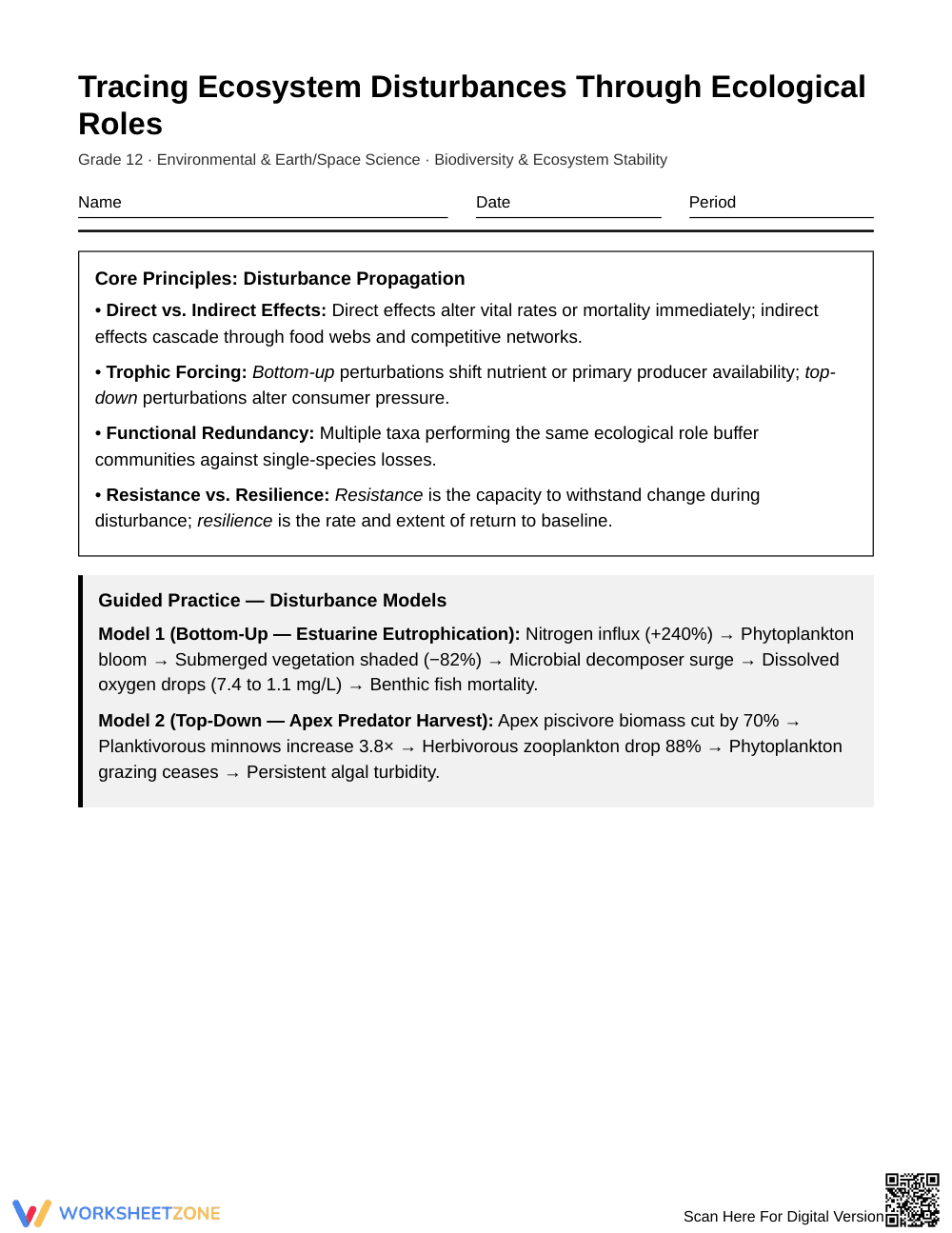
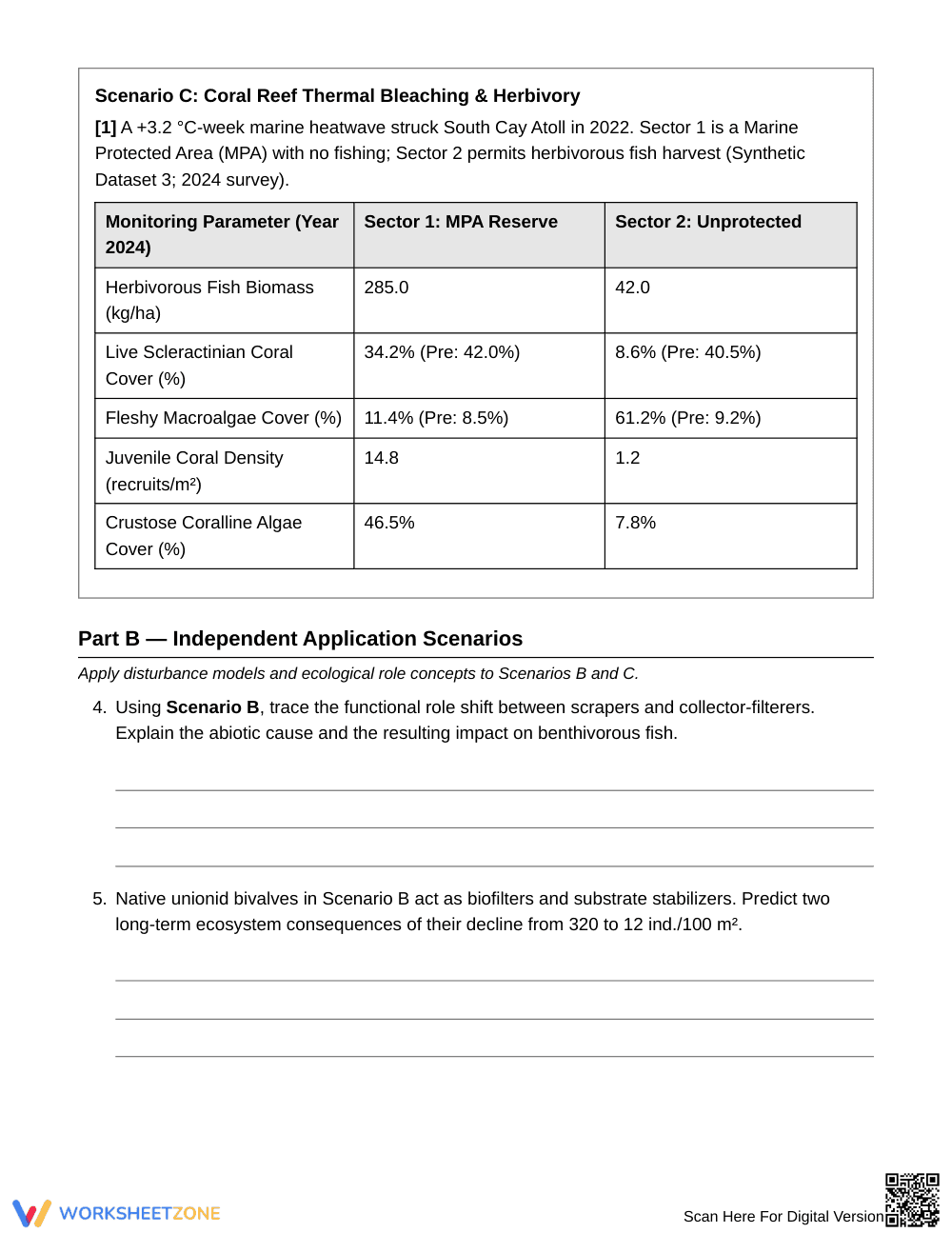
The 5-page worksheet provides three detailed quantitative case studies: sub-boreal wildfire dynamics, riparian siltation shifts, and coral reef bleaching under protected versus fished regimes. Across 10 structured analytical prompts, students interpret multi-year biomass datasets, calculate trophic impacts, and identify phase shifts. A comprehensive 3-page answer key provides complete model justifications, expected data interpretations, and ecological mechanisms.
Skill Progression
- Guided practice: Core principle review and two worked disturbance models (bottom-up eutrophication and top-down predator reduction) introduce perturbation logic before independent analysis begins.
- Supported practice: Part A features 3 scaffolded tasks using wildfire catchment data to guide students through direct versus indirect effects, herbivore-predator surges, and decomposer nutrient retention.
- Independent practice: Parts B and C deliver 7 demanding application and synthesis problems requiring unguided analysis of macroinvertebrate functional guilds, coral bleaching resilience, and alternative stable states.
This structure follows an intentional gradual-release model, moving learners from modeled principles to autonomous quantitative synthesis.
Standards Alignment
This resource aligns with high school standards on ecosystem stability and functional biodiversity. Students model how trophic forcing and niche specialization govern resilience under stress. Both standard codes can be copied directly into lesson plans, IEP goals, or district curriculum mapping tools.
How to Use It
Deploy this worksheet after direct instruction on trophic cascades and community resilience. For formative assessment, examine Part A responses to observe whether students confuse immediate direct mortality with delayed indirect trophic release. Alternatively, use it during an end-of-unit collaborative review where student pairs debate the phase shift mechanisms in Scenario C. Expect completion in 45 to 60 minutes.
Who It's For
This activity is designed for Grade 12 students in Environmental Science, Earth and Space Science, or Advanced Placement Environmental Science (APES). Scaffolded quantitative tables support developing readers, while rigorous feedback loops challenge advanced learners. Pair this resource directly with an anchor diagram illustrating top-down versus bottom-up trophic control.
Grounded in the instructional architecture described by Fisher & Frey (2014), this Grade 12 environmental science worksheet guides students through tracing ecological disturbances across diverse trophic roles and community guilds. By scaffolding data analysis from worked trophic models to multi-year synthetic catchment datasets, the resource operationalizes the gradual release of responsibility framework to build analytical independence. Students systematically evaluate how abiotic perturbations alter primary productivity, consumer pressure, and nutrient cycling, cultivating high-leverage scientific reasoning skills. Research in Fisher & Frey (2014) demonstrates that structured transitions from guided conceptual modeling to complex data interpretation significantly enhance students' ability to synthesize multi-step systemic feedbacks. Secondary educators can deploy these ten rigorous tasks to verify student mastery of functional redundancy, ecological resistance, and alternate stable states, providing actionable evidence of high-level scientific literacy and data-informed ecological reasoning across diverse classroom learning environments.


