





























Essential Distributive Property Worksheet | Grade 6 Math
Paste this activity's link or code into your existing LMS (Google Classroom, Canvas, Teams, Schoology, Moodle, etc.).
Students can open and work on the activity right away, with no student login required.
You'll still be able to track student progress and results from your teacher account.
This Grade 6 algebra worksheet builds conceptual understanding of the distributive property by framing multiplication as equal groups. Students analyze factored expressions, expand and factor linear terms with whole numbers, fractions, and decimals, and write mathematical justifications to generate equivalent expressions with precision.
At a Glance
- Grade: 6 · Subject: Math
- Standard:
6.EE.A.3— Apply properties of operations to generate equivalent expressions- Skill Focus: Distributive Property as Grouping
- Format: 5 pages · 16 problems · Answer key included · PDF
- Best For: Conceptual introduction and independent algebra practice
- Time: 40–50 minutes
This comprehensive resource spans five pages with 16 targeted tasks supported by a core concept anchor box with worked examples. Students progress through conceptual multiple-choice items, error analysis prompts, structural equivalence tables, and real-world geometric modeling tasks. A detailed four-page answer key provides complete step-by-step arithmetic and algebraic explanations for every problem.
The worksheet follows a structured gradual-release architecture:
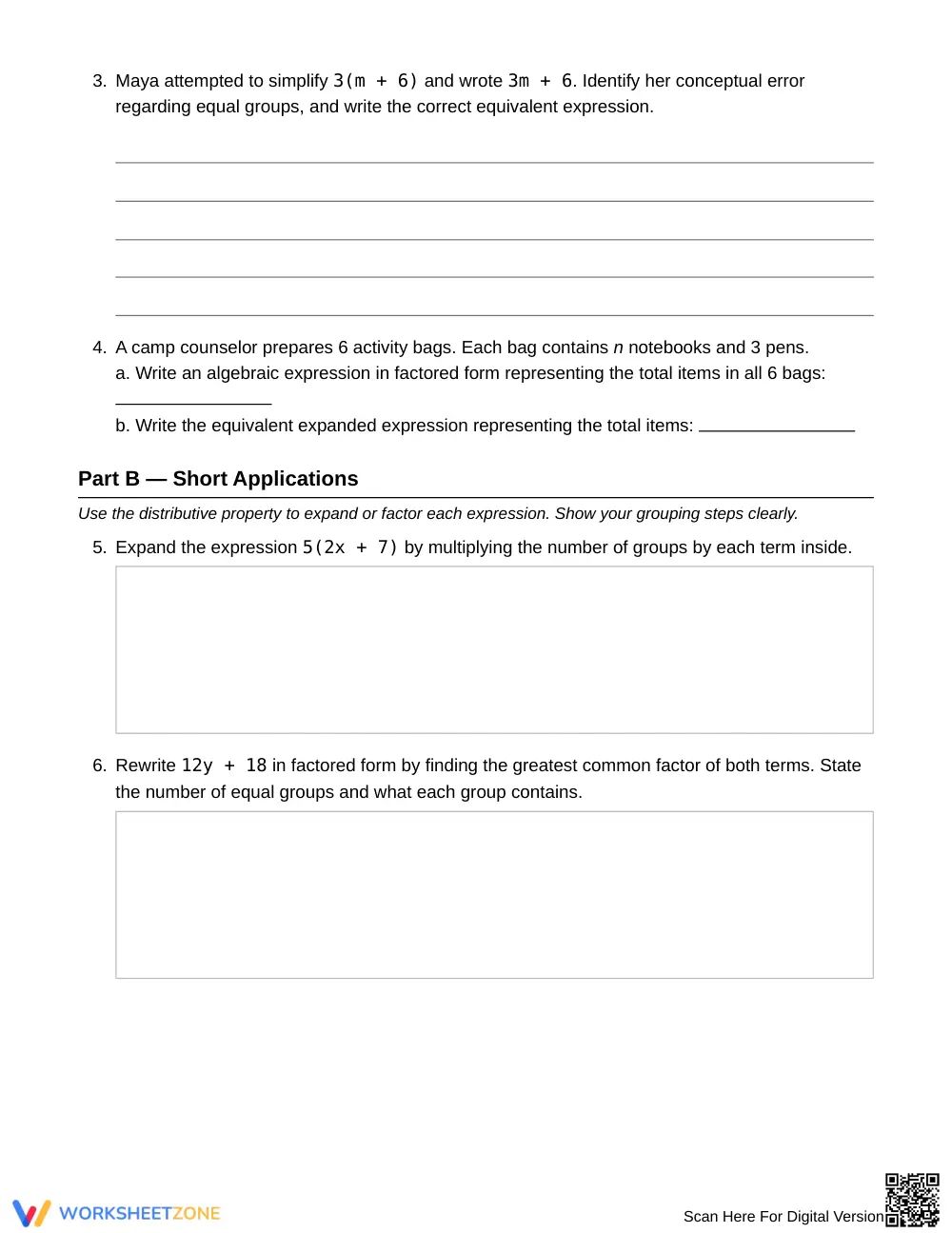
- Guided Practice (Part A, Problems 1–4): Students examine the structural meaning of equal groups, distinguish between expressions like 5(x + 2) and 5x + 2, and identify common misconceptions in student work.
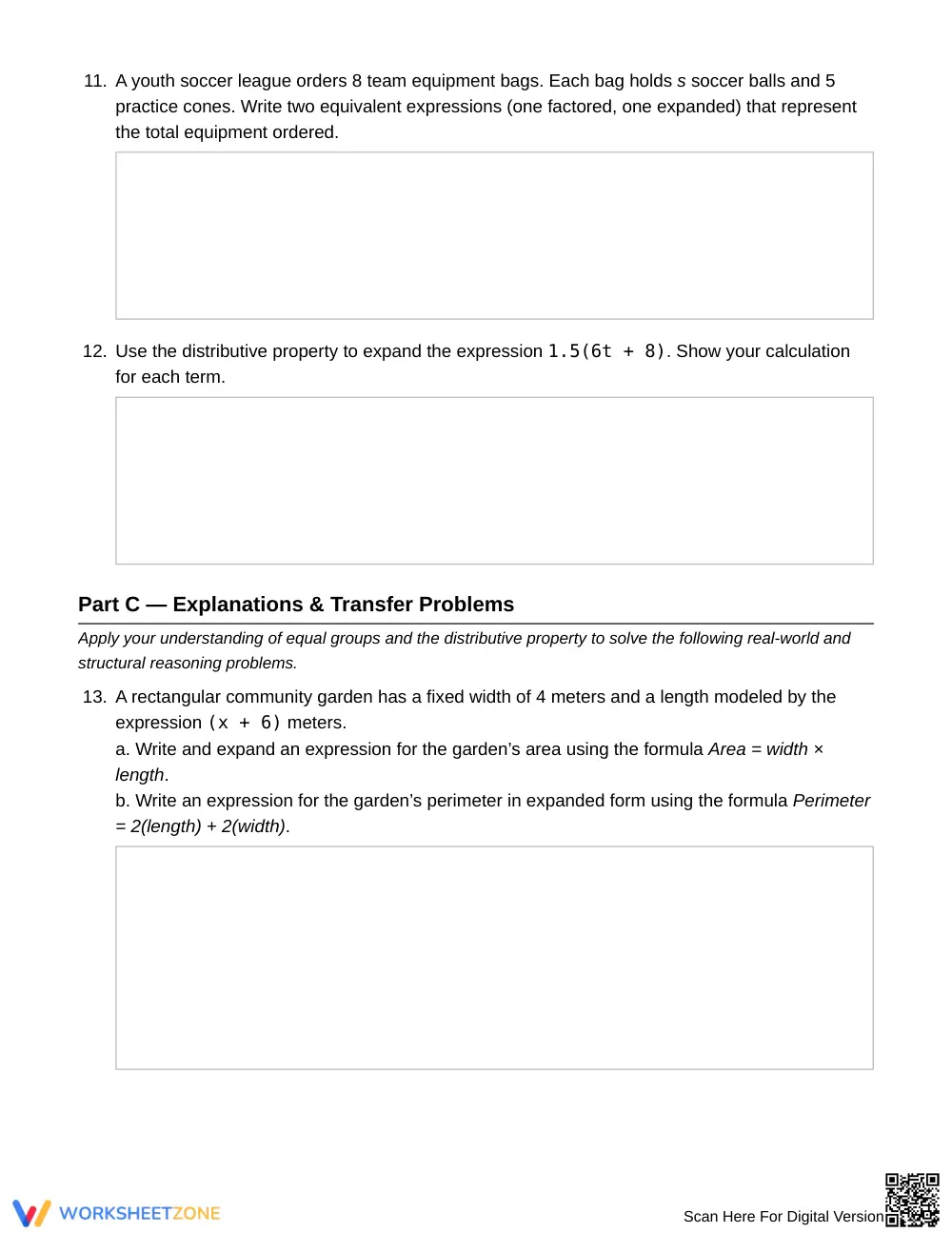
- Supported Practice (Part B, Problems 5–12): Learners expand and factor expressions involving decimals, fractions, and greatest common factors while completing structured multi-column equivalence tables.
- Independent Practice (Part C, Problems 13–16): Students independently solve multi-step geometric area and perimeter applications, mental math grouping strategies, and write formal mathematical arguments disproving common algebraic errors.
This sequence embodies the gradual release of responsibility model, guiding learners from visual grouping intuition to rigorous algebraic manipulation.
This worksheet is aligned directly to primary standard `6.EE.A.3`: Apply properties of operations to generate equivalent expressions. It also supports 6.EE.A.4 by requiring students to verify whether two expressions name the same value regardless of variable substitution. Both standard codes can be copied directly into lesson plans, IEP goals, or district curriculum mapping tools.
Use this resource directly after introducing distributive property models during whole-group instruction, or assign it during targeted small-group intervention stations. For formative assessment, observe whether students distribute the external factor to every term inside the parentheses in Part B or mistakenly apply it only to the first term. Expected completion time is 40 to 50 minutes.
Designed for Grade 6 general mathematics classrooms, this worksheet supports visual learners and students transitioning from arithmetic to introductory algebra. Scaffolded tables and grouped models accommodate tier-2 intervention groups while challenge proofs extend advanced learners. Pair this printable with hands-on algebra tile manipulatives or an anchor chart illustrating equal-sized group models.
According to Fisher & Frey (2014), explicit instructional frameworks that transition students from guided conceptual representations to independent justification significantly strengthen algebraic reasoning and procedural fluency. Grade 6 standard 6.EE.A.3 requires learners to apply operational properties, specifically using the distributive property as combining equal groups, to transform and prove equivalence between factored and expanded expressions. This five-page resource implements that research-backed sequence across 16 scaffolded tasks, pairing conceptual error analysis with concrete geometric representations. By grounding abstract symbolic notation in tangible grouping models, students develop robust mental schemas that prevent chronic operational mistakes such as partial distribution. Teachers can utilize the included four-page answer key to evaluate student explanations against rigorous mathematical standards during independent seatwork, diagnostic screening, or intervention blocks.


