





























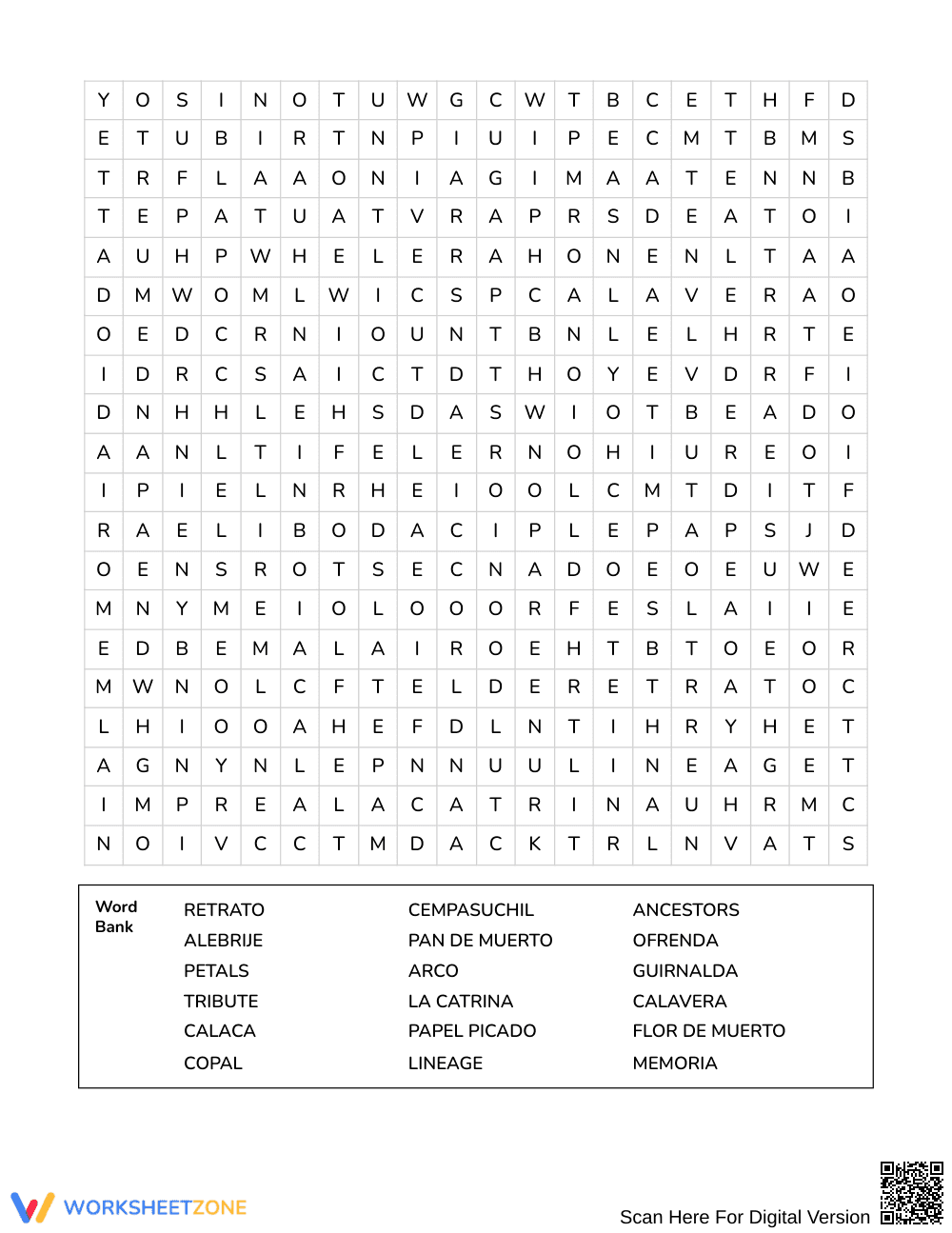


Essential Día de Muertos Word Search | Grades 7–8 ELA

Paste this activity's link or code into your existing LMS (Google Classroom, Canvas, Teams, Schoology, Moodle, etc.).
Students can open and work on the activity right away, with no student login required.
You'll still be able to track student progress and results from your teacher account.
This Grades 7–8 Día de Muertos vocabulary word search reinforces 18 essential cultural terms through clue-based retrieval practice. Students read descriptive definitions of key Day of the Dead customs, artifacts, and concepts, connecting each clue to its authentic Spanish or English term before locating it in the puzzle grid.
At a Glance
- Grade: Grades 7–8 · Subject: English Language Arts
- Standard: Not standards-assessed — vocabulary enrichment
- Skill Focus: Día de Muertos cultural vocabulary and tradition review
- Format: 3 pages · 18 words · Answer key included · PDF
- Best For: Cumulative cultural vocabulary review, holiday units, and enrichment
- Time: 25–35 minutes
What's Inside
This 3-page printable activity delivers a comprehensive vocabulary challenge featuring 18 thematic words. Rather than simply copying words, students read detailed cultural clues for terms such as ofrenda, cempasúchil, and alebrije. The resource includes a shuffled word bank, an expansive puzzle grid, and a full 4-page answer key clearly identifying word locations.
Puzzle Mechanics
The puzzle features a dense 20-by-20 letter grid containing 18 hidden cultural terms. Words run in all 8 compass directions: north, northeast, east, southeast, south, southwest, west, and northwest, including forward and backward orientations. Students use the shuffled word bank alongside descriptive cultural clues, ensuring that identifying each term requires active comprehension rather than passive letter scanning.
Standards Alignment
This resource serves as vocabulary enrichment and cultural literacy practice rather than alignment to an individual assessed content standard. It broadens domain-specific lexicon and cultural background knowledge across middle school humanities coursework, reinforcing multicultural traditions through authentic contextual definitions and orthographic recognition.
How to Use It
Deploy this word search during autumn seasonal units or directly after an introductory lesson on Day of the Dead customs. As an instructional midpoint or independent review, have students solve clues before searching the grid. For formative assessment, scan student answer sheets to verify whether learners accurately connect clues to terms like copal and papel picado. Most middle school learners complete the 18 words within 25 to 35 minutes.
Who It's For
This activity is designed for Grades 7–8 English Language Arts or introductory Spanish culture classes. To support varied readiness levels, encourage students to work in pairs or highlight keywords within clues before searching. For a comprehensive cultural lesson, pair this puzzle with an informational reading passage or visual anchor chart depicting traditional ofrenda components.
Vocabulary enrichment activities that integrate explicit semantic clues with orthographic recognition strengthen middle school reading comprehension and domain-specific knowledge acquisition. Fisher & Frey (2014) demonstrated that intentional vocabulary review grounded in meaningful conceptual definitions significantly improves word retention compared to isolated word study. This Grades 7–8 Día de Muertos cultural vocabulary review operationalizes that research by requiring students to connect 18 detailed contextual clues with authentic terms before scanning the letter grid. While this supplementary word search is designed for cultural vocabulary enrichment rather than formal standards assessment, its dual-layer structure supports active cognitive retrieval. Students encounter high-utility cultural concepts including ofrenda, papel picado, and calavera within rich descriptive contexts. Educators can incorporate this resource during thematic autumn units, providing rigorous linguistic reinforcement that deepens student appreciation of cultural heritage, ancestral traditions, and seasonal customs across humanities disciplines.


