




























Essential Dessert Vocabulary Word Search | Grades 7–8 ELA
Paste this activity's link or code into your existing LMS (Google Classroom, Canvas, Teams, Schoology, Moodle, etc.).
Students can open and work on the activity right away, with no student login required.
You'll still be able to track student progress and results from your teacher account.
This culinary vocabulary word search strengthens middle school reading comprehension by introducing students to baked, chilled, and frozen dessert terminology. Through detailed definitions, learners connect food science concepts with specialized vocabulary before locating each term in the puzzle grid, reinforcing spelling and domain-specific memory.
At a Glance
- Grade: Grades 7–8 · Subject: English Language Arts (ELA)
- Standard: Not standards-assessed — vocabulary enrichment
- Skill Focus: Comparing baked, chilled, and frozen desserts
- Format: 3 pages · 18 words · Answer key included · PDF
- Best For: Vocabulary review and fast-finisher enrichment
- Time: 20–30 minutes
What's Inside
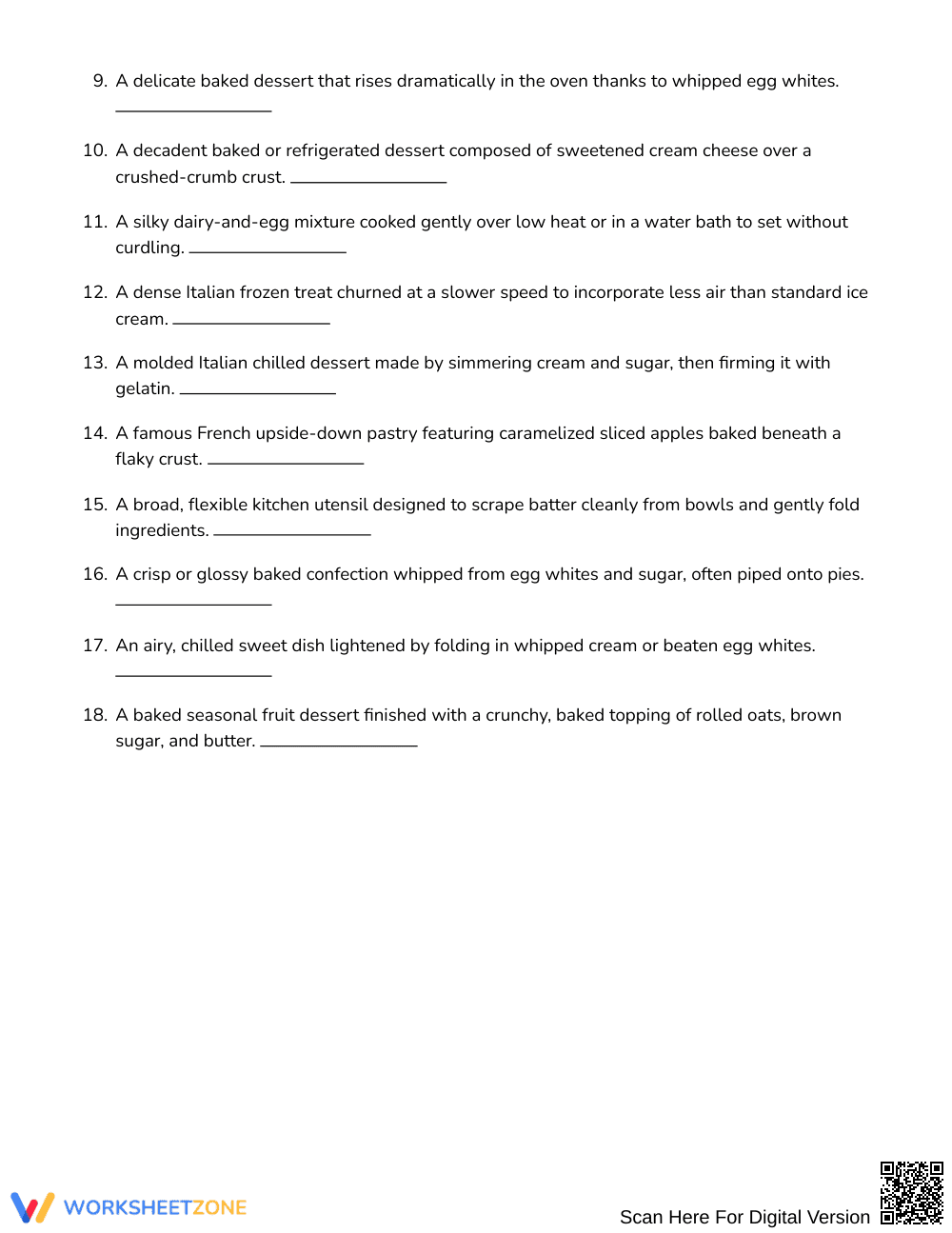
This resource features a 3-page printable activity pack focused on dessert terminology and culinary techniques. The core challenge presents 18 distinct clues that prompt students to identify items such as custard, panna cotta, and tarte tatin from descriptive definitions. A shuffled word bank provides reference support, while the comprehensive answer key includes highlighted letter grids to facilitate quick visual verification.
Puzzle Mechanics and Structure
The activity centers on an expansive 20 x 20 letter grid containing 18 hidden vocabulary terms. Words run in eight possible orientations: north, northeast, east, southeast, south, southwest, west, and northwest. Students read each definition clue to recall or deduce the corresponding term, consult the shuffled word bank to verify spelling, and search the multidirectional letter matrix to circle each hidden target.
Standards Alignment
This activity is designed purely for vocabulary enrichment and general language development. It is not tied to a specific state or national curriculum standard, allowing educators maximum flexibility to integrate it into thematic units, culinary arts electives, or cross-curricular reading modules without pacing restrictions.
How to Use It
Deploy this word search after direct instruction on food science, informational text structures, or culinary vocabulary. It serves effectively as a quiet independent transition task or a collaborative partner exercise during literacy stations. While students work, circulate to observe how accurately they interpret definition clues before scanning the grid, noting any confusion between baked and chilled preparation methods. Most students complete the full 18-word search in 20 to 30 minutes.
Who It's For
This activity is tailored for middle school learners in Grades 7–8 seeking engaging domain-specific vocabulary practice. For emerging bilingual students or those requiring extra scaffolding, provide highlighters and allow peer collaboration to parse complex clues. Pair this puzzle with an informational passage exploring French culinary techniques or an anchor chart classifying desserts by temperature and leavening method.
Domain-specific vocabulary acquisition forms the cornerstone of academic literacy across content areas. As Fisher & Frey (2014) demonstrate, intentional exposure to specialized terminology through structured word play and definition matching substantially deepens conceptual retention and reading comprehension. This Grades 7–8 vocabulary enrichment activity reinforces culinary classifications by requiring students to analyze descriptive clues for 18 distinct baked, chilled, and frozen desserts. By methodically matching definitions of items like panna cotta, soufflé, and granita with terms hidden across an eight-directional 20 x 20 matrix, learners practice active cognitive retrieval and orthographic recognition. The integration of contextual clues transforms standard search tasks into meaningful literacy exercises that promote independent word consciousness. Educators utilizing these structured puzzle materials provide students with evidence-based reinforcement that strengthens spelling accuracy, visual scanning skills, and domain-specific semantic networks across diverse multidisciplinary learning environments.


