































Essential Dessert Utensils Word Search | Grades 6–7 ELA

Paste this activity's link or code into your existing LMS (Google Classroom, Canvas, Teams, Schoology, Moodle, etc.).
Students can open and work on the activity right away, with no student login required.
You'll still be able to track student progress and results from your teacher account.
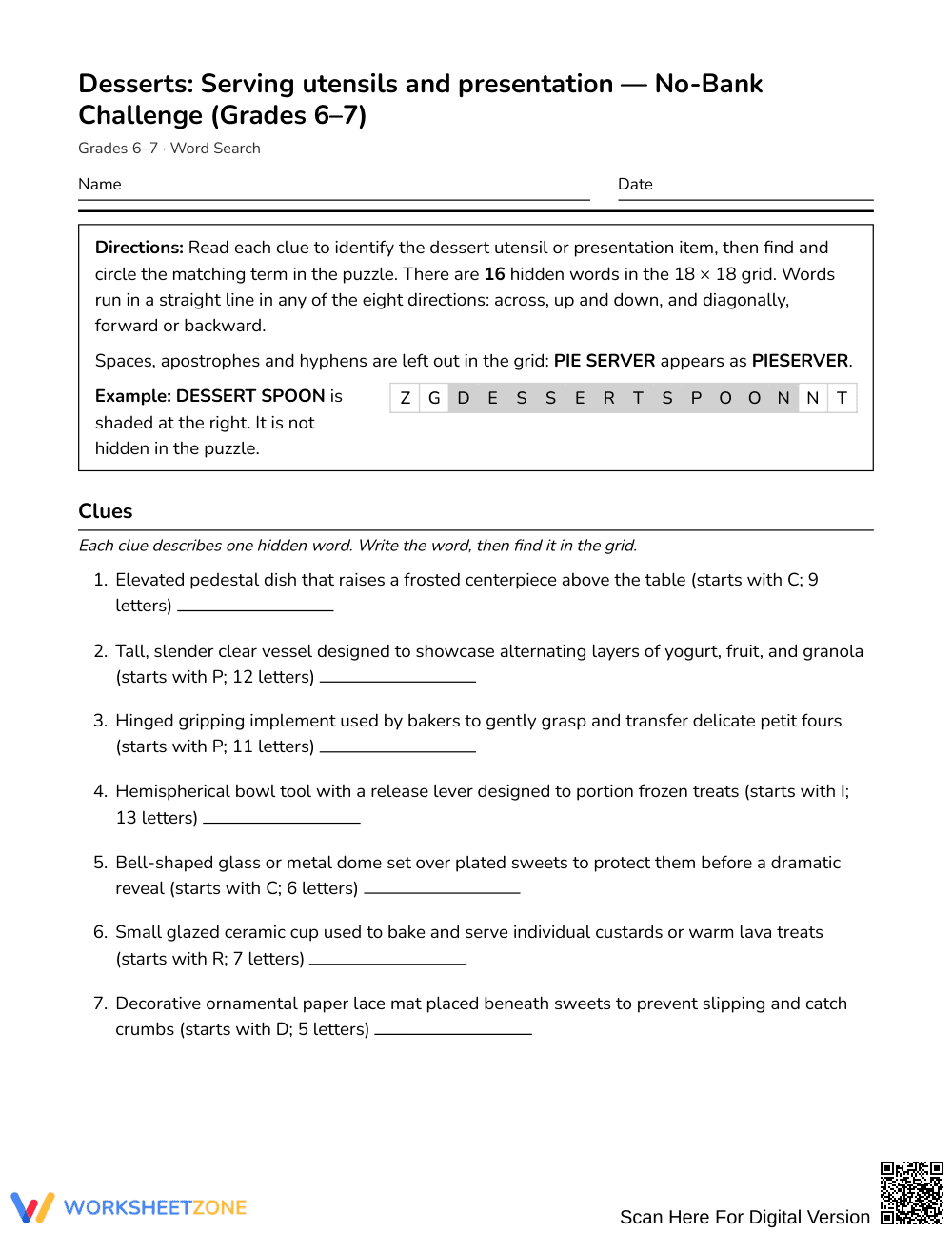
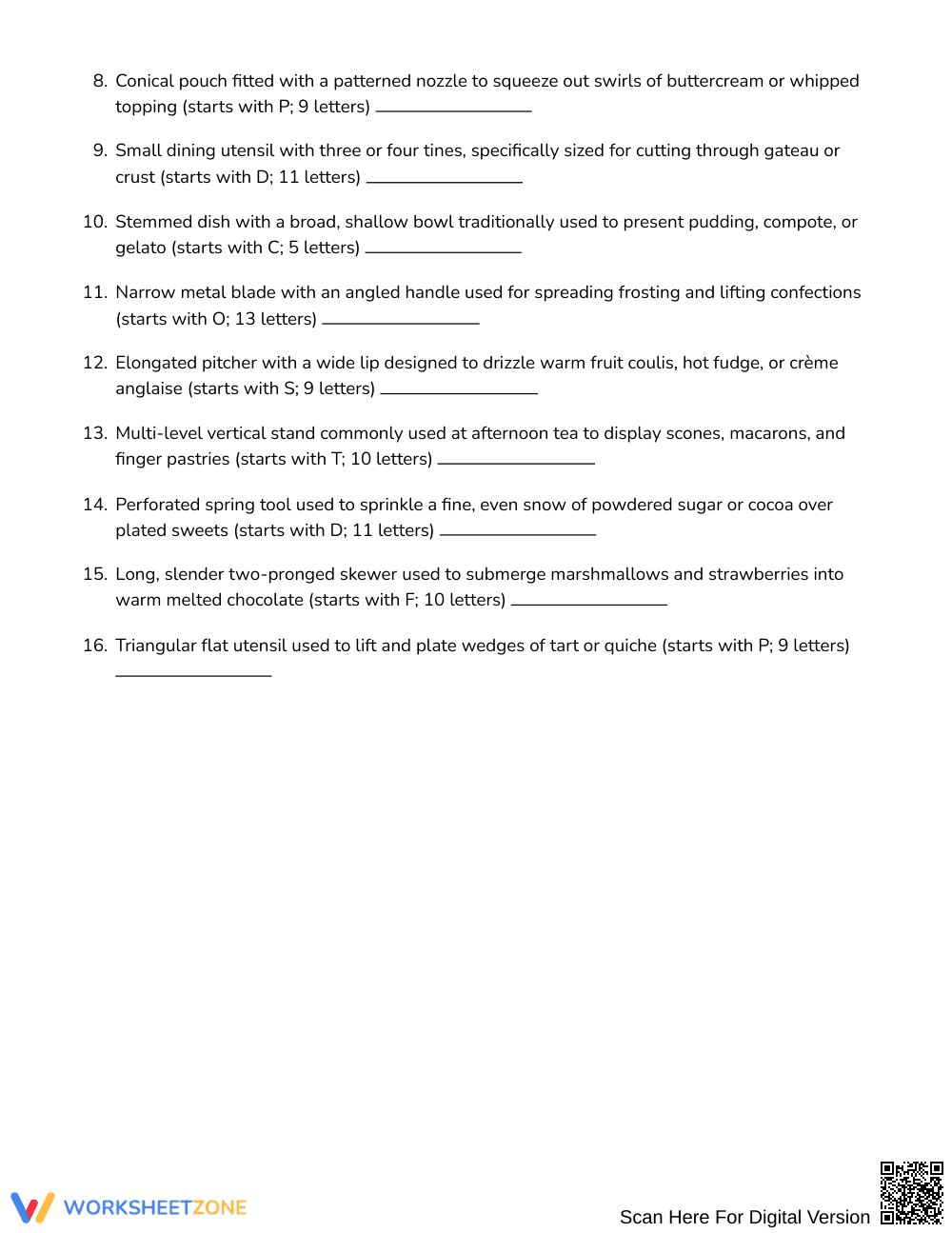
This culinary vocabulary word search sharpens middle school reading comprehension by engaging students with 16 specialized terms related to dessert presentation and serving implements. Learners decode descriptive contextual definitions to identify vocabulary such as ramekin, cloche, and offset spatula, building precise domain-specific language through an engaging, puzzle-based format.
At a Glance
- Grade: Grades 6–7 · Subject: English Language Arts (ELA) Vocabulary
- Standard: Not standards-assessed — vocabulary enrichment
- Skill Focus: Serving utensils, presentation tools, and culinary plating equipment
- Format: 3 student pages · 16 hidden words · Complete answer key included · Printable PDF
- Best For: Independent vocabulary enrichment, literacy centers, and fast-finisher practice
- Time: 25–35 minutes of focused seatwork
This 3-page printable activity features 16 target culinary terms embedded within an authentic puzzle format. Rather than relying on a traditional word bank, the activity provides descriptive clues requiring students to deduce each technical term before locating it. A comprehensive 4-page answer key provides visual solutions, highlighting word placements across the puzzle matrix for quick checking.
Puzzle Structure and Mechanics
The activity is built around a dense 18 x 18 letter grid designed to challenge middle school search strategies. Words run in all 8 possible compass directions: north, northeast, east, southeast, south, southwest, west, and northwest. Because no word bank is provided, students must actively interpret the clues to determine the exact culinary terms before scanning the grid, reinforcing conceptual definitions alongside spatial pattern recognition.
Standards Alignment
This activity serves strictly as vocabulary enrichment and is not aligned to a specific Common Core or state academic standard. It functions as an engaging supplementary resource designed to expand students' technical lexicon, contextual reasoning, and morphology in English Language Arts or career and technical culinary units.
How to Use It
Deploy this puzzle as an extension task after direct instruction on descriptive writing or culinary informational texts. Alternatively, use it during independent station rotations to reinforce semantic connections without direct teacher supervision. While students work, observe whether they solve the clues first or scan the grid blindly; students needing support benefit from discussing keywords like "perforated," "pedestal," or "tines." Most learners complete the search in 25 to 35 minutes.
Who It's For
This resource is tailored for Grades 6–7 students expanding their academic and technical vocabulary. For struggling readers, teachers can highlight keywords within the clues or provide the first letter of each mystery word. Advanced learners can use the completed terms to write descriptive restaurant reviews. Pair this word search with an informational mentor text detailing pastry arts or kitchen safety.
Domain-specific vocabulary acquisition relies heavily on contextual reasoning and repeated exposure to technical terms, as highlighted in instructional frameworks by Fisher & Frey (2014). This vocabulary enrichment resource for Grades 6–7 provides targeted practice with 16 dessert presentation and serving utensil terms without aligning to a formal standard code. By eliminating the conventional word list, the activity requires students to generate words from functional, descriptive definitions—such as identifying a cloche as a protective glass dome or a ramekin as a glazed baking dish—before searching an 18 by 18 letter matrix. Research demonstrates that integrating definitional processing with retrieval practice strengthens semantic memory pathways far more effectively than passive rote copying. Consequently, this resource serves middle school classrooms as a rigorous literacy tool that bridges informational reading comprehension, specialized culinary concepts, and autonomous deduction.


